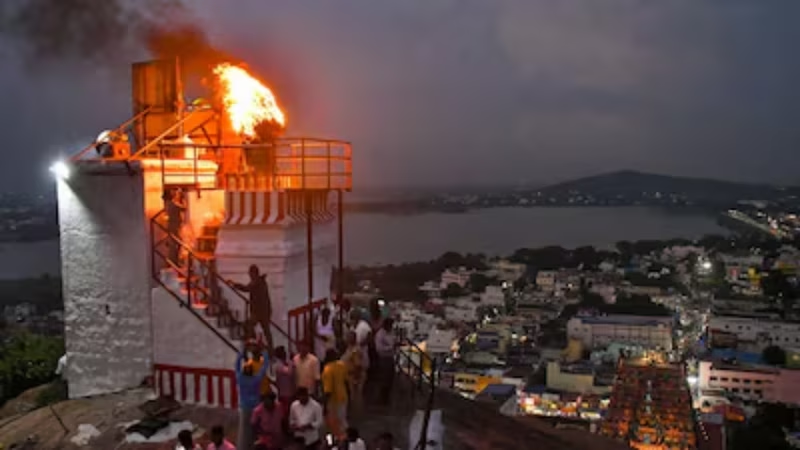
A centuries-old tradition has been decisively protected by the law. The Madras High Court has delivered a clear verdict in the contentious Thiruparankundram deepam dispute, ruling that the Tamil Nadu Wakf Board has “no locus standi”—or legal standing—to interfere in the matter . This landmark judgment upholds a previous single-judge order, allowing the temple management to light the sacred Karthigai Deepam on the stone pillar, known as the deepathoon, during the annual festival. This decision is a significant victory for devotees and clarifies the complex web of land ownership surrounding this sacred hill.
Table of Contents
- The Core of the Dispute: What is the Thiruparankundram Deepam?
- A Brief History of Land and Faith at Thiruparankundram
- Why the Wakf Board Had No Locus Standi
- The Devasthanam’s Role and Historical Ownership
- Legal Implications and the Future of the Festival
- Conclusion: A Tradition Upheld by Law
- Sources
The Core of the Dispute: What is the Thiruparankundram Deepam?
At the heart of this legal battle is a simple yet profoundly symbolic act: lighting a lamp. The Karthigai Deepam is a major Hindu festival of lights, and at the Thiruparankundram hill, a key ritual involves lighting a lamp on a tall stone pillar—the deepathoon—at its summit. For the Subramaniya Swamy temple management, this is a non-negotiable part of their religious practice .
The dispute arose when the Tamil Nadu Wakf Board claimed that this stone pillar was situated on land belonging to the historic Sikandar Badusha Dargah, which is also located atop the hill . They argued that the temple had no right to perform rituals on what they considered Waqf property. This claim brought a centuries-old, peaceful coexistence into a modern legal conflict .
A Brief History of Land and Faith at Thiruparankundram
Thiruparankundram is a unique place of worship, housing both the ancient Arulmigu Subramaniya Swamy Temple at its base and the Sikandar Badusha Dargah at its peak . This dual presence has been a hallmark of the site for generations. The original temple dates back to the 6th century CE, built by the Pandya dynasty, and is now under the purview of the Hindu Religious and Charitable Endowments (HR&CE) Department as a Devasthanam .
Land records and legal battles over the hill’s ownership are not new. In fact, litigation between temple authorities and the dargah’s trustees (hukdars) dates back to between 1915 and 1931 . The most significant historical record is from 1920, which allocated a specific area to the dargah . However, the recent court case clarified that the deepathoon stone pillar itself lies on land that is part of the Devasthanam estate, not the dargah property .
Why the Wakf Board Had No Locus Standi
The Madras High Court’s judgment was particularly scathing of the Wakf Board’s intervention. The court found that the Board’s primary submission—that the deepathoon was on its land—was not just wrong, but “mischievous” . Since the stone pillar is unequivocally on Devasthanam land, the Wakf Board had no direct interest in the matter, hence no legal standing or “locus standi” to challenge the temple’s religious practice .
This is a critical legal principle. It prevents external parties from interfering in disputes where they have no tangible stake, ensuring that court time is not wasted on frivolous or politically motivated claims. The court’s strong language sends a clear message about the sanctity of established land records and the importance of genuine legal interest.
The Devasthanam’s Role and Historical Ownership
The Arulmigu Subramaniya Swamy Temple is administered by the Madurai Devasthanams, a body that manages several major temples in the region under the HR&CE Department . The court’s directive is clear: the Devasthanam is now legally obligated to facilitate the lighting of the Karthigai Deepam at the deepathoon during the festival .
This decision reinforces the Devasthanam’s historical and administrative authority over the temple and its associated properties. It also settles a point of confusion that had been exploited to create communal tension. The court’s ruling is a firm affirmation that the deepathoon is an integral part of the temple’s ritual landscape.
Legal Implications and the Future of the Festival
This verdict has far-reaching implications beyond just one festival. It sets a strong legal precedent for how similar disputes between religious bodies should be handled. The court has emphasized adherence to documented land ownership over speculative claims. This is a win for legal clarity and, arguably, for social harmony, as it removes a potential flashpoint for communal unrest .
For the millions of devotees of Lord Murugan, this ruling ensures that a cherished tradition—the lighting of the Thiruparankundram deepam—can continue without fear of legal obstruction. It’s a powerful reminder that in a diverse society like India, the law can and should protect the right to practice one’s faith on one’s own property. For more on landmark religious judgments in India, see our feature on [INTERNAL_LINK:religious freedom verdicts in India]. To understand the role of the HR&CE Department, you can also refer to the official website of the Tamil Nadu Hindu Religious and Charitable Endowments Department.
Conclusion: A Tradition Upheld by Law
The Madras High Court’s judgment in the Thiruparankundram deepam case is a definitive one. By firmly stating that the Wakf Board has no locus standi and confirming the Devasthanam’s ownership of the land, the court has not only settled a legal dispute but also safeguarded a vital religious practice. This decision upholds the rule of law, respects historical ownership, and ensures that the sacred light of the Karthigai Deepam will continue to shine from the summit of Thiruparankundram for generations to come.
Sources
- Times of India: ‘Wakf has no locus standi’: Madras HC upholds single bench’s order
- The Hindu: Madras HC upholds order allowing lighting of lamp atop Thiruparankundram hill
- Tamil Nadu Hindu Religious and Charitable Endowments Department
- Indian Kanoon: Historical Case on Thirupparankundram Hill Ownership