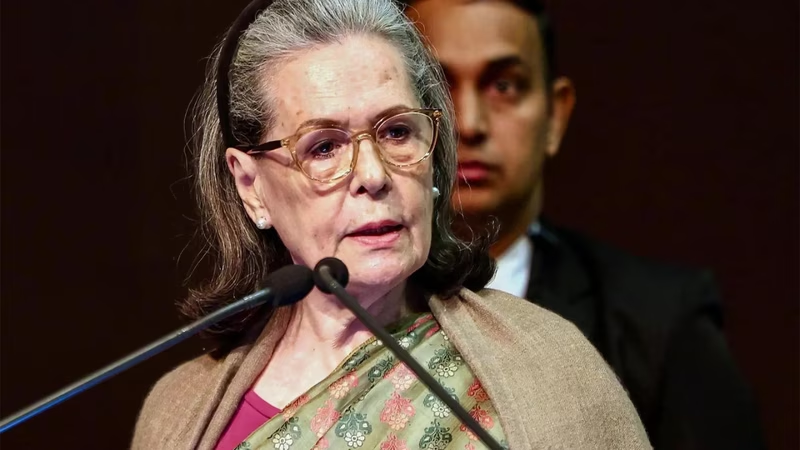
In a development that has stirred the political pot just weeks before a crucial election season, Congress leader Sonia Gandhi has formally requested more time to respond to a notice from the Election Commission of India (ECI) concerning her voter registration. The issue—dubbed the ‘voter list row‘—centers on discrepancies in her electoral rolls documentation, which opposition parties claim could point to irregularities. But in her legal response, Gandhi’s team has pushed back forcefully, calling the cited records “decades old” and irrelevant to her current eligibility .
This isn’t just a bureaucratic delay—it’s a flashpoint in India’s ongoing debate about transparency, legacy politics, and the sanctity of the electoral process. With national attention fixed on every move, the voter list row has quickly escalated from an administrative query into a full-blown political controversy.
Table of Contents
- What Is the Voter List Row All About?
- Sonia Gandhi’s Response: “Decades-Old Records”
- Election Commission Notice and Legal Implications
- Political Reactions: Opposition vs. Congress
- Historical Context: Voter Registration in India
- Why This Matters for Indian Democracy
- Conclusion: A Test of Institutions and Integrity
- Sources
What Is the Voter List Row All About?
The controversy began when right-wing groups and opposition leaders flagged inconsistencies in Sonia Gandhi’s voter ID details—specifically, her listed address and the timeline of her registration in the New Delhi parliamentary constituency. While Gandhi has represented constituencies like Amethi and Rae Bareli for years, her voter enrollment in Delhi has drawn scrutiny due to alleged mismatches in supporting documentation .
The ECI, acting on public complaints and media reports, issued a notice seeking clarification—a routine but significant step in maintaining electoral integrity. Notably, the Commission emphasized that the inquiry is procedural and not an accusation of wrongdoing .
Sonia Gandhi’s Response: “Decades-Old Records”
In a filing submitted through her legal team, Sonia Gandhi acknowledged the notice but requested an extension to prepare a detailed reply. Her representatives argued that the documents being referenced date back to the 1980s and 1990s—long before she entered electoral politics.
“The records cited are not only outdated but were created during a period when Mrs. Gandhi was a private citizen with no political role. To use them now as grounds for questioning her voter status is misleading and politically motivated,” the filing stated .
Her team also pointed out that her voter registration has been verified multiple times over the past two decades during general and by-elections—none of which raised objections from electoral authorities.
Election Commission Notice and Legal Implications
Under Section 16 of the Representation of the People Act, 1950, the ECI has the authority to scrutinize voter registrations if credible doubts arise about residency or eligibility. However, experts note that removing a voter from the rolls requires “conclusive evidence” of fraud or ineligibility—not mere technical inconsistencies .
Legal analysts believe the case is unlikely to result in punitive action, but it could set a precedent for how historical records are used in future electoral disputes. As election law expert Prof. Sujata Manohar explains, “The Commission must balance procedural rigor with fairness—especially when records are decades old and administrative practices have evolved.”
Political Reactions: Opposition vs. Congress
The BJP and its allies have seized on the issue, calling for “equal scrutiny” of all political leaders. “If ordinary citizens must prove their address, why should VIPs be exempt?” said a senior BJP spokesperson .
In response, the Congress party has accused the ruling party of “political vendetta” and “distraction tactics.” Party general secretary Jairam Ramesh stated, “This is a desperate attempt to divert attention from inflation, unemployment, and corruption scandals” .
The exchange highlights how even minor electoral queries can become weaponized in India’s hyper-partisan environment.
Historical Context: Voter Registration in India
Voter registration in India has undergone massive digitization since the early 2000s. Prior to that, records were maintained manually, leading to frequent errors in names, addresses, and family details. Migration, name changes (especially after marriage), and shifting residences often weren’t updated promptly.
This context is crucial. Many senior politicians—including current ministers—have voter records from the pre-digital era. To retroactively challenge those based on modern standards could open a Pandora’s box across the political spectrum.
Why This Matters for Indian Democracy
Beyond the headlines, the voter list row touches on deeper democratic principles:
- Equal Application of Law: Should elected officials face the same scrutiny as ordinary citizens? Absolutely. But the process must be consistent, not selective.
- Institutional Credibility: The ECI’s impartiality is its greatest asset. How it handles this case will be closely watched.
- Public Trust: Repeated allegations—regardless of merit—can erode faith in the electoral system if not addressed transparently.
Conclusion: A Test of Institutions and Integrity
The voter list row involving Sonia Gandhi is more than a political skirmish—it’s a litmus test for India’s democratic machinery. While her request for more time is procedurally normal, the underlying tensions reveal a system under pressure from polarization and distrust. The Election Commission now holds the pen: its next move must be guided by law, not舆论. For a deeper look at electoral reforms in India, see our analysis on [INTERNAL_LINK:eci-reforms-and-digital-voter-id]. You can also review official voter registration guidelines on the Election Commission of India’s website.
Sources
- Times of India. “Voter list row: Sonia Gandhi seeks time to reply; calls records decades old.” https://timesofindia.indiatimes.com/india/voter-list-row-sonia-gandhi-seeks-time-to-reply-calls-records-decades-old/articleshow/126367217.cms
- Press Trust of India (PTI) reports on ECI notice to Sonia Gandhi (January 2026).
- Election Commission of India. “Frequently Asked Questions on Voter Registration.” https://eci.gov.in
- Representation of the People Act, 1950 – Sections 16 & 23.
- Statements from BJP and Congress spokespersons, January 2026.