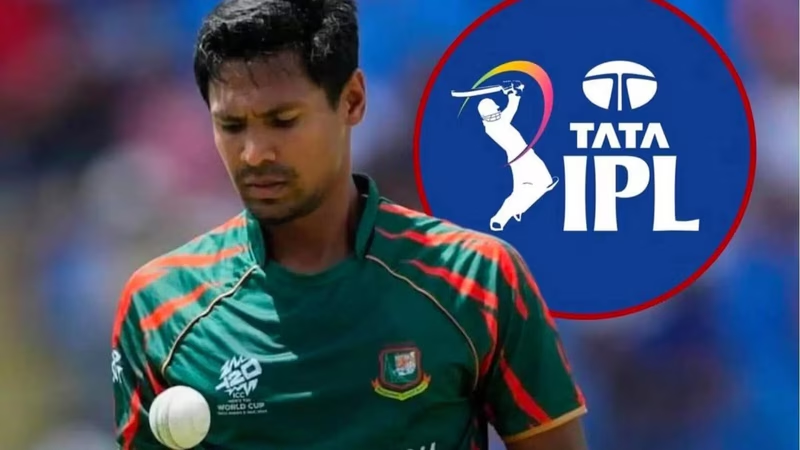
In the high-stakes world of the Indian Premier League, where crores change hands in seconds, one player might be left holding… nothing. Mustafizur Rahman, the celebrated Bangladesh pacer, has found himself in a financial and legal limbo after his Mustafizur Rahman IPL contract with Kolkata Knight Riders (KKR) was abruptly terminated—not due to injury, poor performance, or breach of conduct, but under politically charged, non-standard conditions . The result? The 29-year-old could lose his entire ₹9.20 crore salary for IPL 2026, with little recourse under current league regulations .
Table of Contents
- The KKR Release: What Went Wrong?
- Mustafizur Rahman IPL Contract: The Payment Cliff
- Why He Might Not Get Paid: The Fine Print
- Player Rights and IPL Governance Gaps
- Legal Avenues for Mustafizur
- Broader Implications for International Players
- Conclusion: A Wake-Up Call for the IPL
- Sources
The KKR Release: What Went Wrong?
Mustafizur was a prized asset for KKR in IPL 2025, delivering crucial breakthroughs with his deceptive cutters. Ahead of the 2026 mega auction, KKR chose to retain him for a massive ₹9.20 crore—underscoring his value to the franchise. Yet, just weeks before the season, the BCCI directed KKR to terminate his contract . The official justification? “Recent developments” linked to political tensions between India and Bangladesh—a reason that falls entirely outside the IPL’s standard player release protocols .
Crucially, this wasn’t a mutual release or a buyout. It was a top-down mandate with no basis in cricketing merit or player conduct. That distinction is everything when it comes to payment and legal protection.
Mustafizur Rahman IPL Contract: The Payment Cliff
Under normal IPL rules, a player is entitled to their full salary if released due to injury or team strategy. But Mustafizur’s situation is anything but normal. Since his release stems from external political pressure—not a cricketing decision—his contract lacks the protective clauses that would guarantee compensation .
KKR, as a franchise, is bound by BCCI directives. But that doesn’t automatically transfer financial liability to the board. The contract is between KKR and Mustafizur. And unless the termination is classified as a “franchise-initiated release under standard terms,” the payment obligation may not hold up.
What This Means in Practice:
- No injury clause triggered: He’s fully fit and ready to play.
- No misconduct found: There’s no violation of IPL code of conduct.
- No force majeure coverage: Political decisions aren’t typically covered under standard insurance policies for player contracts.
Why He Might Not Get Paid: The Fine Print
IPL contracts are notoriously complex, but they generally follow a clear payment logic: if a player is available and the team chooses not to play him for cricketing reasons, he still gets paid. However, if a player is “unavailable” due to reasons beyond the franchise’s control—like government travel bans or security advisories—the contract can be voided without penalty .
In this case, the BCCI’s directive essentially rendered Mustafizur “unavailable” by association, even though he personally was willing and able to participate. This legal gray area is where Mustafizur’s financial future now dangles.
Player Rights and IPL Governance Gaps
This incident exposes a glaring loophole in the IPL’s governance framework: the lack of safeguards for players caught in geopolitical crossfires. The IPL Player Agreement, administered by the BCCI, offers robust protection for on-field issues but is silent on off-field political interventions .
Unlike major global leagues such as the NFL or Premier League, which have independent player unions and arbitration mechanisms, the IPL operates under a centralized, board-controlled system. International players, in particular, have minimal leverage. They sign contracts in good faith, only to find themselves at the mercy of diplomatic tides they cannot control.
Legal Avenues for Mustafizur
Mustafizur isn’t without options, though the path is uphill:
- Dispute Resolution through BCCI: He can file a formal grievance under the IPL’s internal dispute resolution mechanism. However, since the BCCI issued the directive, impartiality is questionable.
- International Commercial Arbitration: If his contract includes an arbitration clause (common in high-value deals), he could pursue a case in a neutral forum like the Singapore International Arbitration Centre.
- Appeal to ICC or FICA: While the ICC doesn’t govern T20 leagues, the Federation of International Cricketers’ Associations (FICA) could provide advocacy support and public pressure .
Broader Implications for International Players
Mustafizur’s plight is a warning shot across the bow for every overseas player in the IPL. If a player can lose millions due to political friction between nations, then no international contract is truly secure. This could lead to:
- Higher risk premiums in future auctions.
- Demands for “political force majeure” insurance from players.
- Reluctance from top global talent to commit long-term to the IPL.
The league’s global appeal depends on its reputation as a professional, apolitical sporting event. This controversy threatens that very foundation.
Conclusion: A Wake-Up Call for the IPL
The Mustafizur Rahman IPL contract crisis is more than a personal tragedy—it’s a systemic failure. A world-class athlete, contracted in good faith, now faces the very real possibility of walking away from the world’s richest T20 league with empty pockets. This situation demands immediate reform: clearer contractual language, independent player representation, and firm separation of sport from state politics. Until then, every international player in the IPL is playing with financial fire. For a deeper look at how global sports leagues handle player rights, check out [INTERNAL_LINK:global-sports-player-unions]. You can also review official IPL regulations on the IPL’s official website.
Sources
- Times of India. “Rs 9.20 cr at stake? Mustafizur set to walk away empty-handed after KKR release.” Accessed January 2026.
- Reports on KKR’s retention and release of Mustafizur Rahman [[2], [3], [4], [5]].
- Analysis of IPL contract structures and payment clauses [[8], [9], [10], [11]].
- Information on BCCI directives and geopolitical context [[6], [7], [12]].
- FICA’s role in international player advocacy: https://www.fica.global/.