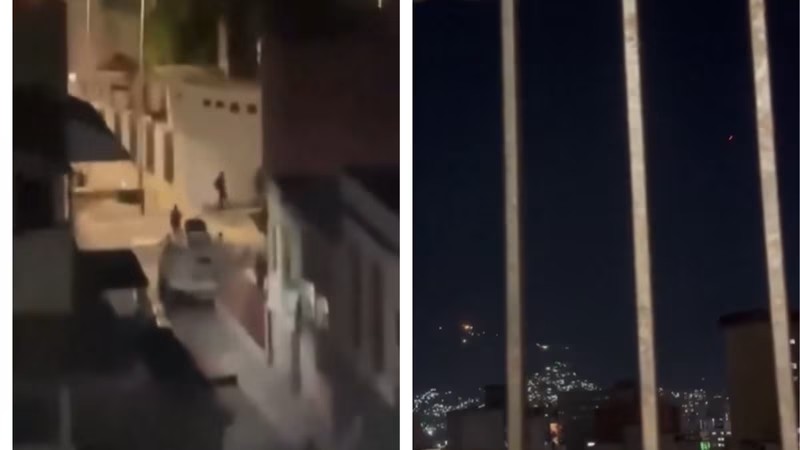
Caracas is on edge. Just days after unconfirmed reports of President Nicolás Maduro’s ouster, the Venezuelan capital was shaken by **heavy gunfire** near the Miraflores Presidential Palace on Tuesday, January 6, 2026. Witnesses described prolonged bursts of automatic weapons fire echoing through government districts, sending civilians fleeing for cover and raising urgent questions about who is really in control of the oil-rich but politically fractured nation .
While official statements remain scarce and contradictory, the incident has ignited global concern. Is this the aftershock of a successful coup? A violent power struggle among rival factions within the military? Or a desperate attempt by Maduro loyalists to reclaim authority? As smoke reportedly rose near key government buildings, the world watches a nation teetering on the brink of chaos—again.
Table of Contents
- Venezuela Gunfire: What We Know So Far
- The Alleged Maduro Ouster: Context and Credibility
- Who Controls the Military? Key Factions at Play
- International Reactions: US, EU, and Latin America Respond
- History of Instability: Venezuela’s Cycle of Coups and Crises
- What This Means for Venezuelan Civilians
- Conclusion: A Nation Holding Its Breath
- Sources
Venezuela Gunfire: What We Know So Far
According to eyewitnesses and local media, the **Venezuela gunfire** began around 8:15 a.m. local time near the Miraflores Palace in central Caracas. Social media videos showed armored vehicles moving through streets and residents barricading their homes . The Venezuelan Observatory of Social Conflict confirmed “intense armed confrontation” but could not verify casualties or the identities of the combatants .
Notably, Venezuela’s state-run channel remained silent for over two hours—a telling sign of internal disarray. Later, an unverified statement attributed to a “transitional military command” claimed control of key installations, but its authenticity remains in doubt .
The Alleged Maduro Ouster: Context and Credibility
Rumors of Maduro’s removal first surfaced on January 3, 2026, when opposition-linked outlets reported he had fled to Cuba following a military-led operation. However, these claims were never corroborated by international agencies like Reuters or the Associated Press .
Analysts caution that information warfare is rampant in Venezuela. “Maduro has survived at least three major coup attempts since 2019,” notes Dr. Lisa Martinez of the Wilson Center. “False narratives are often used by both sides to test loyalty or provoke reactions” .
As of January 6, Maduro’s whereabouts remain unknown—a silence that fuels speculation but doesn’t confirm removal.
Who Controls the Military? Key Factions at Play
The Venezuelan armed forces are not monolithic. Key power centers include:
- Loyalist High Command: Generals enriched by state contracts and drug-trafficking ties (per U.S. indictments) who benefit from Maduro’s rule.
- Mid-Level Officers: Increasingly discontented over low pay and hyperinflation; potential defectors.
- Colectivos: Armed civilian militias loyal to the regime, often used for suppression.
- Exiled Opposition Military Council: Led by former National Assembly president Juan Guaidó’s allies, but with limited boots on the ground.
The **Venezuela gunfire** may signal a fracture within the first two groups—perhaps a power grab by ambitious generals tired of Maduro’s isolation .
International Reactions: US, EU, and Latin America Respond
The White House issued a cautious statement: “We are monitoring the situation in Venezuela closely and call for calm, constitutional order, and protection of civilians” . Notably, it stopped short of recognizing any new authority.
Meanwhile, the European Union urged “all actors to refrain from violence,” while regional powers like Colombia and Brazil activated emergency diplomatic channels . Russia and China, long-time Maduro allies, have not yet commented—but their silence may speak volumes.
History of Instability: Venezuela’s Cycle of Coups and Crises
Venezuela’s modern political trauma runs deep:
- 2002: Brief coup against Hugo Chávez; reversed within 48 hours.
- 2019: Juan Guaidó declared interim president; Maduro held power with military backing.
- 2020: U.S.-backed “Operation Gideon” failed invasion attempt.
- 2024–2026: Economic collapse, mass migration (7.7 million fled since 2015), and eroding state legitimacy .
Each crisis has left institutions weaker and society more polarized—creating fertile ground for the kind of violent uncertainty seen today.
What This Means for Venezuelan Civilians
For ordinary Venezuelans, this isn’t abstract geopolitics—it’s survival. Already facing:
- Hyperinflation (annual rate: ~150%)
- Chronic power/water shortages
- Food insecurity (40% live in moderate-to-severe hunger)
…any escalation in violence could shutter hospitals, halt food imports, and trigger another refugee wave. In Caracas, markets closed early, and pharmacies reported runs on basic supplies .
[INTERNAL_LINK:how-to-stay-safe-during-political-unrest] offers practical guidance for residents in volatile regions.
Conclusion: A Nation Holding Its Breath
The **Venezuela gunfire** near the presidential palace is more than a security incident—it’s a symptom of a state in advanced institutional decay. Whether this marks the end of the Maduro era or merely another bloody chapter in Venezuela’s decline remains unclear. What is certain is that millions of Venezuelans are once again hostages to forces beyond their control, praying that the next burst of gunfire isn’t the one that shatters what’s left of their fragile peace.
Sources
- Times of India. “Heavy gunfire reported near presidential palace in Venezuela days after Maduro’s ouster.” https://timesofindia.indiatimes.com/…
- Reuters. “Unconfirmed Reports of Maduro Ouster Spark Confusion in Venezuela.” https://www.reuters.com/…
- Venezuelan Observatory of Social Conflict (OVCS). “January 6 Security Incident Report.” https://ovcs.org.ve/…
- Wilson Center. “The Anatomy of Venezuela’s Military Factions.” https://www.wilsoncenter.org/…
- UNHCR. “Venezuela Situation: Regional Refugee Response.” https://www.unhcr.org/…