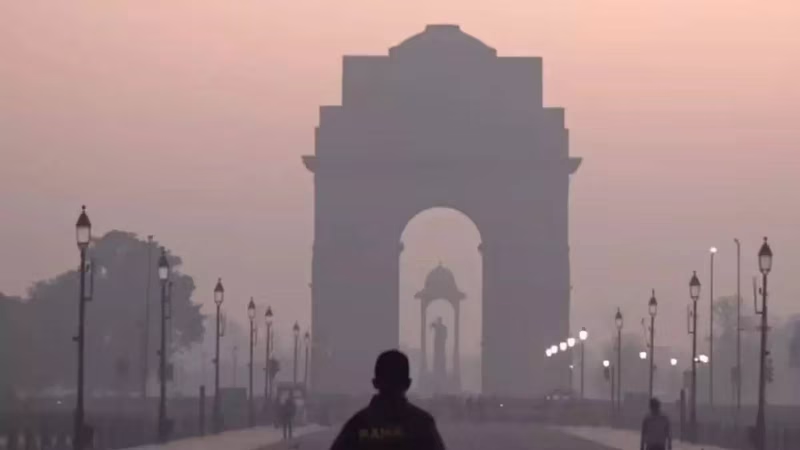
Another winter morning in Delhi—and another day breathing air that feels more like smoke than oxygen. As of Tuesday, January 6, 2026, the city’s Air Quality Index (AQI) has climbed to a worrying 288, firmly placing it in the ‘poor’ category . A thick, grey haze—locally known as ‘smog’—hangs low over the capital, reducing visibility and casting an eerie silence over its usually chaotic streets. Flights at Indira Gandhi International Airport are still operating under CAT III protocols, but delays are mounting, and residents are once again being forced to choose between staying indoors or risking their health .
Table of Contents
- Delhi AQI Climbs to 288: What Does It Mean?
- Why Is Delhi Choking? The Science Behind Winter Smog
- Flight Operations Under Siege: How Smog Affects Travel
- Health Risks of Poor Air Quality: Who Is Most at Risk?
- What You Can Do to Protect Yourself and Your Family
- Long-Term Solutions: Is There Any Hope for Delhi?
- Conclusion: Breaching in a Crisis
- Sources
Delhi AQI Climbs to 288: What Does It Mean?
An AQI of 288 falls squarely in the ‘Poor’ category on India’s National Air Quality Index scale (201–300). At this level, even healthy individuals may begin to experience respiratory symptoms like coughing, throat irritation, and shortness of breath . For children, the elderly, and those with pre-existing conditions like asthma or heart disease, the risks are significantly higher.
The Delhi AQI is a composite measure that tracks major pollutants, including PM2.5 (fine particulate matter), PM10, nitrogen dioxide, sulfur dioxide, and ozone. PM2.5 levels are of particular concern—they’re so small they can penetrate deep into the lungs and even enter the bloodstream, leading to long-term cardiovascular and respiratory damage .
Why Is Delhi Choking? The Science Behind Winter Smog
Delhi’s winter pollution isn’t an accident—it’s a perfect storm of meteorology and human activity. During this season, a phenomenon called ‘temperature inversion’ occurs: cold, dense air gets trapped near the ground, while a layer of warmer air acts like a lid above it . This prevents pollutants from dispersing vertically.
Compounding the problem are ‘low wind speeds,’ which fail to blow the stagnant air away . Add to that the lingering effects of post-harvest stubble burning in Punjab and Haryana, vehicular emissions, industrial discharge, and construction dust—and you get the toxic cocktail that blankets Delhi every November through January .
Flight Operations Under Siege: How Smog Affects Travel
Despite the hazardous conditions, Indira Gandhi International (IGI) Airport remains operational—thanks to CAT III Instrument Landing Systems (ILS). These advanced systems allow planes to land safely with visibility as low as 50 meters . However, this doesn’t mean smooth sailing.
- Delays are common: Aircraft may circle longer or be held at origin airports.
- Taxiing becomes hazardous: Ground visibility issues can slow down movement on runways.
- Cancellations may follow: If AQI drops further into the ‘very poor’ or ‘severe’ range, more disruptions are likely.
Travelers are advised to check real-time flight status and allow extra time for transit.
Health Risks of Poor Air Quality: Who Is Most at Risk?
Prolonged exposure to a Delhi AQI above 250 can lead to serious health consequences:
- Children: Their developing lungs are more vulnerable to damage.
- Senior citizens: Increased risk of heart attacks and strokes.
- Asthmatics & COPD patients: High likelihood of acute attacks.
- Pregnant women: Linked to low birth weight and preterm births.
The World Health Organization (WHO) states that air pollution is a leading environmental risk factor for non-communicable diseases globally .
What You Can Do to Protect Yourself and Your Family
While systemic change is needed, individuals can take practical steps:
- Wear N95 masks when stepping outside.
- Use air purifiers with HEPA filters at home.
- Avoid morning walks until after 10 AM when inversion lifts slightly.
- Stay indoors as much as possible, especially during peak pollution hours.
- Monitor real-time AQI via apps like SAMEER or AirVisual.
[INTERNAL_LINK:best-air-purifiers-for-delhi-homes] can be a lifesaver during these months.
Long-Term Solutions: Is There Any Hope for Delhi?
Short-term fixes like smog towers and odd-even car schemes offer limited relief. Sustainable change requires:
- Strict enforcement of anti-stubble burning laws.
- Massive investment in public transport to reduce private vehicle use.
- Transition to cleaner energy for industries and power plants.
- Urban greening to act as natural air filters.
The Supreme Court of India has repeatedly intervened, and the Graded Response Action Plan (GRAP) is in place—but consistent political will and public cooperation remain the biggest hurdles .
Conclusion: Breathing in a Crisis
A Delhi AQI of 288 is not just a number—it’s a public health emergency wrapped in a grey blanket of smog. While flights continue and life goes on, the silent toll on millions of lungs is impossible to ignore. Until long-term solutions are prioritized over temporary band-aids, Delhi’s residents will keep paying the price for a crisis that’s as predictable as it is preventable.
Sources
- Times of India. “Toxic smog: Delhi remains in ‘poor’ category as AQI hits 288.” https://timesofindia.indiatimes.com/…
- Central Pollution Control Board (CPCB). “National Air Quality Index.” https://cpcb.nic.in/…
- World Health Organization (WHO). “Ambient (Outdoor) Air Pollution.” https://www.who.int/…
- Ministry of Environment, Forest and Climate Change. “Graded Response Action Plan (GRAP).” https://moef.gov.in/…