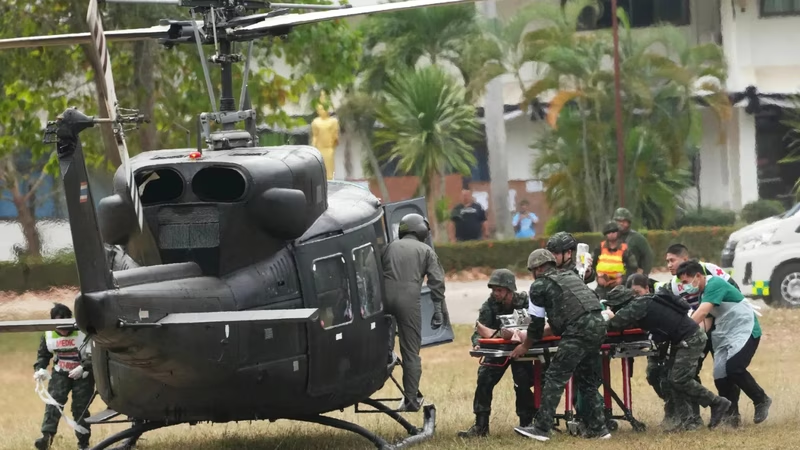
A carefully negotiated 10-day ceasefire between Cambodia and Thailand lies in tatters after Cambodian troops allegedly fired across the border in what Phnom Penh later described as an “operational error.” The incident, which left one Thai soldier wounded, has reignited long-simmering tensions along the 817-kilometer border—a frontier marked by historical disputes, territorial ambiguity, and periodic outbreaks of violence. As diplomats scramble to contain fallout, questions swirl: Was this really a mistake, or a calculated test of resolve?
Table of Contents
- The Ceasefire That Didn’t Last
- What Happened During the Violation?
- Cambodia’s “Operational Error” Explained
- Historical Roots of Thailand-Cambodia Border Tensions
- Strategic Significance of the Disputed Zone
- Thailand’s Response and Regional Implications
- Role of ASEAN and International Mediation
- Conclusion: Fragile Peace in a Volatile Region
- Sources
The Ceasefire That Didn’t Last
Just ten days after both nations agreed to a temporary truce following earlier skirmishes near the Preah Vihear temple area, the ceasefire collapsed on January 5, 2026. Thai military sources reported that Cambodian forces opened fire without provocation along a contested stretch of the border in Surin Province, injuring a Royal Thai Army soldier.
Within hours, Cambodia’s Ministry of National Defense issued a statement acknowledging the incident but framed it as an “operational error” during a routine patrol—claiming troops misidentified movement in dense jungle terrain and discharged weapons in “self-defense posture.”
What Happened During the Violation?
According to Thai military briefings:
- Gunfire erupted just after 4:30 AM local time near the Ta Muen Thom border pass.
- One Thai soldier sustained shrapnel wounds to the leg but is in stable condition.
- No return fire was ordered, preserving restraint despite the ceasefire breach.
Thai authorities released aerial footage showing fresh bullet casings on their side of the demarcated line, contradicting Cambodia’s claim of “misidentification.” The incident occurred in a zone previously designated for joint patrols under a 2025 bilateral agreement—now seemingly ignored.
Cambodia’s “Operational Error” Explained
While “operational error” sounds like bureaucratic jargon, in military parlance, it typically refers to unintended actions during field operations—such as misreading intelligence, malfunctioning equipment, or poor communication. However, experts are skeptical.
“Calling it an ‘error’ is a diplomatic shield,” says Dr. Niranjan Joshi, a Southeast Asia security analyst at the Institute for Defence Studies and Analyses (IDSA). “But repeated incidents in the same corridor suggest either systemic incompetence—or deliberate probing.”
Notably, this is the third such “error” in the past 18 months, raising doubts about Cambodia’s command-and-control discipline—or intent.
Historical Roots of Thailand-Cambodia Border Tensions
The conflict isn’t new. It stretches back over a century:
- 1907: French colonial maps ceded Preah Vihear temple to Cambodia—a ruling Thailand contested for decades.
- 2008: UNESCO declared Preah Vihear a Cambodian World Heritage site, sparking violent clashes.
- 2011: Full-scale artillery duels killed dozens and displaced thousands.
- 2013: ICJ reaffirmed Cambodia’s sovereignty over the temple but left surrounding land ambiguous.
This legal gray area—covering nearly 4.6 square kilometers—remains a flashpoint.
Strategic Significance of the Disputed Zone
Beyond symbolism, the area holds tactical value:
- High ground: The Dângrêk Mountains offer surveillance advantage over both nations’ troop movements.
- Smuggling routes: The dense jungle is used for trafficking wildlife, drugs, and weapons.
- National pride: For both nations, ceding territory is politically toxic.
Moreover, with China increasing military aid to Cambodia—including radar and drone systems—Thailand fears an asymmetry that could embolden Phnom Penh.
Thailand’s Response and Regional Implications
Thailand has suspended all joint military coordination with Cambodia and summoned the Cambodian ambassador. Prime Minister Paetongtarn Shinawatra’s office stated, “A ceasefire is not a suggestion. It is a binding commitment.”
Regionally, the incident undermines ASEAN’s credibility. The bloc prides itself on “Asian solutions to Asian problems,” yet recurring border violence exposes its limited enforcement power. For more on regional security frameworks, see our analysis on [INTERNAL_LINK:asean-neutrality-challenges-in-modern-conflicts].
Role of ASEAN and International Mediation
ASEAN has called an emergency meeting in Jakarta. However, its consensus-based approach often leads to weak statements. The UN and ICJ remain available for arbitration, but both Thailand and Cambodia have so far resisted formal referral—preferring bilateral talks to avoid “internationalization” of the dispute.
Still, as noted by the ASEAN Secretariat, “Preventing escalation is the immediate priority. Trust-building measures must resume immediately.”
Conclusion: Fragile Peace in a Volatile Region
The Cambodia ceasefire violation—masked as an “operational error”—is a stark reminder that paper truces mean little without mutual trust and clear demarcation. For Thailand, this breach isn’t just about one wounded soldier; it’s about the reliability of its neighbor’s commitments. As geopolitical currents shift in Southeast Asia, the world watches to see whether diplomacy can prevail—or if the jungle hills will echo with gunfire once again.