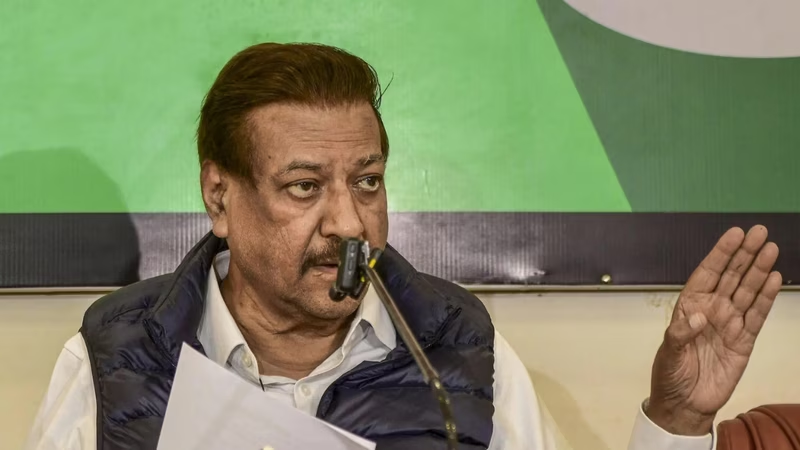
In a scathing critique that cuts to the heart of India’s foreign policy stance, veteran Congress leader and former Maharashtra Chief Minister Prithviraj Chavan has accused the Modi government of maintaining a “deafening silence” on the recent US military operation in Venezuela. Warning that “this can happen to India too,” Chavan claimed the Centre is avoiding any comment because it is “scared of Americans”—a statement that has reignited debate over India’s geopolitical balancing act in an increasingly polarized world.
Table of Contents
- What Happened in Venezuela? The US Military Operation
- Chavan Slams Centre Over Strategic Silence
- Why India’s Silence on Venezuela Matters
- India’s Historical Stance on Foreign Interventions
- The US-India Strategic Partnership: A Delicate Balance
- Reactions from Political Opposition and Diplomats
- Could It Really Happen to India? Analysing Chavan’s Warning
- Conclusion: Navigating Principles and Pragmatism
- Sources
What Happened in Venezuela? The US Military Operation
On January 4, 2026, the United States launched a targeted military operation in Caracas, Venezuela, described by the Pentagon as a “counter-narcotics and counter-terrorism strike” against a suspected drug cartel with alleged ties to terrorist networks. While the US claims the action was “limited and precise,” Venezuela condemned it as a violation of its sovereignty—echoing decades of anti-imperialist rhetoric under the Maduro regime.
The operation has drawn sharp criticism from Russia, China, and several Latin American nations, while Western allies like the UK and France have issued cautious, non-committal statements. Notably absent from the global discourse: India.
Chavan Slams Centre Over Strategic Silence
Speaking at a public event in Mumbai on Tuesday, Prithviraj Chavan did not mince words. “The Centre has not said a single word about the US military action in Venezuela. Why? Because they are scared of Americans,” he alleged. “But let me remind everyone: what is happening in Venezuela today can happen to India tomorrow.”
Chavan argued that unchecked US interventionism, especially under the guise of “security operations,” sets a dangerous global precedent. He pointed to historical cases—from Iraq to Libya—as evidence that even sovereign nations are not immune to unilateral military actions by powerful states.
Why India’s Silence on Venezuela Matters
India has long championed the principle of non-interference in domestic affairs—a cornerstone of its foreign policy since the Nehruvian era. Its silence on Venezuela is thus seen by critics as a departure from that legacy. Key implications include:
- Erosion of moral authority: India risks appearing inconsistent on sovereignty issues, especially after vocal stances on Ukraine.
- Strategic ambiguity: While neutrality may serve short-term diplomacy, prolonged silence can be interpreted as tacit approval.
- Domestic political fallout: Opposition parties are using the issue to question the government’s independence in foreign affairs.
India’s Historical Stance on Foreign Interventions
Historically, India has opposed unilateral military actions:
- It voted against the 2003 Iraq War in the UN General Assembly.
- It criticized NATO’s 2011 intervention in Libya.
- It consistently advocates for peaceful resolution through multilateral forums like the UN.
This tradition aligns with India’s leadership role in the Non-Aligned Movement and its current position as a “Vishwaguru” (global teacher). Breaking that mold—even by omission—carries reputational costs.
The US-India Strategic Partnership: A Delicate Balance
The Modi government’s reticence likely stems from its deepening ties with Washington. The two nations now collaborate closely on defense, technology, and Indo-Pacific security through forums like the Quad. Publicly condemning a US operation—even a controversial one—could strain this partnership.
However, as noted by the Carnegie India think tank, “India can voice principled concerns without rupturing ties. Strategic autonomy means speaking up when core values are at stake.”
Reactions from Political Opposition and Diplomats
Chavan’s remarks have found support within the INDIA bloc:
- Congress spokesperson Jairam Ramesh called for an “urgent parliamentary discussion” on Venezuela.
- DMK leader Kanimozhi urged the government to “reaffirm its commitment to sovereignty.”
Meanwhile, retired diplomats are divided. Former Foreign Secretary Shyam Saran cautioned against “emotional foreign policy,” while others, like Ambassador M.K. Bhadrakumar, backed Chavan, stating, “Silence legitimizes aggression.”
Could It Really Happen to India? Analysing Chavan’s Warning
While a direct US military strike on India remains highly improbable, Chavan’s warning taps into deeper anxieties:
- Hybrid warfare: Economic sanctions, cyberattacks, or proxy destabilization are modern tools of coercion.
- Alliance pressures: As India leans closer to the US, it may face demands to align on issues against its interests.
- Precedent setting: Normalizing interventions in weaker states erodes the global rule-based order India relies on.
His point isn’t about literal invasion—it’s about the erosion of sovereignty in a world where power often overrides principle.
Conclusion: Navigating Principles and Pragmatism
Chavan slams Centre not just for what it didn’t say—but for what that silence implies about India’s evolving identity on the world stage. In an era of strategic realignments, the challenge isn’t just to build partnerships, but to do so without compromising the foundational values that earned India global respect. As Chavan’s warning echoes, the real test of foreign policy isn’t in times of calm—but in moments of moral clarity.