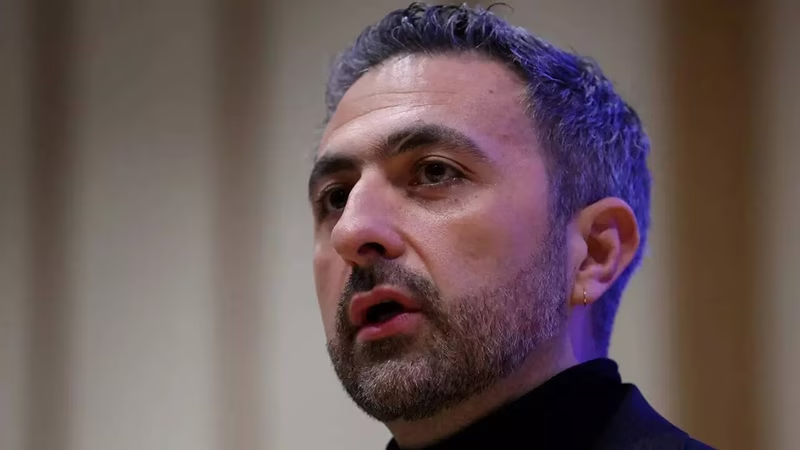
Forget chatting with a machine to see if it sounds human. The new frontier in AI evaluation isn’t about conversation—it’s about cold, hard cash. Microsoft’s AI chief, Mustafa Suleyman, has proposed a bold, real-world benchmark that could become the definitive AI Turing Test for our era: can an autonomous AI agent legally turn $100,000 into $1 million?
This isn’t science fiction. It’s a serious challenge aimed at measuring what Suleyman calls “Artificial Capable Intelligence”—the ability of AI to not just process information but to navigate the messy, unpredictable complexities of the real economy with strategy, foresight, and execution.
Table of Contents
- What Is the New AI Turing Test?
- Mustafa Suleyman and the Rise of Artificial Capable Intelligence
- How Would the $100K-to-$1M AI Challenge Actually Work?
- The CEO Betting Pool: Altman, Benioff, and the Future of Agents
- Skeptics Sound the Alarm: The Case Against AI Hype
- Why This New AI Turing Test Matters
- Conclusion: Beyond the Hype to Real Intelligence
- Sources
What Is the New AI Turing Test?
The original Turing Test, proposed by Alan Turing in 1950, asked a simple question: if a human can’t tell whether they’re talking to a machine or another human, has the machine achieved intelligence?
Today, with large language models that can mimic human conversation flawlessly, many argue that test has been passed—or at least rendered obsolete. The new challenge isn’t about mimicry; it’s about agency. The AI Turing Test Suleyman envisions is a practical, economic stress test. It demands that an AI not only understand the world but also act within it to achieve a specific, high-stakes financial goal.
Mustafa Suleyman and the Rise of Artificial Capable Intelligence
Mustafa Suleyman, co-founder of DeepMind and now a key leader at Microsoft AI, isn’t just theorizing. He’s putting his reputation on the line. His concept of “Artificial Capable Intelligence” (ACI) shifts the focus from narrow, task-specific AI to systems that can operate autonomously over long time horizons, manage resources, and adapt to unforeseen obstacles.
For Suleyman, the $100K-to-$1M challenge is the perfect litmus test. It requires the AI to do everything a sophisticated human entrepreneur or investor would: research markets, develop a business strategy, execute trades or build a product, manage risk, and, crucially, stay within the bounds of the law.
How Would the $100K-to-$1M AI Challenge Actually Work?
While the full rules haven’t been published, the challenge’s framework is clear:
- Starting Capital: The AI agent is given $100,000 in a controlled environment.
- Autonomy: The agent must operate with minimal to no human intervention. It can use APIs to interact with the real world (e.g., stock exchanges, e-commerce platforms, legal databases).
- Objective: Grow the capital to $1,000,000.
- Constraints: All actions must be legal and ethical. No market manipulation or illegal schemes.
- Time Limit: A reasonable but challenging timeframe would likely be imposed.
This test forces the AI to integrate a staggering array of skills: financial literacy, legal compliance, strategic planning, and real-time decision-making under uncertainty.
The CEO Betting Pool: Altman, Benioff, and the Future of Agents
Suleyman didn’t just propose this in a vacuum. He’s directly challenging other tech titans who are betting big on AI agents. He’s reportedly put out a call to leaders like Sam Altman (OpenAI) and Marc Benioff (Salesforce) to put their money—and their AI—where their mouth is.
Sam Altman, a vocal proponent of AI agents as the next major paradigm, has stated that he believes such systems are just years away from achieving profound real-world impact [[INTERNAL_LINK:future-of-ai-agents]]. This challenge would be the ultimate proof of concept for his vision.
Skeptics Sound the Alarm: The Case Against AI Hype
Not everyone is on board with this grand vision. One of the most prominent critics is AI pioneer Andrej Karpathy. He’s warned that the current rush towards autonomous AI agents is premature, filled with what he calls “slop”—unreliable, brittle systems that can’t be trusted with serious tasks.
Karpathy’s argument is that while today’s AI is impressive at generating text and images, it still lacks the robust reasoning, reliability, and accountability needed for high-stakes autonomy. He cautions that deploying such agents in the real world before they are truly ready could lead to significant failures and erode public trust in AI as a whole .
Why This New AI Turing Test Matters
This challenge is about more than just a million dollars. It’s a crucial pivot point for the entire field of AI.
Passing the AI Turing Test as defined by Suleyman would signal a quantum leap from AI as a tool to AI as an independent economic actor. It would validate the massive investments being made in agent-based AI and force a global conversation about the economic, legal, and societal implications of such powerful systems.
Conversely, if the challenge proves impossible for the foreseeable future, it could be a much-needed reality check, refocusing the industry on building more reliable, verifiable, and safe AI foundations before chasing autonomy.
Conclusion: Beyond the Hype to Real Intelligence
Mustafa Suleyman’s $1 million challenge is a brilliant move. It cuts through the marketing fluff and AI hype to pose a concrete, measurable question about the true capabilities of our most advanced systems. Whether an AI can pass this new AI Turing Test remains to be seen, but the very act of posing the question is pushing the entire industry toward a more practical and accountable definition of intelligence. The world will be watching to see who takes up the challenge—and who can actually deliver.
Sources
- Times of India – Microsoft AI CEO Mustafa Suleyman has a test for Sam Altman [[ORIGINAL_SOURCE]]
- Karpathy, A. (2024). On the current state of Autonomous AI Agents. AI Commentary
- Microsoft AI – Leadership and Vision
- Turing, A. M. (1950). Computing Machinery and Intelligence. Mind