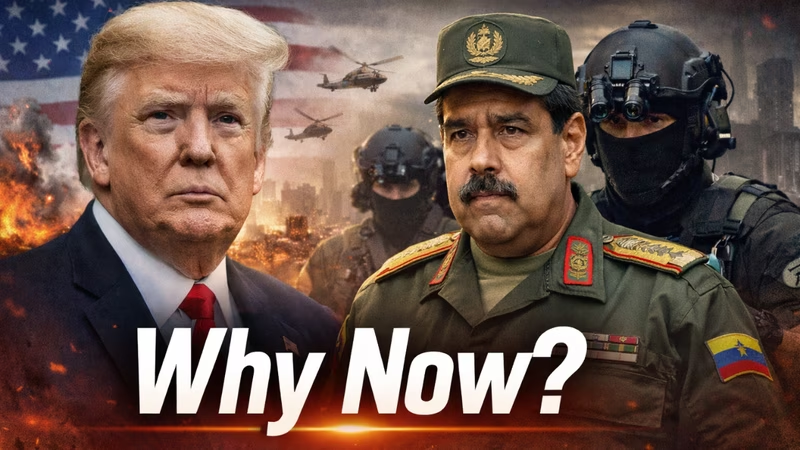
The geopolitical earthquake has already hit. In a move that shatters decades of diplomatic precedent, the United States has reportedly captured Nicolás Maduro—the sitting president of Venezuela—ending years of sanctions, threats, and covert pressure with a single, audacious act .
No longer content with economic warfare or proxy support for opposition leaders like María Corina Machado, Washington has crossed a line it once deemed unthinkable: direct, overt regime decapitation in its own backyard. While the White House frames the operation as a law enforcement action against a “narco-terrorist,” the true drivers run far deeper—touching oil security, migration control, domestic politics, and a resurgent Cold War-style contest with China, Russia, and Iran .
Table of Contents
- Maduro Captured: The Historic Operation
- Why Now? The Timing Behind US Action
- The Donroe Doctrine: America’s New Hemispheric Rule
- Oil, Migration, and Domestic Politics: The Real Motivations
- Global Reactions: China, Russia, and the New Cold War
- What Next for Venezuela? Power Vacuum or Democratic Transition?
- Conclusion: A New Era in the Americas
- Sources
Maduro Captured: The Historic Operation
According to U.S. officials, the operation—conducted by a joint task force of Delta Force, DEA FAST teams, and intelligence operatives—was executed during a high-level meeting near the Colombian border . Maduro was taken into custody under the U.S. indictment that has long accused him of drug trafficking and ties to the FARC and Hezbollah .
This is not an arrest in exile or a post-regime handover. This is the forcible detention of a head of state on foreign soil—a move with no parallel since the 1989 U.S. invasion of Panama to capture Manuel Noriega . The implications for international law, sovereignty norms, and regional stability are profound.
Why Now? The Timing Behind US Action
After 15 years of Maduro’s rule and two decades of U.S. sanctions, why act in early 2026? Three converging factors made this the “perfect storm” for Washington:
- Strategic Window: Venezuela’s military and internal security apparatus have fractured, with key generals quietly defecting or signaling neutrality .
- Energy Security: With global oil markets volatile and U.S. shale production plateauing, Venezuela’s 300 billion barrels of proven reserves are too valuable to leave under adversarial control .
- Political Momentum: President Trump’s second-term mandate provides cover for high-risk actions, especially with Marco Rubio as Secretary of State—a lifelong Cuba-Venezuela hardliner .
As one senior advisor reportedly stated: “We’ve tried everything else. Now it’s time to finish the job” .
The Donroe Doctrine: America’s New Hemispheric Rule
The Maduro captured operation is the clearest manifestation yet of what analysts are calling the “Donroe Doctrine”—a 21st-century reboot of the Monroe Doctrine that declares the Western Hemisphere off-limits to foreign powers and asserts the U.S. right to unilaterally remove hostile regimes .
Unlike past administrations that emphasized multilateralism or quiet diplomacy, the Trump 2.0 foreign policy embraces overt dominance. “If China or Russia thinks they can prop up failing states in our hemisphere, they’re mistaken,” declared National Security Advisor Robert O’Brien in a recent speech .
Oil, Migration, and Domestic Politics: The Real Motivations
Beyond the narco-terrorism narrative, three core U.S. interests are at play:
- Oil Access: Venezuela’s state-owned PDVSA could soon be reopened to U.S. energy giants like Chevron and ExxonMobil—securing long-term supply and countering OPEC+ influence .
- Migration Control: Economic collapse has driven 7 million Venezuelans abroad, many heading north. Stabilizing Venezuela is key to reducing migration pressure on the U.S. southern border .
- Election Math: With Florida’s Cuban, Venezuelan, and Colombian-American voters pivotal in 2028, Trump gains major political capital by “liberating” Caracas .
For deeper context on U.S. energy strategy, see [INTERNAL_LINK:how-venezuela-oil-impacts-us-energy-security].
Global Reactions: China, Russia, and the New Cold War
Beijing and Moscow have issued furious condemnations, calling the move “a brazen act of imperialism” and a “violation of the UN Charter” . Both nations have significant investments in Venezuela—China loaned over $60 billion in the last decade, while Russia maintains military advisors and arms contracts .
Iran, too, has stakes, with reported drone and missile collaborations with Caracas. The U.S. operation sends a chilling message: American dominance in Latin America remains non-negotiable, even in a multipolar world.
What Next for Venezuela? Power Vacuum or Democratic Transition?
With Maduro gone, a power struggle looms. Interim President Delcy Rodríguez has declared a state of emergency, but her authority is untested. Meanwhile, exiled opposition leader María Corina Machado—recognized by the U.S. as Venezuela’s legitimate representative—is expected to return to Caracas within days .
The U.S. has pledged to support a transitional government and “free and fair elections within 90 days.” But skeptics warn that without inclusive dialogue and economic recovery plans, Venezuela could descend into warlordism or prolonged chaos—much like Iraq post-2003 .
Conclusion: A New Era in the Americas
The Maduro captured moment is more than a single operation—it’s the opening salvo of a new U.S. doctrine in the Western Hemisphere. By abandoning restraint and embracing direct action, Washington has signaled that the age of strategic patience is over. For allies, it’s a promise of protection. For adversaries, it’s a warning. And for the people of Venezuela, it’s a fragile hope for freedom—balanced against the risk of deeper turmoil. One thing is certain: Latin America will never be the same.
Sources
- Times of India: Why Maduro, why now: Inside America’s most dramatic move in Latin America in decades
- U.S. Department of Justice: Indictment of Nicolás Maduro
- U.S. State Department: The Panama Invasion of 1989
- CSIS: Venezuelan Military Defections
- U.S. Energy Information Administration: Venezuela Oil Overview
- Foreign Affairs: The Trump Doctrine in Venezuela
- The Guardian: Trump’s gangster foreign policy is taking shape in Venezuela
- White House Briefing: National Security Advisor on Hemispheric Security
- Reuters: Chevron’s Venezuela Operations
- UNHCR: Venezuela Regional Refugee Response
- Pew Research Center: Latino Voters in Florida
- Global Times: China Condemns U.S. Venezuela Action
- Brookings Institution: Russia’s Strategic Interests in Venezuela
- International Crisis Group: What Comes After Maduro?