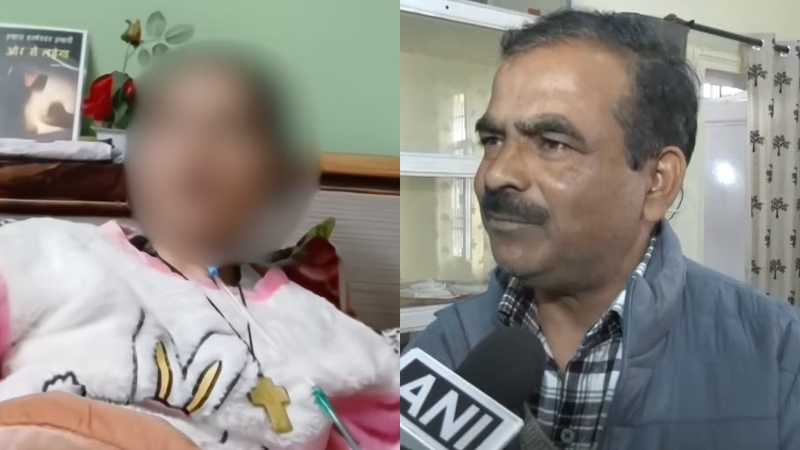
A quiet hill town in Himachal Pradesh is now at the heart of a national outcry. The Himachal student death of a young Dalit man at a Dharamshala college has not only shattered a family but also exposed deep, festering wounds within India’s higher education system—where power imbalances, caste discrimination, and unchecked authority can have deadly consequences .
As protests swell on campus and beyond, one figure stands at the eye of the storm: Professor Ashok Kumar, the faculty member accused of harassment. In a rare public statement, he declared, “I am prepared to face consequences if found guilty” . But what exactly happened? And how did a student’s life end amid claims of institutional silence and systemic abuse?
Table of Contents
- The Tragedy Unfolds: What We Know So Far
- Accused Professor’s Statement: Cooperation or Damage Control?
- College Response and Contradictions
- The Broader Crisis: Ragging, Caste, and Campus Safety
- Legal Framework and What Happens Next
- Conclusion: A Call for Accountability, Not Just Apologies
- Sources
The Tragedy Unfolds: What We Know So Far
The deceased student, a first-year undergraduate from a Dalit community, was found dead under unclear circumstances at his college in Dharamshala. Family members have alleged that he was subjected to persistent mental and physical harassment by a senior faculty member—later identified as Professor Ashok Kumar .
According to the family, the student had confided in relatives about being “targeted” and “humiliated” in class, with incidents escalating in the days leading up to his death. They claim he feared reporting the abuse due to the professor’s influence and the college’s lack of a responsive grievance mechanism—a chillingly common narrative in India’s educational institutions .
The incident has triggered widespread protests by student unions, Dalit rights groups, and civil society organizations, demanding justice and systemic reforms to prevent such tragedies in the future.
Accused Professor’s Statement: Cooperation or Damage Control?
In the face of mounting public pressure, Ashok Kumar issued a carefully worded statement: “I am fully cooperating with the investigation. If I am found guilty, I am prepared to face the consequences” .
While this may appear conciliatory, legal and social justice experts urge caution. “Saying you’ll accept consequences is not the same as admitting wrongdoing,” notes Dr. Anita Reddy, a sociologist who studies caste dynamics in education . “It’s a legally safe statement that avoids accountability while projecting cooperation.”
Notably, Kumar has not denied any specific allegations, nor has he addressed the family’s claims directly. This silence, critics argue, speaks volumes in a case where trust in institutional integrity is already fractured.
College Response and Contradictions
The college principal has stepped in to clarify certain facts—most notably, confirming the student was “regular in attendance and not academically at risk,” countering early rumors that his death was linked to poor performance .
However, this clarification does little to address the core issue: whether the college had mechanisms to prevent or respond to harassment. Under India’s UGC Regulations on Curbing Ragging (2009), every institution must have an anti-ragging squad, a dedicated helpline, and mandatory affidavits from students and faculty .
Questions are now being raised: Did this college have a functional anti-ragging committee? Were complaints ever filed? And if so, what action was taken?
The Broader Crisis: Ragging, Caste, and Campus Safety
The Himachal student death is not an isolated incident. India’s campuses have long grappled with ragging—a form of institutionalized bullying that disproportionately affects marginalized students .
According to the National Anti-Ragging Helpline, over 60 student deaths linked to ragging have been reported since 2000, though activists believe the actual number is far higher due to underreporting . When caste is added to the mix, the vulnerability intensifies.
Why Dalit Students Are at Greater Risk
- Social Isolation: Often from rural or economically disadvantaged backgrounds, they lack peer support networks.
- Power Imbalance: Faculty and senior students may exploit caste hierarchies to assert dominance.
- Fear of Retaliation: Reporting abuse can lead to social ostracization or academic sabotage.
- Institutional Apathy: Colleges may downplay incidents to protect their reputation .
For more on systemic issues in Indian higher education, see our in-depth analysis on [INTERNAL_LINK:caste-discrimination-in-indian-universities].
Legal Framework and What Happens Next
The Himachal Pradesh Police have assured a “thorough and impartial” investigation, with local authorities promising “strict action against all those found responsible” .
Potential legal consequences could include:
- Criminal charges under Section 306 (abetment to suicide) or Section 304 (culpable homicide) of the IPC, depending on evidence.
- Employment termination
- Institutional penalties, including suspension of admissions or derecognition by the UGC.
The case may also be referred to the National Commission for Scheduled Castes (NCSC), which has the power to investigate caste-based atrocities under the SC/ST (Prevention of Atrocities) Act, 1989 .
Conclusion: A Call for Accountability, Not Just Apologies
The Himachal student death is a tragic reminder that policies on paper mean nothing without enforcement, empathy, and genuine institutional will. While Professor Ashok Kumar’s willingness to “face consequences” is a start, true justice requires more: transparent investigation, protection for whistleblowers, and systemic reforms to ensure no student lives in fear simply for seeking an education.
As protests continue and the nation watches, one thing is clear: silence from campuses must end. Accountability must replace optics. And the life of this young Dalit student must not be just another statistic—but a catalyst for lasting change.
Sources
- Times of India: ‘Prepared to face consequences if found guilty’: Accused in Dharamshala college student death case
- Hindustan Times: Ragging in Indian Colleges Still a Menace
- Economic & Political Weekly: Caste and Campus Violence
- University Grants Commission: Anti-Ragging Regulations
- India Today: Ragging Cases in India: A Persistent Scourge
- National Anti-Ragging Helpline: Annual Reports
- The Caravan: When Campuses Fail Dalit Students
- National Commission for Scheduled Castes (NCSC)