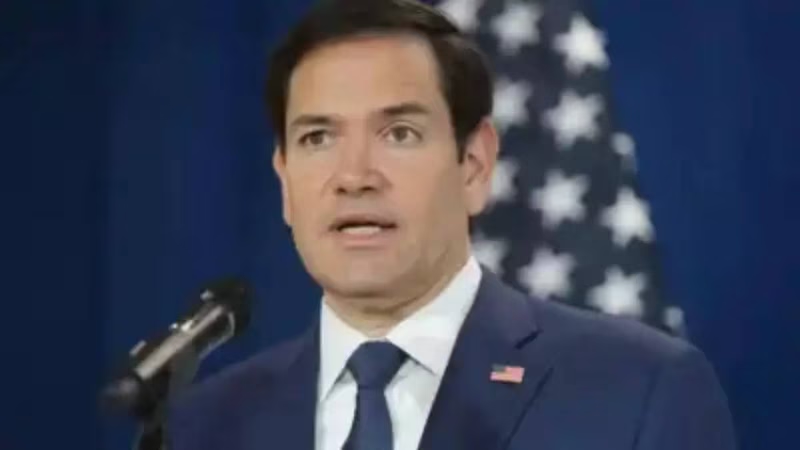
The geopolitical tremors from Washington’s recent action in Venezuela haven’t even settled—and already, another storm is brewing just 90 miles off the Florida coast. In a stark escalation, U.S. Secretary of State Marco Rubio has labeled Cuba a “huge problem” and claimed the regime is “in a lot of trouble.” Meanwhile, President Donald Trump doubled down, calling Cuba a “failing nation” and pledging U.S. support for its people .
This isn’t just political rhetoric. It’s a clear signal that **Cuba next after Venezuela** may not be a question—but a plan. With the administration’s newly assertive “Donroe Doctrine” taking shape , the Western Hemisphere is on high alert. Could Havana be the next domino to fall? And what would that mean for regional stability, U.S. allies, and the Cuban people themselves?
Table of Contents
- Rubio’s Cuba Warning: What He Actually Said
- Why Cuba Could Be Next After Venezuela
- Global Reactions and Regional Backlash
- Trump’s New Latin America Strategy: From Doctrine to Action
- What This Means for the Cuban People
- Conclusion: Is Cuba Really Next?
- Sources
Rubio’s Cuba Warning: What He Actually Said
In the immediate aftermath of the U.S. operation targeting Venezuela’s oil shipments—a move widely seen as the first real-world test of the **Donroe Doctrine**—Marco Rubio didn’t mince words about Cuba. During a press briefing, the Cuban-American Secretary of State stated: “Cuba is a huge problem… They are in a lot of trouble” .
His comments weren’t isolated. President Trump echoed the sentiment, describing Cuba as a “failing nation” and insisting that “the United States wants to help the Cuban people,” not the regime in power . This framing is critical—it mirrors the language used before U.S. interventions in other parts of the world, where “humanitarian aid” and “support for the people” often precede more direct political or economic actions.
Why Cuba Could Be Next After Venezuela
The logic is straightforward—and deeply strategic. Venezuela and Cuba have long maintained a symbiotic relationship: Venezuela provides oil; Cuba sends doctors, intelligence officers, and political advisors . By crippling Venezuela’s oil exports, the Trump administration isn’t just pressuring Maduro—it’s cutting off Cuba’s lifeline.
With that economic artery severed, Havana becomes vulnerable. And for an administration laser-focused on rolling back socialist influence in the Americas, the timing couldn’t be better. Here’s why experts believe **Cuba next after Venezuela** is a real possibility:
- Geopolitical Leverage: Cuba hosts Russian and Chinese interests in the region—something the “Donroe Doctrine” explicitly seeks to counter .
- Domestic Politics: With a large Cuban-American voter bloc in Florida, Trump and Rubio have strong electoral incentives to take a hardline stance .
- Doctrinal Consistency: If the Donroe Doctrine means asserting U.S. dominance in the hemisphere, then neutralizing Cuba—a historic adversary—is a logical next step .
- Economic Opportunity: A post-sanctions Cuba could open lucrative markets for U.S. businesses, particularly in tourism and agriculture .
Global Reactions and Regional Backlash
Not everyone is applauding this approach. Cuban President Miguel Díaz-Canel has condemned the U.S. actions in Venezuela as “imperialist aggression” and warned that similar tactics against Cuba would be met with “unwavering resistance” .
Beyond Havana, traditional U.S. allies have expressed concern. The European Union and several Latin American countries, including Mexico and Brazil, have criticized the unilateral nature of the Venezuela operation, calling it a violation of international law . They fear that labeling Cuba as the next target could ignite a wider regional crisis—or even provoke direct confrontation with global powers like Russia, which maintains intelligence and logistical ties with Cuba .
Trump’s New Latin America Strategy: From Doctrine to Action
This isn’t random saber-rattling. It’s part of a calculated, two-pronged strategy under Trump’s second term:
- Economic Pressure: Use sanctions, blockades, and financial isolation to strangle regimes deemed hostile.
- Regime Change by Proxy: Empower internal opposition movements while offering “humanitarian” support to delegitimize sitting governments .
The message is clear: align with U.S. interests, or face the consequences. As one policy analyst noted, “Trump isn’t just revising foreign policy—he’s rewriting the rules of engagement in America’s backyard” . For more on how this compares to past U.S. interventions, see [INTERNAL_LINK:history-of-us-policy-in-cuba].
What This Means for the Cuban People
While Washington speaks of “helping the Cuban people,” the reality on the ground is more complicated. Increased sanctions could worsen already severe shortages of food, medicine, and fuel—hitting ordinary citizens hardest .
Historically, U.S. embargoes have failed to dislodge Cuba’s leadership but succeeded in deepening public suffering—a fact acknowledged even by some within the U.S. State Department . If the administration follows through with more aggressive measures, the human cost could be immense, potentially triggering a new refugee crisis across the Florida Straits.
Conclusion: Is Cuba Really Next?
The phrase **“Cuba next after Venezuela”** is no longer speculative—it’s a live geopolitical scenario. Marco Rubio’s blunt assessment, combined with Trump’s “failing nation” rhetoric, suggests the administration is laying the groundwork for its next move. Whether that involves intensified sanctions, support for opposition groups, or even covert operations remains to be seen. But one thing is certain: the Western Hemisphere is entering a new era of high-stakes power politics, and Cuba is now squarely in America’s crosshairs. The world watches, waits, and wonders: will history repeat itself—or will this chapter end differently?
Sources
- Times of India: ‘Huge problem’: Is Cuba next after Venezuela? Here’s what Marco Rubio said
- The Guardian: Trump’s gangster foreign policy is taking shape in Venezuela
- CSIS: The Cuba-Venezuela Relationship Explained
- Pew Research Center: How Cuban Americans Vote
- Foreign Affairs: The Trump Doctrine in Venezuela
- U.S. Council for International Business: Cuba Trade Opportunities
- Euronews: EU Criticizes U.S. Venezuela Blockade
- Brookings Institution: Russia’s Strategic Interests in Cuba
- Yale Law School: Trump Targets Latin American Countries
- Council on Foreign Relations: U.S.-Cuba Relations
- Human Rights Watch: Cuba
- U.S. GAO Report on Cuba Sanctions Impact