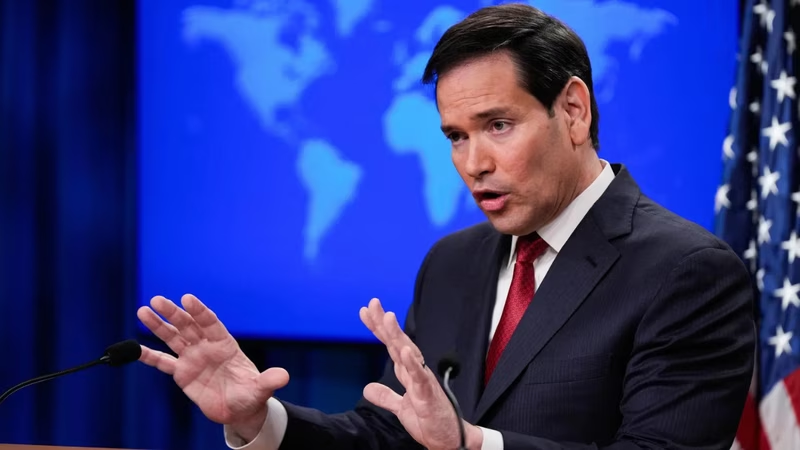
“This is where we live.”
With those four words, U.S. Secretary of State Marco Rubio delivered a blunt geopolitical message that sent ripples from Caracas to Beijing, Moscow, and Tehran. In a recent statement addressing America’s strategic posture toward Venezuela, Rubio made it unmistakably clear: the U.S. will not allow hostile foreign powers—namely China, Russia, and Iran—to gain control over Venezuela’s oil industry.
At the heart of this declaration lies one of the world’s largest proven oil reserves. Venezuela sits on an estimated 300 billion barrels of crude—more than Saudi Arabia. Yet years of economic collapse, mismanagement, and political turmoil have left its oil sector in shambles. Now, as the country teeters between recovery and deeper chaos, a new battle is unfolding—not with tanks, but with pipelines, contracts, and diplomatic pressure. And the U.S. is drawing a line in the sand.
Table of Contents
- Rubio’s Statement on Venezuelan Oil
- Why Venezuelan Oil Matters to Global Powers
- China, Russia, and Iran’s Footprint in Venezuela
- The Monroe Doctrine Reborn? US Asserts Western Hemisphere Dominance
- Linking Oil Control to Regional Stability and Migration
- Continuity from Trump to a Potential Second Term
- Conclusion: A New Era of Assertive US Hemispheric Policy
- Sources
Rubio’s Statement on Venezuelan Oil
In a forceful public address, Secretary Rubio framed U.S. involvement in Venezuela not as imperial overreach, but as a defense of its own neighborhood. “The Western Hemisphere is our backyard,” he stated. “And we will not allow adversaries of the United States to establish strategic footholds here—especially not through control of critical resources like Venezuelan oil.”
Rubio emphasized that foreign interference doesn’t just threaten U.S. energy security—it destabilizes the entire region, fueling corruption, authoritarianism, and mass migration. “When countries like Russia or Iran prop up failed regimes in exchange for oil concessions,” he warned, “they aren’t investing in development—they’re exporting instability.”
Why Venezuelan Oil Matters to Global Powers
Venezuela’s oil reserves are not just large—they’re strategic. Located just off the U.S. Gulf Coast, its heavy crude has historically supplied American refineries. But under Nicolás Maduro’s rule, production has plummeted from over 3 million barrels per day (bpd) in the early 2000s to under 800,000 bpd today .
This vacuum has created an opening for non-Western actors:
- China has provided over $60 billion in loans to Venezuela since 2007, much of it backed by future oil shipments.
- Russia’s state oil giant Rosneft has held stakes in Venezuelan projects and shipped millions of barrels despite U.S. sanctions.
- Iran has sent gasoline, refined products, and technical support to keep Venezuela’s refineries barely functional.
For these nations, Venezuela is more than an economic opportunity—it’s a geopolitical beachhead in America’s backyard, a chance to challenge U.S. hegemony just 2,000 miles from Miami.
China, Russia, and Iran’s Footprint in Venezuela
Each of these countries has built a distinct presence in Venezuela’s energy sector:
China: The Debt-for-Oil Strategy
Beijing’s approach has been financial. Through its “petro-yuan” deals and infrastructure-for-oil swaps, China has sought long-term supply agreements. While recent years have seen a scaling back due to repayment risks, Chinese firms like CNPC remain positioned for a post-sanctions rebound.
Russia: The Military-Energy Nexus
Moscow’s involvement blends energy and security. Russian private military contractors have been spotted near oil facilities, and Rosneft—before exiting in 2020— handled much of Venezuela’s export logistics. Intelligence reports suggest ongoing technical cooperation .
Iran: The Sanctions-Defiance Alliance
Tehran and Caracas share a common enemy: U.S. sanctions. Their oil-for-gas barter deals bypass Western financial systems, creating a test case for alternative trade networks. In 2020, Iran sent five tankers of gasoline to Venezuela—a direct challenge to U.S. maritime enforcement.
The Monroe Doctrine Reborn? US Asserts Western Hemisphere Dominance
Rubio’s language echoes the 1823 Monroe Doctrine, which declared the Americas off-limits to European colonization. Critics call it outdated neo-imperialism; supporters see it as necessary regional stewardship.
Under both the Trump and Biden administrations, the U.S. has used sanctions, diplomacy, and support for opposition figures like Juan Guaidó to isolate Maduro. But Rubio’s latest remarks signal a potential escalation—not just regime change, but resource sovereignty as a core national interest.
This stance aligns with growing bipartisan consensus that great-power competition has gone global, but its most vulnerable front may be just south of the border.
Linking Oil Control to Regional Stability and Migration
Crucially, Rubio tied foreign control of Venezuelan oil directly to the migration crisis. “When authoritarian regimes are propped up by foreign oil deals,” he argued, “they have no incentive to reform. The economy collapses, people flee, and our southern border pays the price.”
The numbers back him up: over 7.7 million Venezuelans have fled since 2015, making it the largest displacement crisis in the Americas . The U.S. has granted Temporary Protected Status (TPS) to hundreds of thousands, but the flow continues. Rubio’s message is clear: energy policy is immigration policy.
Continuity from Trump to a Potential Second Term
Rubio, a key foreign policy advisor to Donald Trump, framed this stance as consistent with the former president’s “America First” doctrine. “Under President Trump,” he said, “we made it clear that the Western Hemisphere is a U.S. priority. That will not change.”
This signals that a potential second Trump term would likely double down on maximum pressure against Maduro while aggressively countering Chinese and Russian influence in Latin America—a region where China has already invested over $130 billion in infrastructure and energy since 2005 .
Conclusion: A New Era of Assertive US Hemispheric Policy
Marco Rubio’s warning over Venezuelan oil is more than rhetoric—it’s a strategic declaration. By framing resource control as a matter of national security, migration, and regional order, the U.S. is reasserting its historical role as the dominant power in the Americas. Whether through sanctions, diplomacy, or support for democratic transition, Washington is signaling that Venezuela’s oil will not become a lever for its global rivals. For countries like China, Russia, and Iran, the message is stark: the backyard is watched. And the gate is locked.
For more on U.S. energy security strategies, see our in-depth analysis on [INTERNAL_LINK:us_energy_independence_policy].