Imagine you’re at the airport, boarding pass in hand, excited for your Greek island getaway. Suddenly, an announcement: all flights are cancelled. No explanation, just chaos. This wasn’t a scene from a disaster movie—it was the reality for thousands of travelers this past Sunday in Greece, all thanks to a sudden, unexplained, and seemingly total loss of radio communication that paralyzed the nation’s airspace. The Hellenic Civil Aviation Authority (HCAA) called it a ‘very serious’ incident, and for good reason. Let’s dive into what happened, why it matters, and what it could mean for the future of European air travel.
Table of Contents
- What Happened During the Greece Flight Grounding?
- The Mysterious Cause of the Radio Frequency Failure
- The Human Cost: Impact on Stranded Travelers
- Official Response and Airspace Recovery
- Broader Implications for European Airspace
- Conclusion: A Wake-Up Call for Aviation Security
- Sources
What Happened During the Greece Flight Grounding?
Early Sunday morning, a massive technical failure struck the heart of Greece’s air traffic control (ATC) system. The problem? A complete and unexplained loss of radio frequency communication across the Athens Flight Information Region (FIR), which covers the entire country’s airspace. This meant air traffic controllers were suddenly unable to speak with any aircraft in the sky or on the ground.
As a direct result, the Hellenic Civil Aviation Authority was forced to make an unprecedented decision: close the entire Greek airspace. All arrivals and departures were suspended at approximately 9 AM local time (7 AM GMT) . This wasn’t a minor delay; this was a full, nationwide shutdown . Over 90 flights were either delayed or cancelled, with incoming international flights diverted to airports in neighboring countries like Italy, Turkey, and Egypt .
The Mysterious Cause of the Radio Frequency Failure
The most alarming aspect of this Greece flight grounding was the complete lack of immediate clarity on its origin. The HCAA described the issue as a “massive interference incident” that disrupted nearly all radio frequencies . Initial speculation ran the gamut from a sophisticated cyberattack to a cascading hardware failure or even severe atmospheric interference.
While a 24-hour strike by Greek air-traffic controllers had caused cancellations just days before , officials were quick to confirm this was a purely technical, not a labor-related, issue . The failure affected the central radio frequency infrastructure for the Athens FIR, which is critical for managing the high volume of flights, especially during the summer holiday season . The European network relies on systems like SAFIRE for managing aeronautical radio frequencies, but a failure at the national level can still bring everything to a halt .
Could it have been a cyberattack?
Given the scale and simultaneity of the failure, a cyberattack remains a distinct possibility that is likely under intense investigation. Aviation authorities across Europe are on high alert for such threats, which can exploit vulnerabilities in critical communication systems. While no group has claimed responsibility, the incident serves as a stark reminder of the digital fragility of modern air travel.
The Human Cost: Impact on Stranded Travelers
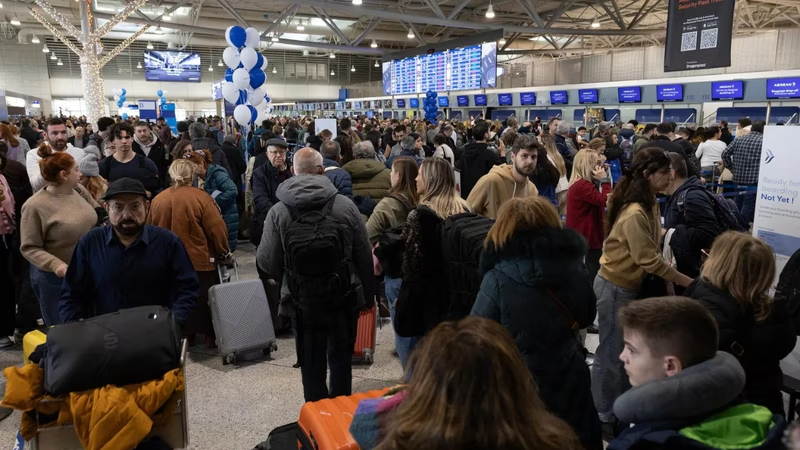
Behind the technical jargon and official statements are the stories of thousands of real people whose lives were thrown into disarray. Airports across Greece, especially Athens International, became scenes of overcrowded terminals and long, frustrated queues .
Travelers faced hours of uncertainty with little information. Many were left to find their own solutions for accommodation, food, and rescheduling, often at significant personal cost. For tourists on tight itineraries, the disruption meant the potential loss of precious vacation days. The incident also highlights a critical gap in passenger rights during large-scale, non-weather-related technical failures, an area that may need new regulatory attention from the EU.
Official Response and Airspace Recovery
The Hellenic Civil Aviation Authority acted swiftly to contain the crisis. They announced that the airspace would remain closed until the issue was fully resolved, with a target of a 4 PM reopening . During the closure, only a few aircraft already in flight were handled for emergency landings, often using backup communication procedures or landing “manually” .
The recovery process was complex. Once a single, reliable frequency was restored, a massive effort began to clear the backlog of grounded planes and integrate the diverted flights back into the European air traffic network, which is already operating near capacity according to Eurocontrol . The public broadcaster ERT confirmed that technical teams worked tirelessly to restore the aeronautical communication systems .
Broader Implications for European Airspace
This incident isn’t just a Greek problem; it’s a European one. The Athens FIR is a crucial corridor for flights between Europe, the Middle East, and North Africa. Its sudden closure created a ripple effect across the continent’s air traffic management system, managed in part by Eurocontrol .
With European air traffic volumes projected to reach 11 million flights this year , the system has little resilience for such a total failure in a key node. This event underscores an urgent need for more robust, redundant, and perhaps even decentralized communication systems within national ATC networks to prevent a single point of failure from grounding an entire country. It also raises serious questions about the preparedness of national aviation authorities for sophisticated electronic or cyber threats.
Conclusion: A Wake-Up Call for Aviation Security
The “very serious” Greece flight grounding was a stark reminder of how vulnerable our modern, interconnected world truly is. A single, unexplained technical glitch in a radio system brought a nation’s skies to a halt, disrupted thousands of lives, and sent shockwaves through the European aviation industry. While the immediate crisis has passed, the underlying causes must be thoroughly investigated. For travelers, this event is a lesson in the importance of flexible travel insurance and patience. For the aviation world, it’s a critical wake-up call to invest in more resilient and secure infrastructure. Stay informed about potential disruptions with our guide to [INTERNAL_LINK:travel_insurance_europe].
Sources
- Radio frequency problem severely disturbs air traffic in Greece – ERT
- Chaos in Greek airspace as Athens FIR restores systems – Ekathimerini
- Summer FlashBriefing: A complex week for European airspace – Eurocontrol
- Hellenic Civil Aviation Authority (HCAA)
- Greece forced to close entire airspace with all flights in and out suspended – Reuters