Table of Contents
- Why the India-EU FTA Matters More Than Ever
- Goyal in Brussels for Decisive Talks
- The Sticking Points: Carbon Tariffs and Market Access
- What India Wants from the EU
- What the EU Wants from India
- Economic Impact: A $200 Billion Opportunity
- Conclusion: Can Both Sides Compromise in Time?
- Sources
After nearly two decades of on-and-off negotiations, the India-EU FTA is finally at a crossroads. This week, Union Commerce Minister Piyush Goyal lands in Brussels for what officials on both sides are calling the “final and most critical” round of talks. With geopolitical realignments accelerating and global trade under pressure, the stakes couldn’t be higher.
The proposed free trade agreement between the world’s largest democracy and its richest trading bloc promises to unlock over $100 billion in bilateral trade—yet it remains hostage to thorny disagreements on climate policy, agricultural protections, and digital regulations. As Goyal meets his European counterparts, the world watches to see if diplomacy can triumph over deadlock.
Why the India-EU FTA Matters More Than Ever
Trade between India and the EU stood at €124 billion in 2024, making the EU India’s third-largest trading partner. But this relationship is lopsided: while India exports pharmaceuticals, textiles, and IT services, it imports high-value machinery, chemicals, and automobiles. An FTA would level the playing field by eliminating tariffs on over 90% of goods.
More importantly, in a world fracturing into rival economic blocs—US-led, China-centric, and now EU-anchored—the India-EU partnership represents a strategic alignment of democratic, rules-based economies. As one EU diplomat put it, “This isn’t just about trade. It’s about building resilience against economic coercion” .
Goyal in Brussels for Decisive Talks
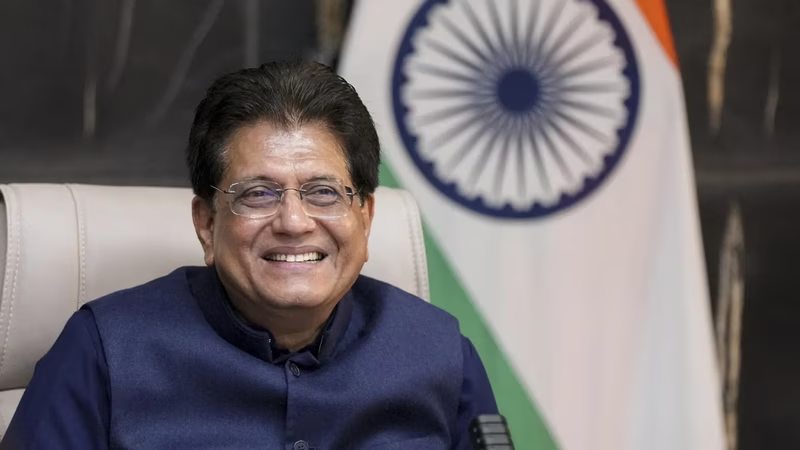
Piyush Goyal’s visit comes after 22 formal negotiation rounds since talks resumed in 2022. Both sides have agreed to “intensify engagement” and aim for a political-level closure by mid-2026. Goyal is expected to meet European Commission Vice-President Valdis Dombrovskis and Trade Commissioner Maroš Šefčovič in high-stakes sessions focused on closing the last gaps.
“We are in the final stretch,” Goyal told reporters before departure. “There is goodwill on both sides, but we must ensure the outcome is balanced and mutually beneficial.” His tone reflects India’s firm stance: no deal is better than a bad deal.
The Sticking Points: Carbon Tariffs and Market Access
Despite progress, two issues remain explosive:
The EU’s Carbon Border Adjustment Mechanism (CBAM)
The EU’s new climate law imposes a carbon tariff on imports of steel, aluminum, cement, and fertilizers from countries with weaker emissions standards. India—still heavily reliant on coal—fears this could cost its exporters up to $4–5 billion annually .
India argues that CBAM is discriminatory and violates WTO principles. It’s pushing for exemptions, phase-in periods, or recognition of its own green initiatives like the Green Credits Programme. The EU, however, insists CBAM is non-negotiable—it’s central to its “Fit for 55” climate agenda.
EU Agricultural Protections and Indian Service Providers
The EU refuses to lower tariffs on sensitive farm products like dairy, wine, and olive oil—fearing backlash from its own farmers. Meanwhile, India wants easier visa access for its IT and healthcare professionals, a demand the EU resists due to domestic labor concerns.
What India Wants from the EU
India’s priority list includes:
- Tariff elimination on key exports like textiles, gems & jewelry, and auto components.
- Greater market access for Indian generic medicines and IT services.
- Relaxation of Geographical Indications (GI) rules that restrict Indian products like Basmati rice and Darjeeling tea.
- Recognition of data protection equivalence to ease digital trade flows [INTERNAL_LINK:india-eu-data-sharing-agreement].
Delivering on these would boost millions of Indian MSMEs and service exporters.
What the EU Wants from India
The European side is pushing for:
- Lower tariffs on cars, wines, and machinery (currently up to 100% on EU automobiles).
- Stronger IPR enforcement to protect European brands and patents.
- Regulatory alignment on digital services, sustainability standards, and food safety.
- Commitments on labor rights and environmental protections as part of the trade framework.
For the EU, this deal is also a geopolitical counterweight to China’s growing influence in Asia.
Economic Impact: A $200 Billion Opportunity
According to a 2025 study by the European Commission, a comprehensive India-EU FTA could:
- Increase EU exports to India by 20% ($17 billion annually).
- Boost Indian exports to the EU by 35% ($25 billion annually).
- Create over 500,000 new jobs across both economies by 2030.
Sectors like renewable energy, electronics manufacturing, and pharmaceuticals stand to gain the most. For India, it’s a chance to integrate deeper into high-value global supply chains.
Conclusion: Can Both Sides Compromise in Time?
The India-EU FTA is no longer just a trade negotiation—it’s a test of whether democracies can forge pragmatic economic partnerships in an age of climate urgency and strategic competition. Piyush Goyal’s Brussels visit may not yield a final signature, but if both sides show flexibility—especially on CBAM and services mobility—a political agreement could be within reach by year-end.
One thing is clear: the world needs this deal to succeed. Not just for trade, but for trust.