Table of Contents
- Trump’s Bold Claim About Venezuela
- Why Venezuela’s Oil Won’t Flood Global Markets Soon
- How India’s Oil Bill Is Structured
- India’s Minimal Ties to Venezuelan Oil
- Geopolitical Theater vs. Energy Reality
- What Really Drives India’s Fuel Prices
- Conclusion: Why This Doesn’t Change Much for India
- Sources
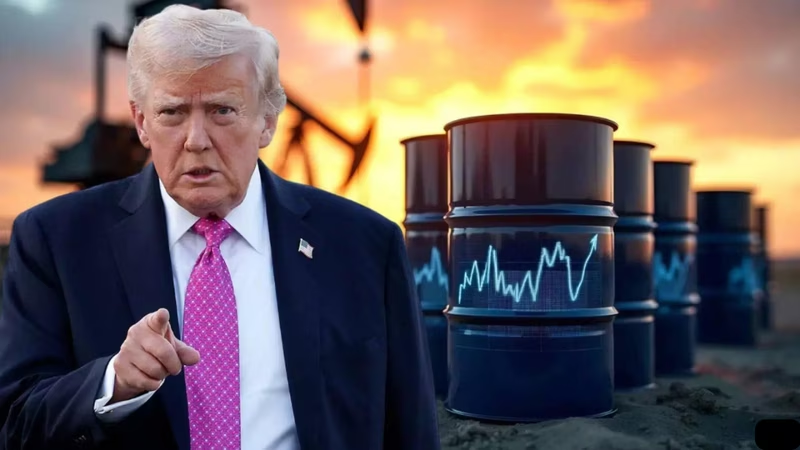
Donald Trump is back in the headlines—and this time, it’s not just about elections or tariffs. In a striking statement, the former U.S. president declared that America would “run” Venezuela and tap into its vast crude oil reserves. Given that Venezuela holds the world’s largest proven oil reserves—more than Saudi Arabia—that sounds like a game-changer, right?
But for India, a nation that imports over 85% of its crude, the reality is far less dramatic. Despite the geopolitical fireworks, India’s oil bill is unlikely to see any meaningful relief from this development. Here’s why Trump’s Venezuela oil gambit is more political theater than a practical solution for global energy markets—and especially for Indian consumers.
Trump’s Bold Claim About Venezuela
During a recent rally, Trump confidently asserted that if re-elected, the U.S. would take “temporary control” of Venezuela to “unlock” its oil wealth, even suggesting that Venezuelan President Nicolás Maduro should be “captured.” The goal? To flood the market with cheap oil and reduce American—and by extension, global—fuel prices.
On paper, it sounds plausible. Venezuela’s Orinoco Belt contains an estimated 300 billion barrels of proven reserves, the largest in the world. But oil in the ground isn’t the same as oil in the tank—especially in a country ravaged by economic collapse, U.S. sanctions, and decades of underinvestment.
Why Venezuela’s Oil Won’t Flood Global Markets Soon
The idea that Venezuela can quickly ramp up production ignores harsh operational realities. Its oil infrastructure is in shambles. According to the U.S. Energy Information Administration (EIA), Venezuela’s output has plummeted from a peak of 3.2 million barrels per day (bpd) in the early 2000s to just around 700,000–800,000 bpd in 2024 .
Reviving production isn’t just a matter of political will—it requires billions in investment, skilled labor, spare parts, and time. Even under a stable, pro-Western government, analysts estimate it would take **5–10 years** to meaningfully increase output. And that’s assuming sanctions are fully lifted and international oil majors return—a big “if.”
As one expert from the Center on Global Energy Policy at Columbia University notes, “Venezuela’s oil is heavy, sour, and expensive to refine. It’s not the light, sweet crude that most refiners prefer—especially in Asia” .
How India’s Oil Bill Is Structured
To understand why Venezuela’s oil woes (or promises) don’t impact India’s oil bill, you need to look at where India actually buys its crude.
India is the world’s third-largest oil importer, spending over $100 billion annually on crude. But its sourcing is highly diversified:
- Russia: Now the top supplier (over 35% of imports), especially since discounted deals post-Ukraine war.
- Iraq & Saudi Arabia: Traditional pillars, together accounting for nearly 30%.
- United Arab Emirates, USA, Nigeria: Growing or steady contributors.
- Venezuela: Effectively **zero** in recent years.
Thanks to smart procurement strategies and long-term contracts, India has insulated itself from overreliance on any single source—a lesson learned from past oil shocks.
India’s Minimal Ties to Venezuelan Oil
India did import some Venezuelan crude in the 2010s, but that ended when U.S. sanctions intensified under the Trump and Biden administrations. Indian refiners—like Reliance and Nayara Energy—quickly pivoted to alternatives, especially Russian Urals and Middle Eastern grades.
Even if Venezuela’s oil becomes freely available tomorrow, Indian refiners are already locked into cost-effective, logistically efficient supply chains. Reintroducing a complex, high-sulfur crude like Venezuela’s Merey would require refinery upgrades and new logistics—adding cost, not savings.
As one oil analyst in Mumbai put it, “Why switch to a problematic barrel when you’re already getting reliable, discounted Russian crude at your doorstep?” [INTERNAL_LINK:india-russia-oil-deal]
Geopolitical Theater vs. Energy Reality
Trump’s Venezuela comments must be seen in context: they’re campaign rhetoric aimed at U.S. voters worried about gas prices. But translating that into actual policy—even if he wins—is a different story.
A U.S. military or administrative “takeover” of Venezuela is legally dubious, diplomatically explosive, and logistically near-impossible. Even if Washington eases sanctions, it won’t magically rebuild Petróleos de Venezuela (PDVSA), the state-owned oil company mired in corruption and mismanagement.
For India, this is a distant geopolitical sideshow—not a market-moving event.
What Really Drives India’s Fuel Prices
If you’re waiting for cheaper fuel at the pump because of Trump’s Venezuela plan, don’t hold your breath. India’s oil bill is shaped by far more immediate factors:
- Brent crude prices: Global benchmark that sets the base cost.
- Exchange rates: A weaker rupee makes imports costlier.
- Logistics & refining margins: Shipping and processing costs.
- Domestic taxes: Central and state levies make up over 50% of retail fuel prices.
Venezuelan oil—years away from meaningful production—doesn’t even make this list.
Conclusion: Why This Doesn’t Change Much for India
Trump’s Venezuela oil fantasy may dominate headlines, but it won’t move the needle on India’s oil bill. The combination of Venezuela’s crippled infrastructure, India’s diversified import strategy, and the long timeline for any production rebound means this is a non-issue for Indian energy security. The real story isn’t about untapped reserves—it’s about how India has strategically navigated global oil turbulence to keep its economic engine running. That’s the kind of energy policy that actually matters.
Sources
- Times of India: Trump says US to ‘run’ Venezuela, tap its crude
- U.S. Energy Information Administration (EIA) – Venezuela Country Analysis
- Meer: Venezuela’s Oil Industry – A Brief History
- Center on Global Energy Policy, Columbia University
- Press Information Bureau, Government of India – Oil Import Data