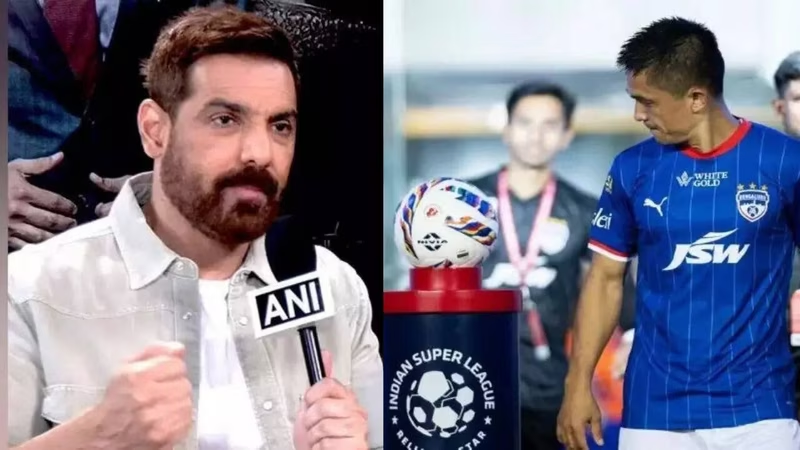
Indian football is at a crossroads—and not the kind that leads to glory. In a heartbreaking turn of events, the 2025–26 Indian Super League (ISL) season has been **indefinitely suspended**, throwing the careers of hundreds of players into chaos and the future of the sport into uncertainty. The trigger? A bitter, unresolved dispute over the **Master Rights Agreement** between the All India Football Federation (AIFF) and the league’s commercial stakeholders.
Now, high-profile voices are joining the outcry. Actor and football advocate **John Abraham**—who once owned an ISL franchise—has called the situation a **“shame on us,”** echoing the anguish of players who warn the sport faces “permanent paralysis” if immediate action isn’t taken.
Even greater alarm comes from the players themselves. National legend **Sunil Chhetri**, along with over 50 current and former professionals, has sent a formal plea to **FIFA**, urging the world governing body to step in before the damage becomes irreversible.
Table of Contents
- What Is the Indian Football Crisis All About?
- Indian Football Crisis: John Abraham’s Emotional Response
- Players’ Plea to FIFA: Sunil Chhetri Leads the Charge
- The Master Rights Agreement Dispute Explained
- What the AIFF Says—and What’s Next
- Historical Context: India’s Recurring Football Governance Issues
- Conclusion: Can Indian Football’s Reputation Survive This?
- Sources
What Is the Indian Football Crisis All About?
At its core, the Indian football crisis stems from a breakdown in negotiations over the **Master Rights Agreement (MRA)**—a critical contract that governs broadcasting, sponsorship, and commercial rights for Indian football, including the ISL and national team matches.
With the previous MRA expiring in 2024, the AIFF and the league’s promoter, Football Sports Development Limited (FSDL), have failed to agree on revenue sharing, governance roles, and long-term vision. Talks have stalled for months, and with no resolution in sight, the AIFF made the controversial decision to **suspend the upcoming ISL season**.
This isn’t just about delayed kick-offs—it’s about livelihoods. Players haven’t received contracts. Coaches are unemployed. Grassroots academies are losing funding.
Indian Football Crisis: John Abraham’s Emotional Response
John Abraham, who owned **NorthEast United FC** from 2014 to 2021, took to social media to express his dismay: “This is a shame on us. We had momentum. We had hope. And now we’re letting bureaucracy and ego destroy it all.”
His words carry weight. Abraham invested not just money but passion into building a football culture in India. Seeing the sport regress after years of progress—driven by ISL’s initial success—has left him and many fans disillusioned.
For a deeper look at how celebrity ownership shaped the ISL’s early years, see [INTERNAL_LINK:celebrity-owners-impact-on-indian-super-league].
Players’ Plea to FIFA: Sunil Chhetri Leads the Charge
In an unprecedented move, players have bypassed domestic channels and appealed directly to FIFA. Their letter states:
“Without immediate intervention, Indian football faces permanent paralysis. We are not just unemployed—we are watching our dreams evaporate.”
Signed by icons like **Chhetri**, **Gurpreet Singh Sandhu**, and rising stars such as **Liston Colaco**, the plea warns that a lost season could trigger a **mass exodus** of talent to other sports or abroad—depleting India’s already thin player pool ahead of crucial World Cup qualifiers.
The Master Rights Agreement Dispute Explained
Here’s a simplified breakdown of the key sticking points:
- Revenue Split: AIFF wants a larger share to fund grassroots programs; FSDL argues it bears most commercial risk.
- Decision-Making Power: Who controls fixture dates, team approvals, and marketing? Both sides claim authority.
- Duration: AIFF seeks a 10-year deal for stability; FSDL prefers shorter, flexible terms.
Without compromise, the deadlock continues—and the calendar ticks closer to the point of no return.
What the AIFF Says—and What’s Next
The AIFF maintains it’s “working tirelessly” to resolve the issue. In a recent statement, it announced that a **new ISL start date will be declared next week**, suggesting negotiations may be nearing a breakthrough.
However, players remain skeptical. “Promises won’t pay our rent,” said one ISL midfielder anonymously. “We need signed contracts, not press releases.”
FIFA has yet to respond publicly but is monitoring the situation closely. Under its statutes, it can intervene in cases of “serious governance failure”—a threshold many believe has now been crossed.
Historical Context: India’s Recurring Football Governance Issues
This isn’t the first time Indian football has been derailed by infighting. From the **2017 AIFF presidential crisis** to the **2022 FIFA suspension** over third-party interference, governance has long been the sport’s Achilles’ heel.
Each time, progress is made—only to be undone by ego, legal battles, or lack of long-term vision. As noted by the FIFA Governance Office, sustained development requires “stable, transparent, and independent administration”—something India has struggled to institutionalize.
Conclusion: Can Indian Football’s Reputation Survive This?
The phrase “Indian football crisis” has become tragically familiar. But this moment may be the most critical yet. With global attention increasingly on South Asian football—and India’s population offering unmatched potential—the stakes couldn’t be higher.
John Abraham’s “shame on us” isn’t just anger—it’s a plea for accountability. If stakeholders don’t act swiftly and selflessly, the dream of a vibrant Indian football ecosystem may fade not with a whimper, but with a bureaucratic shrug.
Sources
Times of India. (2026, January 4). ‘Shame on us’: John Abraham reacts to Indian football crisis. https://timesofindia.indiatimes.com/…
The Hindu. (2026). Indian players appeal to FIFA over ISL suspension. https://www.thehindu.com/…
ESPN India. (2026). Master Rights Agreement: What’s holding up ISL 2025–26? https://www.espn.in/…
FIFA Official Governance Guidelines