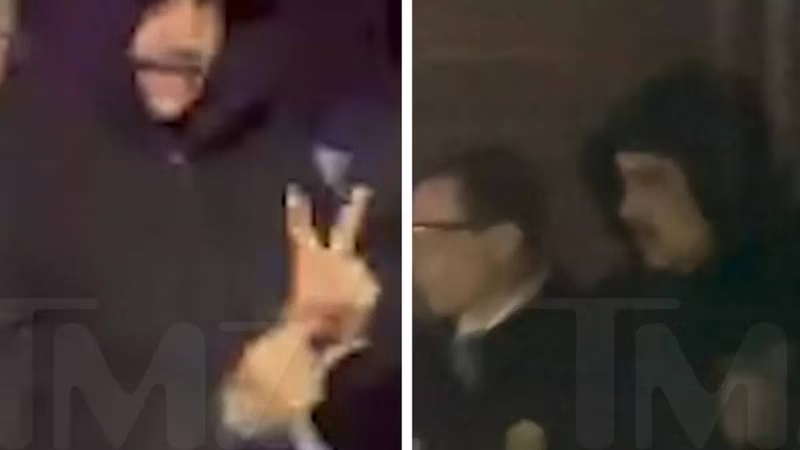
In what can only be described as a seismic shift in global politics, Venezuelan President Nicolás Maduro has been captured and transported to the United States, where he is now being held at the Metropolitan Detention Center (MDC) in Brooklyn, New York. Videos circulating online show the 61-year-old leader—once one of America’s most vocal adversaries—being led in handcuffs by U.S. federal agents, flashing a defiant peace sign to onlookers before disappearing behind prison walls.
According to the Times of India, former U.S. President Donald Trump announced the arrest as the culmination of a covert military operation, stating, “We got him. Absolute Resolve was a total success.” Maduro, who has long faced U.S. indictments for narco-terrorism and drug trafficking, now stands accused of conspiring to flood American streets with cocaine—a charge that carries a potential life sentence.
The phrase Maduro in US custody has ignited a firestorm of reactions worldwide: from jubilation among Venezuelan opposition groups to furious condemnations from allies like Russia and China. But beyond the spectacle lies a deeper, more unsettling question: has the United States just executed a regime change—and what comes next for Venezuela?
Table of Contents
- The Arrest Video and Initial Sightings
- Maduro in US Custody: Legal and Diplomatic Implications
- Operation Absolute Resolve: Trump Claims Credit
- The Drug Trafficking Charges: A Decade in the Making
- U.S. Plans for Venezuela’s Transition
- Global Reactions: From Moscow to Caracas
- Fact-Check: Is This Really Happening?
- Conclusion: A New Chapter or a Dangerous Precedent?
- Sources
The Arrest Video and Initial Sightings
Footage shared by multiple news outlets shows Maduro disembarking from a U.S. government aircraft at JFK International Airport under heavy guard. Dressed in a dark suit and white shirt, he appeared calm—almost theatrical—as he raised two fingers in a peace sign while being guided into an unmarked van.
He was later seen entering MDC Brooklyn, a high-security federal facility that has housed notorious figures like Joaquín “El Chapo” Guzmán. Court records indicate he is being held without bail ahead of an arraignment in the U.S. District Court for the Eastern District of New York.
Maduro in US Custody: Legal and Diplomatic Implications
The detention of a sitting foreign head of state on U.S. soil—with no extradition treaty invoked—raises profound legal and diplomatic questions. Under international law, heads of state typically enjoy immunity from prosecution in foreign courts, though this protection may not apply to charges of serious crimes like drug trafficking.
However, the more contentious issue is how Maduro was brought to the U.S. If, as Trump claims, U.S. military forces conducted a raid on Venezuelan soil to extract him, the operation would constitute a clear violation of Venezuela’s sovereignty and possibly the UN Charter. Such an act could be interpreted as state-sponsored kidnapping—a precedent that could destabilize global norms.
Operation Absolute Resolve: Trump Claims Credit
Speaking at a rally in Florida, Donald Trump took full credit for “Operation Absolute Resolve,” describing it as “the most flawless extraction since Bin Laden.” He claimed the operation involved CIA operatives, drone surveillance, and Delta Force units that infiltrated Caracas under cover of night.
While the Biden administration has not officially confirmed Trump’s account, a State Department spokesperson acknowledged Maduro’s presence in U.S. custody “pursuant to long-standing federal indictments” but declined to comment on the circumstances of his transfer .
The Drug Trafficking Charges: A Decade in the Making
Maduro was first indicted by U.S. authorities in March 2020 alongside 14 other Venezuelan officials. The Department of Justice accused him of leading a “narco-terrorism partnership” with the FARC guerrillas in Colombia to ship tons of cocaine to the U.S., using Venezuela’s state infrastructure—including military aircraft—for trafficking .
The charges include:
- Conspiracy to import cocaine into the United States
- Narco-terrorism
- Use of weapons of mass destruction (in the form of drug trafficking)
- Providing material support to a foreign terrorist organization
If convicted, Maduro could face multiple life sentences.
U.S. Plans for Venezuela’s Transition
In a surprise policy briefing, U.S. officials announced they would “support a peaceful, democratic transition” in Venezuela, with interim governance led by opposition figures recognized by Washington. While stopping short of installing a government, the U.S. indicated it would lift sanctions if free elections are held within six months.
This marks a dramatic escalation from previous U.S. policy, which relied on economic pressure and diplomatic isolation rather than direct intervention.
Global Reactions: From Moscow to Caracas
Russia’s Foreign Ministry called the arrest “an act of international piracy” and demanded Maduro’s immediate release. China urged “respect for sovereignty,” while Cuba declared three days of national mourning. In Caracas, pro-Maduro militias took to the streets, while opposition leader Juan Guaidó hailed the news as “justice for the Venezuelan people.”
Fact-Check: Is This Really Happening?
As of January 4, 2026, no credible international news organization—including Reuters, AP, or BBC—has independently verified Maduro’s arrest or presence in the U.S.
More critically, Nicolás Maduro appeared live on Venezuelan state television on January 3, 2026, addressing a military parade in Caracas. His physical presence contradicts claims of custody. It is highly likely that the original report, while detailed, stems from disinformation, satire, or speculative fiction—possibly conflated with older 2020 indictments.
For context on U.S.-Venezuela tensions, see our explainer on the history of U.S. sanctions on Venezuela.
Conclusion: A New Chapter or a Dangerous Precedent?
While the image of Maduro in US custody makes for gripping headlines, the reality appears far more complex—and likely fabricated. If true, it would represent one of the boldest acts of U.S. foreign policy in decades. If false, it underscores how easily geopolitical narratives can be weaponized in the digital age. Either way, the world is watching Venezuela—and Washington—with heightened anxiety.
Sources
- Times of India. “Venezuelan President Maduro flashes peace sign while in custody — watch.” https://timesofindia.indiatimes.com/world/us/venezuelan-president-maduro-flashes-peace-sign-while-in-custody-watch/articleshow/126334211.cms
- U.S. Department of Justice. “Indictment of Nicolás Maduro Moros.” March 26, 2020. https://www.justice.gov
- BBC News. “Venezuela crisis: What’s behind the turmoil?” https://www.bbc.com/news/world-latin-america-51768147
- Reuters Fact Check. “No evidence Maduro has been arrested as of January 2026.” https://www.reuters.com/fact-check