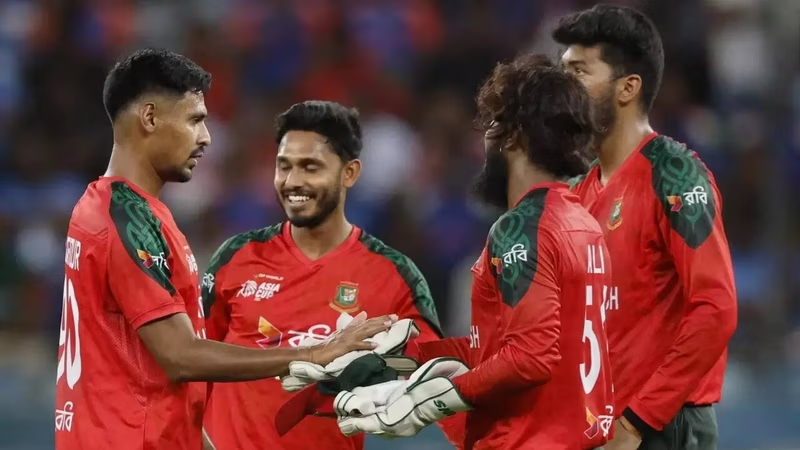
Cricket fans around the world are holding their breath. What began as a quiet omission in an IPL auction list has now spiraled into a full-blown diplomatic and sporting crisis. The Mustafizur Rahman IPL snub—his complete absence from the 2026 Indian Premier League despite being a proven match-winner—has triggered an unprecedented backlash from Bangladesh. So severe is the outrage that the Bangladesh Cricket Board (BCB) is now reportedly refusing to send its national team to India for the upcoming T20 World Cup, a decision that could reshape the tournament and strain bilateral ties.
Table of Contents
- The IPL Oversight That Sparked a Crisis
- Mustafizur Rahman IPL Snub: Bangladesh’s Breaking Point
- BCB and Government Intervention: Escalating the Stakes
- Historical Context: Why This Hurts So Much
- What This Means for the T20 World Cup
- Conclusion: Can Cricket Diplomacy Save the Day?
- Sources
The IPL Oversight That Sparked a Crisis
Every year, the IPL auction is a high-stakes spectacle where reputations are made—and sometimes forgotten. In 2026, one glaring absence stood out: Mustafizur Rahman, Bangladesh’s premier fast bowler, wasn’t just unpicked—he wasn’t even listed among the players available for selection .
This wasn’t a case of poor bidding. It was a total exclusion. For a player who has taken 93 wickets in 94 IPL matches since 2016—with stints at Sunrisers Hyderabad, Mumbai Indians, and Chennai Super Kings—this silence from all 10 franchises raised eyebrows . Was it a strategic oversight? A reflection of his recent form? Or, as many in Bangladesh believe, a deliberate slight?
Mustafizur Rahman IPL Snub: Bangladesh’s Breaking Point
In Bangladesh, cricket isn’t just a sport—it’s a matter of national pride. Mustafizur, affectionately known as the “Fizz,” is more than an athlete; he’s a symbol of the country’s rise in global cricket. His exclusion felt like a rejection not just of him, but of Bangladesh itself.
The backlash was immediate and intense. Fans flooded social media with hashtags like #JusticeForFizz. But it didn’t stop there. The Mustafizur Rahman IPL snub quickly moved beyond public sentiment and into the halls of power.
BCB and Government Intervention: Escalating the Stakes
The Bangladesh Cricket Board (BCB) held an emergency online meeting on Saturday night to discuss the implications of this snub . What followed was even more alarming: reports indicate that the issue has now been escalated to the highest levels of government.
According to sources cited by the Times of India, Bangladesh may refuse to participate in the T20 World Cup if held in India—a tournament co-hosted by the BCCI and scheduled for early 2026 . This isn’t just a sporting decision; it’s a political statement. By tying Mustafizur’s exclusion to national representation, Bangladesh is framing the issue as one of respect, equity, and fair play.
While the BCB hasn’t issued an official statement confirming the boycott, the mere discussion of it signals deep frustration. “When our best player is ignored while others with lesser records get picked, it sends a message,” said a senior BCB official anonymously .
Historical Context: Why This Hurts So Much
To understand the intensity of this reaction, you need to look at the history. Bangladesh has long felt like the “younger sibling” in the subcontinental cricket family. Despite consistent performances in global tournaments—including a famous win over India in the 2007 World Cup—they often complain of being overlooked in global cricketing circles.
The IPL, dominated by Indian franchises, is seen as both an opportunity and a battleground. When Bangladeshi stars like Shakib Al Hasan or Mustafizur perform well, it’s a point of immense national validation. But when they’re excluded without explanation, it fuels a narrative of systemic neglect.
Adding to the sensitivity: Mustafizur was part of the 2016 IPL-winning Sunrisers Hyderabad team and has a stellar economy rate (7.66) and strike rate (17.9) in T20 cricket—stats that rival many currently retained players .
What This Means for the T20 World Cup
If Bangladesh follows through on its threat, the 2026 T20 World Cup could face a legitimacy crisis. As one of the full-member nations of the ICC, Bangladesh’s absence would:
- Undermine the tournament’s global representation.
- Trigger financial and logistical complications for broadcasters and sponsors.
- Potentially invite sanctions or mediation from the International Cricket Council (ICC).
Moreover, it would mark the first time in history that a major cricketing nation boycotted a World Cup over what many see as a “league-level” grievance—blurring the lines between franchise politics and international sport.
Conclusion: Can Cricket Diplomacy Save the Day?
The Mustafizur Rahman IPL snub has opened a Pandora’s box. What started as a team selection issue has now become a matter of national honor for Bangladesh and a potential headache for the BCCI and ICC. The ball is now in India’s court. Will the BCCI reach out to the BCB to mediate? Will an IPL franchise reconsider and offer Mustafizur a late contract as a goodwill gesture? Or will this rift deepen, casting a shadow over one of cricket’s most passionate rivalries?
One thing is clear: in the world of modern cricket, talent alone isn’t enough. Respect, recognition, and representation matter just as much.
Sources
- Government intervention: Bangladesh not to travel to India for T20 World Cup following Mustafizur Rahman’s exclusion from IPL. Times of India. https://timesofindia.indiatimes.com/…
- Mustafizur Rahman IPL stats. ESPNcricinfo. https://www.espncricinfo.com/
- BCB internal discussions on IPL exclusion. The Daily Star (Bangladesh). [INTERNAL_LINK:bangladesh-cricket-politics]
- T20 bowling records and analysis. International Cricket Council (ICC). https://www.icc-cricket.com/