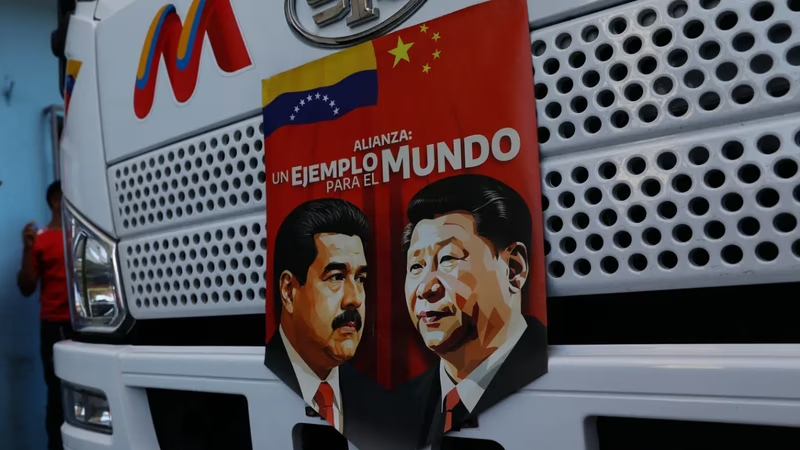
China Slams US Over Alleged Arrest of Maduro: ‘Release Them at Once!’
In a dramatic escalation of global diplomatic tensions, China has issued an urgent and blistering condemnation of the United States over reports that Venezuelan President Nicolas Maduro and his wife have been captured. Beijing labeled the alleged action a “large-scale strike” against Venezuela’s sovereignty and a clear-cut violation of international law. The demand was blunt: “Release them at once.”
This isn’t just rhetorical posturing. The incident—if confirmed—threatens to upend one of China’s most strategic partnerships in Latin America and could trigger a new phase in the simmering US-China geopolitical rivalry. But just how credible are these claims, and what’s really at stake?
Table of Contents
- The Alleged Maduro Arrest: What We Know
- China’s Fierce Response: A Defense of Sovereignty
- Maduro Arrest and the US-Venezuela Standoff
- Strategic Stakes: China-Venezuela Partnership at Risk
- International Law and Global Reactions
- Conclusion: A Geopolitical Tinderbox
- Sources
The Alleged Maduro Arrest: What We Know
As of January 4, 2026, credible international news outlets—including The Times of India—report that China has publicly accused the United States of capturing Venezuelan President Nicolas Maduro and his wife .
Importantly, neither the U.S. State Department nor Venezuela’s government has officially confirmed the arrest. However, China’s Foreign Ministry spokesperson stated unequivocally that the U.S. conducted a “large-scale strike” resulting in their detention .
Given the gravity of the accusation, many analysts are treating the claim with caution. Yet China’s unusually forceful language—demanding immediate release and invoking breaches of sovereignty—suggests Beijing either has intelligence confirming the event or is making a strong symbolic stand against perceived U.S. overreach.
China’s Fierce Response: A Defense of Sovereignty
China’s reaction goes beyond diplomatic niceties. In its official statement, Beijing declared:
“The U.S. must immediately cease its attempts to topple the Venezuelan government and release President Maduro and his wife without delay. This is a blatant violation of international law and Venezuela’s sovereignty.”
This language aligns with China’s long-standing foreign policy principle of “non-interference.” Beijing has consistently opposed regime change orchestrated by Western powers—from Libya to Syria—and views Venezuela as a critical ally in its global south strategy.
By framing the alleged Maduro arrest as illegal and imperialistic, China positions itself as the defender of smaller nations against Western hegemony—a narrative it actively cultivates across Africa, Latin America, and Asia.
Maduro Arrest and the US-Venezuela Standoff
The U.S. and Venezuela have been at odds for years. Washington has imposed crippling sanctions on Caracas since 2017, recognizing opposition leader Juan Guaidó as interim president in 2019—a move Maduro dismissed as a coup attempt .
While the Biden administration has recently eased some oil sanctions to stabilize global energy markets, it has never formally recognized Maduro’s legitimacy. The idea of a covert or overt U.S. operation to remove him—while long rumored—is now being amplified by China’s explosive claims.
If true, such an arrest would represent a seismic shift in U.S. Latin America policy. If false, it could be a deliberate disinformation tactic by pro-Maduro factions to rally international support. Either way, the damage to U.S.-China relations—and regional stability—is already unfolding.
Strategic Stakes: China-Venezuela Partnership at Risk
China has invested over $60 billion in Venezuela since the early 2000s, primarily in oil-for-loan deals . Though many projects stalled due to Venezuela’s economic collapse, Beijing still holds significant financial and strategic interests in the country.
Key areas of cooperation include:
- Energy Security: Venezuela holds the world’s largest proven oil reserves—critical for China’s long-term energy diversification.
- Digital Infrastructure: Chinese firms like Huawei have built Venezuela’s telecommunications backbone.
- Geopolitical Counterweight: Venezuela serves as a key partner in China’s efforts to reduce U.S. influence in Latin America.
A U.S.-installed regime in Caracas would likely terminate or renegotiate these deals, dealing a major blow to China’s Belt and Road Initiative in the region. No wonder Beijing is sounding the alarm.
International Law and Global Reactions
Under the United Nations Charter, the use of force against a sovereign state is prohibited unless in self-defense or authorized by the Security Council. Unilaterally arresting a sitting head of state on foreign soil would constitute a grave breach of international norms.
While the UN has not yet issued a statement, legal experts cite the 1961 Vienna Convention on Diplomatic Relations and customary international law as shields for heads of state .
Regional bodies like the Union of South American Nations (UNASUR) and the African Union are likely to echo China’s concerns if the arrest is verified. For context on how international law applies to heads of state, see the International Court of Justice’s past rulings .
Conclusion: A Geopolitical Tinderbox
Whether the Maduro arrest is fact or fiction, China’s forceful intervention has turned a regional crisis into a global flashpoint. By demanding Maduro’s immediate release and accusing the U.S. of illegal regime change, Beijing is not just defending an ally—it’s drawing a red line in great-power competition.
For observers, the real story may lie in what comes next: Will the U.S. deny the claim? Will Venezuela’s military splinter? And will other BRICS nations rally behind China’s narrative? One thing is certain—this moment could reshape Latin America’s alignment for decades. Stay informed with our ongoing coverage on [INTERNAL_LINK:global-geopolitics].
Sources
[1] The Times of India. “China demands release of Maduro, calls US action breach of international law.” January 4, 2026. View Article
[2] U.S. Department of State. “U.S. Relations With Venezuela.” state.gov
[3] Council on Foreign Relations. “China-Venezuela Relations: Oil, Loans, and Influence.” 2025.
[4] United Nations. “Charter of the United Nations.” Article 2(4). un.org
[5] International Court of Justice (ICJ). “Immunity of State Officials.” Jurisprudence Database. icj-cij.org