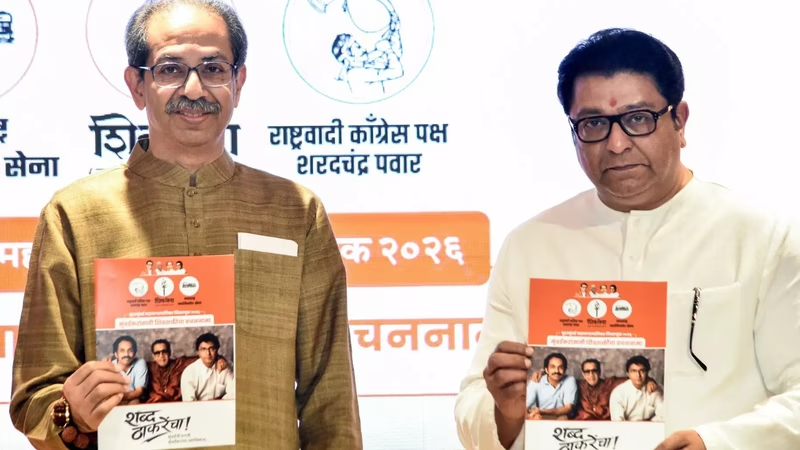
After years of bitter rivalry, ideological splits, and courtroom battles, the Thackeray brothers have done the unthinkable: they’ve joined hands.
Uddhav Thackeray (Shiv Sena UBT) and Raj Thackeray (Maharashtra Navnirman Sena) stood side by side in Mumbai on Sunday to unveil their joint manifesto—‘Vachan Nama’—for the upcoming Brihanmumbai Municipal Corporation (BMC) elections. And at the heart of their historic alliance? A bold, emotionally charged promise: “The next Mayor of Mumbai will be Marathi.”
The announcement has sent shockwaves through Maharashtra’s political landscape. Once bitter adversaries—Uddhav accusing Raj of “splitting the Marathi vote,” Raj labeling Uddhav as “compromised”—the brothers now present a united front against what they call “outsider dominance” and “BMC apathy.” This reunion isn’t just symbolic; it’s a calculated move to reclaim Mumbai’s civic soul—and its political future.
Table of Contents
- The Thackeray Brothers BMC Polls Manifesto Unveiled
- Why a ‘Marathi Mayor’ Matters in Mumbai’s Politics
- Key Promises in the ‘Vachan Nama’
- The Strategic Reunion: Why Now?
- Opposition Reactions and Public Response
- Can This Alliance Hold Through the Elections?
- Conclusion
- Sources
The Thackeray Brothers BMC Polls Manifesto Unveiled
Dubbed ‘Vachan Nama’ (The Promise Charter), the 28-point manifesto blends Uddhav’s governance experience with Raj’s grassroots Marathi assertiveness. Launched at a packed event in Dadar—the historic heart of the Sena movement—the document pledges to “restore Mumbai to its rightful owners: the Marathi manoos.”
The most headline-grabbing vow? That the next Mayor of Mumbai—currently an apolitical, rotational post—will be a Marathi-speaking Mumbaikar, chosen through a transparent internal consensus between the two factions. “For too long, the Mayor’s chair has been a rubber stamp,” Uddhav declared. “We will make it a symbol of Marathi pride.”
Raj, standing just feet away, added: “This isn’t about division. It’s about dignity.”
Why a ‘Marathi Mayor’ Matters in Mumbai’s Politics
At first glance, the Mayor of Mumbai holds limited executive power—the real authority lies with the Municipal Commissioner, an IAS officer. But symbolically, the role is potent:
- It’s the public face of the city’s civic body.
- It presides over debates, sets agendas, and represents Mumbai nationally.
- Historically, Mayors have come from diverse communities—Gujarati, Muslim, Dalit—but rarely from the core Marathi working class that the Sena claims to represent.
By demanding a Marathi Mayor, the Thackerays are tapping into deep-seated anxieties about cultural erosion, housing displacement, and economic marginalization in a city where nearly 60% of residents are migrants.
As political analyst Dr. Pradeep Chakraborty notes, “This isn’t just policy—it’s identity politics weaponized for electoral gain.”
Key Promises in the ‘Vachan Nama’
Beyond the Marathi Mayor pledge, the manifesto includes concrete civic commitments:
- Affordable Housing for Locals: 50,000 new tenements exclusively for Marathi families with 15+ years in Mumbai.
- Slum Rehabilitation Overhaul: Faster redevelopment with stronger tenant rights and no private builder monopolies.
- Flood-Proof Infrastructure: Complete revamp of drainage systems ahead of 2027 monsoons.
- Local Job Quota: 85% of new BMC contractual jobs reserved for Marathi youth.
- Heritage Revival: Restoration of Marathi cultural landmarks like Shivaji Park and Wankhede’s old pavilion.
Notably absent? Direct attacks on Prime Minister Modi or CM Eknath Shinde—suggesting the alliance wants to stay narrowly focused on civic, not national, issues.
The Strategic Reunion: Why Now?
This reconciliation didn’t happen in a vacuum. Three factors forced the Thackeray brothers back together:
- Electoral math: Split votes in 2022 BMC by-elections cost both factions dearly. United, they control nearly 40% of the Marathi vote.
- Rising MNS influence: Raj’s grassroots work has made him a kingmaker—Uddhav can’t afford to ignore him.
- 2029 state elections: This BMC alliance is a dress rehearsal for a bigger comeback against the BJP-Shinde combine.
For more on Maharashtra’s evolving political map, see our deep dive on [INTERNAL_LINK:maharashtra-2029-election-forecast].
Opposition Reactions and Public Response
The BJP and Eknath Shinde’s Shiv Sena (SHS) have dismissed the ‘Vachan Nama’ as “desperate theatrics.” BJP Mumbai chief Ashish Shelar called it “a photo-op between estranged brothers with no administrative vision.”
Meanwhile, the public response has been mixed. On social media, #VachanNama trended for hours, with Marathi netizens praising the unity—but critics warn of “xenophobic overtones.”
At local tea stalls in Matunga and Andheri, however, the mood is hopeful. “If they can work together, maybe our roads will finally get fixed,” said Vikas Desai, a small shop owner.
Can This Alliance Hold Through the Elections?
History isn’t on their side. The Thackeray family has a long record of alliances that collapse under pressure. Key challenges ahead:
- Candidate selection: Will Uddhav’s UBT or Raj’s MNS get more tickets?
- Ideological friction: Raj’s hardline rhetoric vs. Uddhav’s softer, inclusive brand.
- BJP’s counter-narrative: Likely to paint the alliance as “anti-national” and “divisive.”
Yet, if they can present a disciplined front, this could be the most significant Marathi consolidation since Bal Thackeray’s era.
Conclusion
The Thackeray brothers BMC polls alliance marks a seismic shift in Mumbai’s political narrative. With the ‘Vachan Nama,’ they’re not just promising better roads and drains—they’re offering a cultural homecoming for the city’s original residents. Whether this reunion is a fleeting truce or the start of a new Marathi renaissance remains to be seen. But one thing is clear: Mumbai’s civic future just got a lot more complicated—and a lot more personal.
Sources
[1] “BMC polls: Thackeray brothers unveil joint manifesto ‘Vachan Nama’,” Times of India
[2] Press Release: Shiv Sena UBT & MNS Joint Manifesto Launch, January 2026
[3] Brihanmumbai Municipal Corporation (BMC) – Mayor Powers and Functions
[4] Election Commission of India – BMC Ward Data 2022
[5] “Marathi Identity and Urban Politics,” Economic & Political Weekly, Vol. 61, No. 4