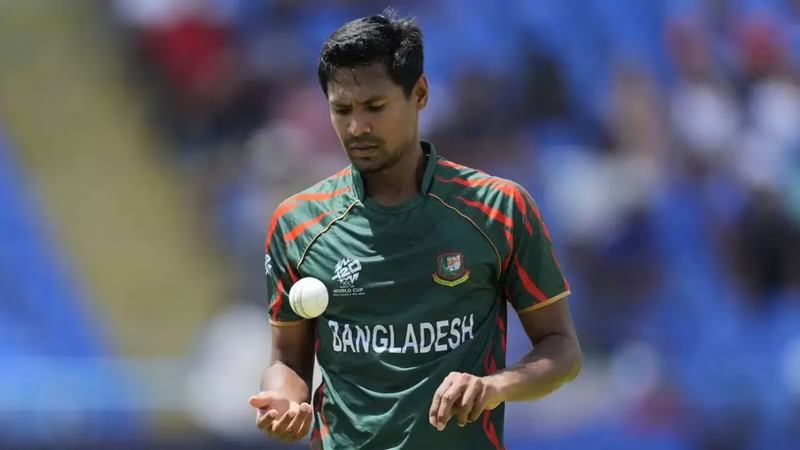
In a dramatic escalation of the ongoing cricketing rift between South Asia’s neighbors, Bangladesh has announced its Bangladesh T20 World Cup squad—but with a major caveat. Citing “serious concerns about players’ safety,” the Bangladesh Cricket Board (BCB) has formally requested the ICC to relocate all of its league-stage matches from India to Sri Lanka.
The move comes directly on the heels of star pacer Mustafizur Rahman’s shocking exclusion from the 2026 Indian Premier League (IPL)—a decision insiders claim was influenced by the Board of Control for Cricket in India (BCCI). Now, with the government in Dhaka allegedly backing the BCB’s stance, the T20 World Cup, co-hosted by India, Sri Lanka, and Bangladesh, faces its biggest political test yet.
What started as a snub in a franchise auction has now spiraled into a full-blown diplomatic and sporting crisis—one that could reshape the tournament’s landscape and strain Indo-Bangla relations for years to come.
Table of Contents
- Bangladesh T20 World Cup Squad Announcement
- The Mustafizur Rahman IPL Controversy Explained
- Why BCB Cites “Safety Concerns”
- Government Role and Diplomatic Undertones
- ICC and BCCI Response
- Impact on T20 World Cup 2026
- Historical Context of Bangladesh-India Cricket Tensions
- Conclusion
- Sources
Bangladesh T20 World Cup Squad Announcement
Despite the turmoil, the BCB unveiled a strong 15-member squad for the ICC Men’s T20 World Cup 2026, led by veteran all-rounder Shakib Al Hasan. The team includes:
- Mustafizur Rahman (despite IPL snub)
- Najmul Hossain Shanto (vice-captain)
- Towhid Hridoy (in-form middle-order batter)
- Rishad Hossain (young leg-spinner)
- Mahmudullah (senior mentor)
Notably, the squad features a balanced mix of youth and experience—on paper, a genuine contender. But its participation hinges on one condition: matches must not be played in India.
The Mustafizur Rahman IPL Controversy Explained
Mustafizur Rahman, a two-time IPL winner with 108 wickets in 98 matches, was left unsold in the 2026 mega auction—a first in his career. While franchises cited “strategic fit” and “salary cap,” multiple reports, including from Times of India, suggest the BCCI quietly discouraged teams from bidding due to “political sensitivities.”
Mustafizur himself has not commented, but sources close to him say he’s “devastated.” In Bangladesh, the snub was seen not as a sporting decision but as a national insult—especially after he’d publicly expressed hope to return to the league.
Why BCB Cites “Safety Concerns”
The BCB’s official statement reads: “Given recent developments and the hostile environment created around our players, we cannot guarantee their physical and mental well-being in India.”
While not explicitly naming Mustafizur, the subtext is clear. The board fears:
- Targeted harassment from sections of the crowd during matches.
- Media vilification that could affect player morale.
- Lack of institutional support from Indian authorities in case of incidents.
Crucially, the BCB claims it received “advisories” from Bangladesh’s Ministry of Foreign Affairs urging caution—a rare level of government involvement in cricket matters.
Government Role and Diplomatic Undertones
This is no longer just a cricketing dispute. Bangladesh’s Sports Ministry has formally instructed the BCB to pursue venue relocation, framing it as a “matter of national dignity.”
Analysts see this as part of a broader recalibration in Dhaka’s foreign policy—pushing back against perceived Indian dominance in regional affairs. With elections approaching, the government appears to be using cricket as a soft-power lever.
As one Dhaka-based diplomat noted: “When a player like Mustafizur is treated as expendable, it sends a message. Bangladesh is saying: we won’t be taken for granted.”
ICC and BCCI Response
The International Cricket Council (ICC) has acknowledged the BCB’s request and confirmed an emergency executive meeting will be held within 72 hours. “Participant safety is non-negotiable,” an ICC spokesperson said.
Meanwhile, the BCCI has denied any role in Mustafizur’s IPL exclusion, calling it “a franchise-level decision.” A senior BCCI official told reporters: “We have always welcomed Bangladeshi teams and fans. This is regrettable and unfounded.”
Still, the damage may already be done.
Impact on T20 World Cup 2026
If the ICC agrees to relocate Bangladesh’s matches, the consequences could be severe:
- Logistical chaos: Reshuffling venues mid-planning affects ticketing, broadcasting, and security.
- Financial loss: India stands to lose millions in expected revenue from Bangladesh-India fixtures.
- Precedent setting: Other nations may demand similar concessions, weakening host authority.
- Competitive fairness: Teams in Bangladesh’s group face uncertainty over match conditions.
Alternatively, if Bangladesh refuses to play in India, it risks forfeiting matches—or even ICC sanctions for political interference.
Historical Context of Bangladesh-India Cricket Tensions
While the two nations share deep cultural ties, cricket has often been a flashpoint:
- 2015 World Cup quarterfinal: Alleged biased umpiring sparked fan riots.
- 2017 ODI series in India: Dhaka crowd backlash led to BCCI warnings.
- IPL representation gap: Only three Bangladeshis have ever been regular IPL players, despite talent.
The Mustafizur snub appears to be the final straw in a long-simmering grievance about unequal access and respect.
For more on how politics shapes cricket, see our feature on [INTERNAL_LINK:geopolitics-in-modern-cricket].
Conclusion
The announcement of the Bangladesh T20 World Cup squad was supposed to be a moment of celebration. Instead, it’s become a referendum on fairness, safety, and sovereignty in international sport. Whether this dispute is resolved through diplomacy or escalates into a full boycott, one truth is undeniable: cricket can no longer hide behind the “gentleman’s game” facade when real-world power dynamics come into play. The world is watching—not just for sixes and wickets, but for how institutions choose to uphold the spirit of the game.
Sources
[1] “Bangladesh announce T20 World Cup squad amid Mustafizur controversy,” Times of India
[2] BCB Official Statement, January 2026
[3] ICC Media Release on T20 World Cup 2026 Venues
[4] “Mustafizur Rahman’s IPL Omission: What Really Happened,” ESPNcricinfo
[5] https://www.icc-cricket.com