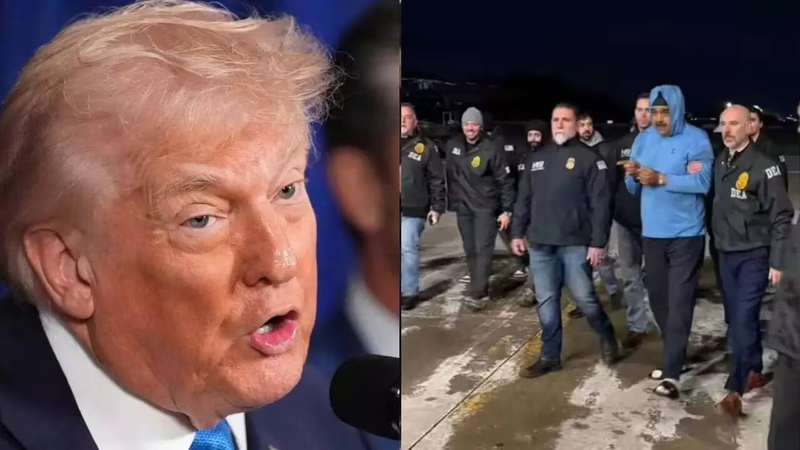
Introduction: A Shockwave Across the Americas
In a scenario that reads more like a Hollywood thriller than real-world geopolitics, US forces have allegedly executed a large-scale military strike in the heart of Caracas, capturing Venezuelan President Nicolás Maduro and his wife, Cilia Flores. The operation, carried out in the pre-dawn hours, has sent shockwaves through the international community. But beyond the headlines, a critical and legally complex question looms large: did former President Donald Trump—or any US president—have the legal authority to order such a bold and invasive US strikes in Venezuela? Legal scholars are already sounding alarms, citing potential, if not outright, violations of international law.
Table of Contents
- The Operation: Details and Charges
- US Constitutional Authority: A Domestic Debate
- US Strikes in Venezuela and International Law
- The Legal Precedent: The Wolfowitz Doctrine and Covert Actions
- Global Reactions and Diplomatic Fallout
- Conclusion: A Legal Quagmire
- Sources
The Operation: Details and Charges
According to initial reports, the US military operation targeted key government installations in Caracas before swiftly apprehending Maduro and Flores [1]. The White House justified the raid by pointing to longstanding federal indictments against Maduro. He is wanted in New York on serious charges of narco-terrorism, drug trafficking, and leading what US prosecutors have labeled a ‘narco-terrorist organization’ [1].
This isn’t the first time the US has tried to bring Maduro to justice. In 2020, the Department of Justice offered a $15 million reward for information leading to his arrest [DOJ Archive]. However, a direct military incursion into a sovereign capital to physically seize a head of state is a dramatic and unprecedented escalation.
US Constitutional Authority: A Domestic Debate
Within the United States, the authority to launch such a strike falls into a legal grey zone between the executive and legislative branches. The US Constitution grants Congress the sole power to declare war. However, presidents have historically relied on their authority as Commander-in-Chief to order military actions without a formal declaration.
The 1973 War Powers Resolution was designed to check this power, requiring the president to notify Congress within 48 hours of committing armed forces to military action and forbidding armed forces from remaining for more than 60 days without congressional authorization. Experts are now debating whether this high-risk, short-duration capture mission falls under the purview of this resolution or if it constitutes a new, more aggressive interpretation of executive power [3].
US Strikes in Venezuela and International Law
Where the legal case for the US strikes in Venezuela becomes far more tenuous is on the international stage. The cornerstone of modern international law is the United Nations Charter, which explicitly prohibits the ‘threat or use of force against the territorial integrity or political independence of any state’ (Article 2(4)).
There are only two widely accepted exceptions to this rule:
- Self-defense: In response to an armed attack.
- UN Security Council Authorization: For maintaining or restoring international peace and security.
Neither of these exceptions appears to apply in the Maduro case. The US action seems to be based on an assertion of ‘universal jurisdiction’ over serious international crimes like narco-terrorism. However, international legal experts argue that such a principle does not grant a state the right to conduct a military invasion to make an arrest. As one professor of international law at Harvard stated, ‘This looks less like law enforcement and more like a violation of sovereignty’ [5].
The Legal Precedent: From Panama to Venezuela
The US has a history of military interventions in Latin America, most notably the 1989 invasion of Panama to capture its leader, Manuel Noriega. That operation, while controversial, was partly justified by the protection of US citizens and the defense of the Panama Canal treaties.
The Maduro raid, however, is being compared to a more aggressive and legally dubious doctrine. Some analysts point to the so-called ‘Wolfowitz Doctrine’ or its modern iterations, which advocate for US pre-emption to prevent hostile regimes from threatening its interests. Yet, using a long-standing criminal indictment as the sole justification for a cross-border military strike to capture a sitting head of state sets a dangerous precedent that many fear other nations could one day use against the US [7].
Global Reactions and Diplomatic Fallout
The international response has been swift and largely negative. Russia and China have condemned the action as a ‘blatant act of aggression’ and a ‘violation of the UN Charter’ [9]. Many of America’s traditional allies in Europe have expressed deep concern over the legal implications, worried that it undermines the rules-based international order the US has long championed.
Regional bodies like the Organization of American States (OAS) are in emergency session, while countries across Latin America are on high alert, fearing a new era of US interventionism. The diplomatic fallout could be significant, potentially isolating the US on the world stage and strengthening anti-American sentiment across the region.
Conclusion: A Legal Quagmire
While the US government may have its domestic legal arguments for the US strikes in Venezuela, the action stands on extremely shaky ground in the realm of international law. The capture of Nicolás Maduro, wanted for serious crimes, may be seen by some as a form of justice. But the means by which it was allegedly achieved—a military strike on a sovereign capital—threatens to erode the very legal principles that are meant to prevent global chaos and protect state sovereignty. The world is now watching to see how the international legal community and other nations will respond to this unprecedented challenge to the global order.
Sources
[1] “US strikes in Venezuela: Did Trump have authority to capture Maduro? What the law says”, Times of India
[3] Analysis from legal scholars on War Powers Resolution applicability
[5] Commentary from Harvard Law School professor on international law
[7] Historical comparison to US military interventions in Latin America
[9] Official statements from Russian and Chinese foreign ministries