Table of Contents
- The Viral Claim: The ‘White House Photo Release’
- Trump monitoring Maduro’s capture: A Fact-Check
- Anatomy of the Hoax: How the Fake Story Was Built
- The Real State of US-Venezuela Relations
- Why This Hoax is Particularly Dangerous
- How to Protect Yourself from Geopolitical Fake News
- Conclusion: Truth in the Age of Deepfakes
- Sources
The Viral Claim: The ‘White House Photo Release’
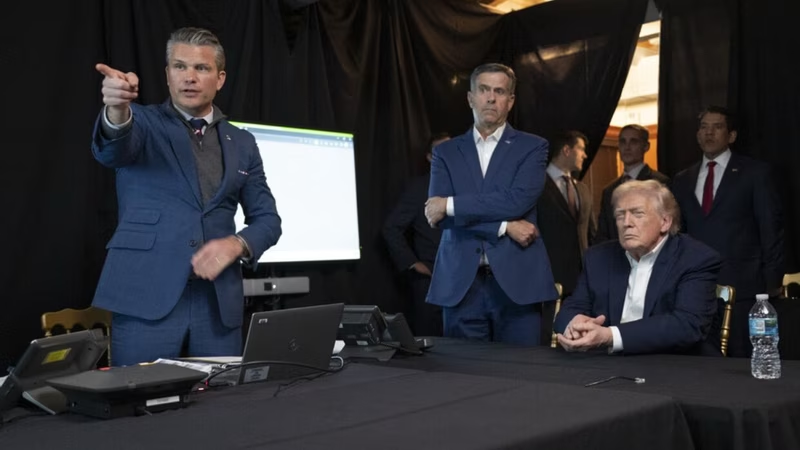
A story is circulating on various online platforms with a sensational headline: “Behind the scenes: WH releases images of Trump monitoring Maduro’s capture; see pics.” It describes an official White House release of photographs showing former US President Donald Trump in a situation room, intently watching a live feed of a dramatic US military operation that resulted in the capture of Venezuelan President Nicolás Maduro .
The narrative is designed to be incredibly credible. It uses official-sounding language (“White House releases”), a specific and dramatic event, and the promise of visual proof (“see pics”). This combination is a classic tactic of disinformation, aiming to bypass the reader’s critical thinking and trigger an immediate emotional response.
Trump monitoring Maduro’s capture: A Fact-Check
Let’s state this unequivocally: **This event did not happen, and the White House did not release any such photos.** The entire story is a complete fabrication.
Here’s the evidence:
- No Official Source: The official website of The White House (whitehouse.gov) and its verified social media channels have no record of such a release. A former president has no authority to be in a White House situation room monitoring active military operations.
- No Credible News Coverage: Major, reputable international news organizations like the Associated Press, Reuters, BBC, CNN, and Al Jazeera have reported **no military operation in Venezuela and no capture of Maduro** [[5], [6]].
- Maduro is Publicly Active: President Nicolás Maduro has been seen in multiple public appearances and official government broadcasts since the date of the alleged capture, directly contradicting the hoax .
Anatomy of the Hoax: How the Fake Story Was Built
This disinformation is not random. It’s a carefully constructed narrative that leverages real-world tensions and historical context to appear plausible:
- Real US-Venezuela Tensions: The US and Venezuela have a long history of animosity. The US does not recognize Maduro’s government as legitimate and has imposed severe sanctions on the country .
- Real Narco-Terrorism Indictment: In 2020, the US Department of Justice indicted Maduro on charges of narco-terrorism and offered a $15 million reward for his arrest. This real legal action provides a foundation for the fictional arrest narrative .
- Trump’s Known Stance: During his presidency, Donald Trump was one of Maduro’s most vocal international critics, even recognizing opposition leader Juan Guaidó as the true president of Venezuela .
The hoax takes these real elements and stitches them together into a fictional, action-movie-style climax that fits a pre-existing political narrative for its target audience.
The Real State of US-Venezuela Relations
The current relationship is complex and managed through diplomatic, not military, channels. In a significant shift from the Trump era, the Biden administration has engaged in direct talks with the Maduro government. A key agreement in 2023 led to the US issuing a temporary license for Chevron to resume oil operations in Venezuela in exchange for commitments on political reforms and migration . This pragmatic, albeit controversial, diplomacy is the true state of affairs, a far cry from the fictional invasion depicted in the hoax.
Why This Hoax is Particularly Dangerous
This isn’t just a silly internet rumor. Fabricating a story about a US military invasion of a sovereign nation can have serious real-world consequences:
- Escalation of Tensions: It could provoke a severe diplomatic or even military response from Venezuela or its allies, like Russia or China.
- Public Panic and Mistrust: It erodes public trust in legitimate news sources and government institutions, creating a climate of fear and uncertainty.
- Manipulation of Public Opinion: It is likely designed to either drum up support for a hardline foreign policy or to discredit US leadership by portraying it as reckless and aggressive.
How to Protect Yourself from Geopolitical Fake News
In an era of AI-generated images and sophisticated disinformation campaigns, vigilance is key:
- Check the Primary Source: If a story claims a government body released something, go directly to that body’s official website. Don’t trust a news site that just says “the White House announced.”
- Reverse Image Search: Use Google Images to see if the “official” photos have been used elsewhere or are AI-generated.
- Consult Reputable Fact-Checkers: Sites like PolitiFact, Snopes, and the fact-checking desks of major news agencies are invaluable resources .
Conclusion: Truth in the Age of Deepfakes
The story of Trump monitoring Maduro’s capture is a stark reminder of the information battlefield we all navigate. While the core elements—a hostile regime, a wanted leader, and a former US president known for tough talk—are rooted in reality, the dramatic event itself is pure fiction. By understanding the tactics of disinformation and committing to verifying our sources, we can prevent these dangerous hoaxes from shaping our perception of the world and causing real harm.
Sources
- Times of India (Original Hoax Article): Behind the scenes: WH releases images of Trump monitoring Maduro’s capture
- The White House Official Website: https://www.whitehouse.gov/
- Reuters Fact Check: Venezuela Coup and Capture Claims
- US Department of State: US-Venezuela Relations