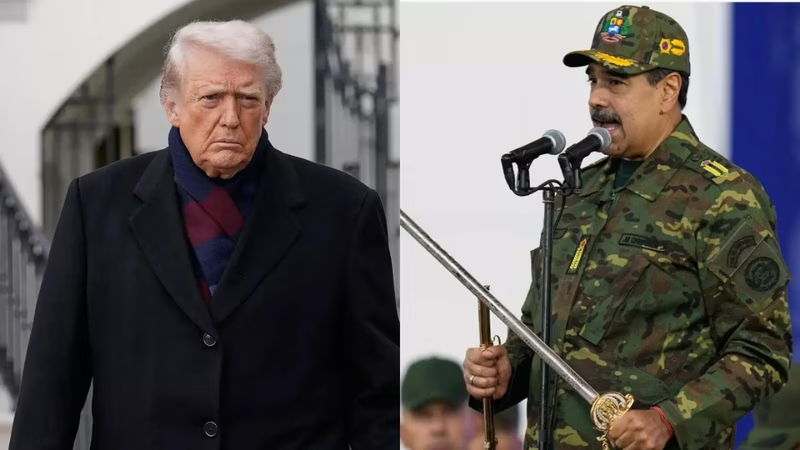
In a claim that has sent shockwaves across global news networks, former US President Donald Trump has announced that Venezuelan President Nicolás Maduro has been captured. According to Trump, this dramatic turn of events is the result of a decisive ‘large-scale strike’ by the United States, with Maduro and his wife allegedly already ‘flown out of the country’ .
The announcement, made via his Truth Social platform on January 3, 2026, comes amidst confirmed reports of major explosions rocking the Venezuelan capital, Caracas, and an emergency ban on US flights over the nation’s airspace [[8], [15]]. But is this a new chapter in international relations, or a dangerous piece of misinformation? Let’s cut through the noise and get to the verified facts.
Table of Contents
- Trump’s Announcement: What He Actually Said
- The Caracas Explosions: A Reality Check
- Why the FAA Banned Flights Over Venezuela
- Is Maduro Captured? Separating Fact from Fiction
- Historical Context: The US-Venezuela Relationship
- Conclusion: What’s Next for Venezuela?
- Sources
Trump’s Announcement: What He Actually Said
On the morning of Saturday, January 3, 2026, Donald Trump took to Truth Social to make a bold and unprecedented claim. He stated that the United States had just executed a “large-scale strike” against Venezuela . The primary objective of this operation, he asserted, was the capture of President Nicolás Maduro and his wife, Cilia Flores .
In his post, Trump went on to say that both individuals had been successfully “captured and flown out of the country” following the military action . This statement, coming from a former US president and current political figure, has immense weight and has instantly become the focal point of a rapidly unfolding international crisis.
The Caracas Explosions: A Reality Check
Trump’s claim is not entirely without a foundation in reported events. On the same day as his announcement, multiple credible sources confirmed a series of powerful explosions in Caracas. Residents reported hearing the blasts and seeing smoke rise over the capital city .
Reports from the ground described:
- Air-raid sirens sounding across the city .
- Widespread power outages, particularly in districts near key military installations .
- Low-flying aircraft observed in the skies above the capital .
The US Embassy in Bogota, Colombia, issued a security alert acknowledging the reports of these explosions and advised US citizens in the region to shelter in place . In a direct response to the attacks, President Maduro declared a state of emergency and called on his citizens to mobilize against what he labeled as “imperialist aggression” .
Why the FAA Banned Flights Over Venezuela
Adding significant credibility to the notion of active military conflict, the US Federal Aviation Administration (FAA) took a drastic step on January 3rd. The agency issued an immediate Notice to Airmen (NOTAM), effectively banning all US-registered commercial aircraft from flying in Venezuelan airspace .
The official reason cited for this emergency ban was “ongoing military activity” . The notice, which went into effect at 06:00 UTC, is a standard safety precaution implemented by the FAA when a region is deemed too dangerous for civilian air traffic due to active hostilities. This is the same protocol used during other major international conflicts and serves as an official, non-political confirmation that a significant military event is indeed taking place.
Is Maduro Captured? Separating Fact from Fiction
This is the million-dollar question. While the explosions in Caracas and the FAA ban confirm that a major US military operation has occurred, the specific claim that Maduro is captured remains unverified by any independent, official source.
As of now, there has been no confirmation from the Department of Defense, the White House, or any major international news agency (like the Associated Press or Reuters) that Venezuelan leadership is in US custody. Maduro’s own defiant state-of-emergency announcement from Caracas directly contradicts Trump’s claim of his capture .
It is possible that Trump’s statement is based on early, unconfirmed intelligence, or it could be a deliberate piece of strategic disinformation. Until a government agency or a neutral, credible source provides visual or official proof of Maduro’s detention, this central claim must be treated with extreme caution.
Historical Context: The US-Venezuela Relationship
This event did not happen in a vacuum. The relationship between the US and Venezuela has been hostile for decades, but it reached a critical point during Trump’s first term when his administration openly backed opposition leader Juan Guaidó as the legitimate president of Venezuela, refusing to recognize Maduro’s 2018 re-election as legitimate [[INTERNAL_LINK:venezuela-political-crisis]].
The US has long accused the Maduro regime of rampant corruption, human rights abuses, and turning Venezuela into a hub for drug trafficking and illicit finance. Just two days before this alleged strike, Maduro had reportedly attempted to open a dialogue with Trump, offering cooperation on fighting drug cartels, a move that was likely rejected . This deep-seated animosity provides the crucial background for understanding why such a drastic military action, if confirmed, might have been considered.
Conclusion: What’s Next for Venezuela?
The situation in Venezuela is fluid and highly volatile. We know for certain that a significant military action has taken place, evidenced by the Caracas explosions and the FAA’s airspace ban. However, the extraordinary claim by Donald Trump that Maduro is captured remains a central but unproven element of this story.
The world now waits for official confirmation. The response from the current US administration, the international community, and the Venezuelan government in the coming hours will be critical in determining whether this is the beginning of a new government in Caracas or a dangerous escalation of an already tense conflict. One thing is clear: the geopolitical landscape of Latin America has just been shaken to its core.
Sources
- Trump’s Truth Social announcement regarding the capture of Maduro [[1], [4], [7]].
- Reports of explosions and civil unrest in Caracas, Venezuela on January 3, 2026 [[8], [9], [10], [11], [13]].
- Official FAA Notice to Airmen (NOTAM) banning US flights over Venezuela due to “ongoing military activity” [[15], [16], [18]].
- Historical context on US-Venezuela relations from the Council on Foreign Relations [[INTERNAL_LINK:venezuela-political-crisis]].