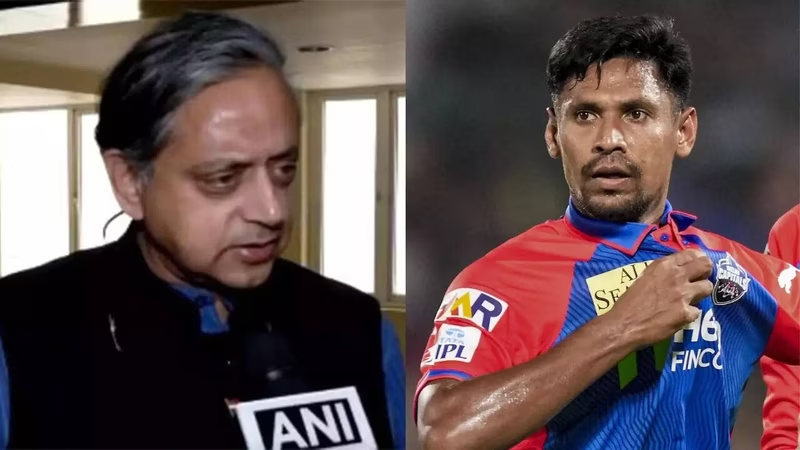
Cricket fans around the world are reeling after news broke that Bangladeshi fast-bowling sensation Mustafizur Rahman has been dropped from the Kolkata Knight Riders (KKR) squad for the upcoming IPL 2026 season. But this isn’t just another roster shake-up—it’s a story dripping with political tension, diplomatic friction, and a fiery rebuke from one of India’s most articulate public figures. Enter: Shashi Tharoor.
In a strongly-worded social media post on Friday, Tharoor slammed what he described as the “mindless politicising of sport”—a direct response to the reported intervention by the Board of Control for Cricket in India (BCCI) that led to Mustafizur’s removal. His message was clear: sports should be a sanctuary from politics, not a battleground for it.
Table of Contents
- Why Was Mustafizur Rahman Dropped?
- Shashi Tharoor’s Scathing Response
- The Political Backdrop Fueling the Decision
- Historical Precedents: Bangladesh Players in the IPL
- What This Means for Future IPL Auctions
- Conclusion: A Sport in Danger of Losing Its Soul?
- Sources
Why Was Mustafizur Rahman Dropped?
While KKR hasn’t issued a detailed public statement, multiple media reports—including The Times of India—confirm that the BCCI instructed the franchise to release Mustafizur Rahman from its squad. The move appears linked to rising bilateral tensions between India and Bangladesh over reports of communal violence targeting minority Hindu communities in Bangladesh.
Technically, all foreign players require government clearance to participate in the IPL. But experts argue this clearance is typically a formality—unless political winds shift. In this case, the Mustafizur Rahman IPL exit seems less about paperwork and more about optics.
Notably, Mustafizur wasn’t just any signing. The left-arm pacer is a T20 legend—nicknamed “The Fizz”—with proven impact in high-pressure leagues worldwide, including the IPL. His removal isn’t just a loss for KKR; it’s a symbolic severing of sporting ties.
Shashi Tharoor’s Scathing Response
Tharoor, a former UN diplomat and author known for his sharp intellect and love for cricket, didn’t mince words. Sharing a video, he stated: “Recalling my views on the subject, now that BCCI has deplorably pulled the plug on Mustafizur Rahman.” He then posed a rhetorical but powerful question:
“And what if the Bangladeshi player in question had been Litton Das or Soumya Sarkar?”
Tharoor’s point cuts deep: Why single out Mustafizur? Is he being punished for the actions of a government he doesn’t control? His message underscores a fundamental principle—athletes should not bear the burden of geopolitical disputes.
This isn’t Tharoor’s first time defending the separation of sport and state. He has long advocated for international sporting events to remain neutral zones of competition and mutual respect—a view echoed by global bodies like the International Olympic Committee, which champions sport as a tool for peace.
The Political Backdrop Fueling the Decision
The timing is telling. India and Bangladesh, long considered close neighbors with deep cultural and economic ties, have seen a rise in diplomatic friction over recent months. Reports of attacks on Hindu temples and communities in Bangladesh have sparked outrage among Indian politicians and civil society groups.
Some political parties have called for a reassessment of bilateral relations—including cultural and sporting exchanges. In this charged atmosphere, Mustafizur’s inclusion in an Indian franchise became politically inconvenient—even though he, like millions of Bangladeshis, is a victim of circumstance, not a perpetrator.
Ironically, this move may hurt India’s global image more than Bangladesh’s. The IPL markets itself as the world’s premier T20 league—an open, inclusive festival of cricket. Introducing political litmus tests for foreign players undermines that brand and alienates international talent.
Historical Precedents: Bangladesh Players in the IPL
Bangladeshi cricketers have always had a complicated relationship with the IPL. Despite producing world-class T20 performers like Shakib Al Hasan and Mustafizur himself, they’ve been consistently underrepresented.
In the IPL 2025 auction, not a single Bangladeshi player was picked—a fact that drew criticism from fans and analysts alike. While franchises cite tactical or financial reasons, many suspect underlying political sensitivities play a role.
Mustafizur’s brief return in 2026 (before his abrupt exit) had offered hope of a thaw. Now, that hope seems dashed—replaced by uncertainty over whether any Bangladeshi player will ever feel truly welcome in the IPL again.
What This Means for Future IPL Auctions
The implications are far-reaching:
- Chilling Effect on Talent Acquisition: Franchises may avoid signing players from geopolitically sensitive nations, even if they’re cricketing assets.
- Erosion of IPL’s Global Appeal: If the league becomes viewed as politically selective, top international stars may think twice before committing.
- Precedent for Other Sports: If cricket bows to political pressure, what stops football, tennis, or athletics from following suit?
For fans who tune in for the game—not the geopolitics—this is a troubling development. As one commentator noted, “We come to the IPL to see boundaries, not borders.”
Conclusion: A Sport in Danger of Losing Its Soul?
The Mustafizur Rahman IPL exit is more than a roster change—it’s a warning sign. When sport becomes a proxy for political messaging, everyone loses: fans, players, and the spirit of fair play itself.
Shashi Tharoor’s intervention is a much-needed call to protect the integrity of the game. As he implies, punishing an apolitical athlete like Mustafizur doesn’t send a message to a foreign government—it sends a message to the world that India is willing to sacrifice its sporting ideals for short-term political gain.
Let’s hope cooler heads prevail before the IPL loses what makes it truly special: its universal passion for cricket, unburdened by borders. For more on the evolving politics of global sports, see our deep dive on [INTERNAL_LINK:politics-in-sports].
Sources
- The Times of India: “‘Who are we punishing?’: Tharoor slams ‘mindless politicising of sports’ after KKR release Bangladesh player Mustafizur Rahman”
- International Olympic Committee – Sport for Hope and Unity
- Press Trust of India (PTI) reports on IPL 2025 auction outcomes, April 2025.
- Statements from KKR management (as cited in Indian media, January 2026).