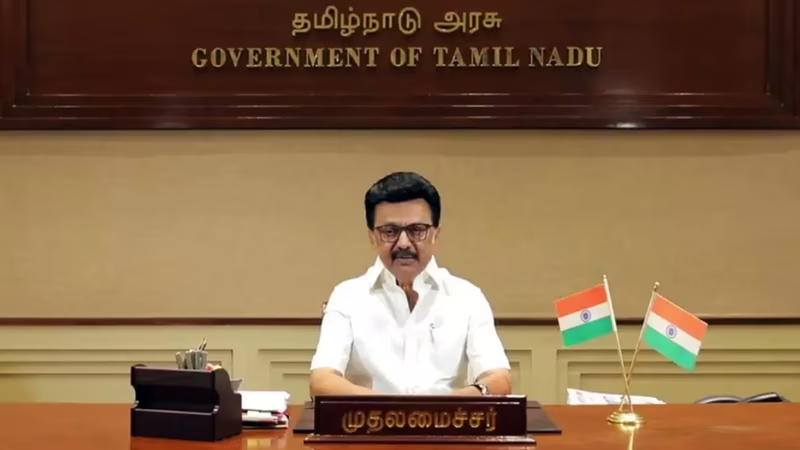
In a state where politics is akin to a religion, the announcement of a new election manifesto is a sacred event. This time, however, DMK president and Tamil Nadu Chief Minister M.K. Stalin has flipped the script. He’s not just dictating promises from the top; he’s asking the people for their wishlist. The launch of the DMK 2026 manifesto portal in Chennai is a bold, and perhaps calculated, move that has everyone talking.
Is this a genuine attempt to create a true “people’s manifesto” or a masterstroke of political theater in an increasingly competitive landscape? Let’s dissect this unprecedented initiative and what it means for the Tamil Nadu Assembly elections in 2026.
Table of Contents
- The Big Announcement: What is the Portal?
- The Voice Behind the Vision: Kanimozhi’s Role
- DMK 2026 Manifesto: A Strategic Move in a Fractured Political Climate
- The Crowdsourcing Challenge: Can It Really Work?
- Conclusion: From Promise to Proof
- Sources
The Big Announcement: What is the Portal?
On a recent Saturday, at the iconic Anna Arivalayam, M.K. Stalin officially unveiled the DMK’s online portal dedicated to the 2026 election manifesto . This platform isn’t just a static page listing party promises. Instead, it’s an interactive gateway designed to crowdsource suggestions from every section of Tamil society .
The core idea is simple yet ambitious: before the party finalizes its official commitments, it wants to hear directly from farmers, students, women, entrepreneurs, and laborers. This marks a significant shift from the traditional model where manifestos are crafted in closed-door meetings by a select group of advisors and then unveiled as a fait accompli to the public.
The Voice Behind the Vision: Kanimozhi’s Role
Leading this entire initiative is none other than senior DMK leader and Lok Sabha MP Kanimozhi Karunanidhi, who has been entrusted with heading the party’s 12-member manifesto committee . Her public statements have been the clearest articulation of the party’s intent. She declared that the leadership’s vision is for this to be a true “people’s manifesto,” echoing the wishes of their leader .
Her role is pivotal. Kanimozhi’s job is to sift through the public feedback, identify the most pressing and feasible demands, and weave them into a coherent and deliverable set of promises. She has already begun the groundwork, with the committee holding its first meeting and planning outreach programs across the state, including in Coimbatore [[25], [23]]. This hands-on approach is meant to signal that the party is serious about listening, not just talking.
DMK 2026 Manifesto: A Strategic Move in a Fractured Political Climate
While the initiative sounds noble on its face, its timing is anything but coincidental. The DMK 2026 manifesto is being crafted in a political environment that is more unpredictable than ever.
The ruling DMK-Congress alliance is under intense scrutiny, especially after the Congress party has reportedly asked for 38 seats and three cabinet berths for the upcoming polls—a demand that could create friction . At the same time, a new wildcard has entered the fray in the form of actor Vijay’s newly launched party, which is poised to split the anti-DMK vote in a major way .
By launching this portal, the DMK is attempting to achieve several strategic goals at once:
- Reinforcing its Pro-People Image: It reminds voters of its legacy as a Dravidian party that champions the common man.
- Countering New-Age Rivals: It offers a structured, party-led alternative to the charismatic, personality-driven politics of newcomers.
- Managing Alliance Expectations: Having a data-driven, public-mandated manifesto could give the DMK a strong position in internal negotiations with its ally, the Congress.
The Crowdsourcing Challenge: Can It Really Work?
The concept of a crowdsourced manifesto is exciting, but its execution is fraught with challenges. The biggest question is one of feasibility and authenticity.
Can the DMK’s committee truly filter through thousands of suggestions to create a practical and fiscally responsible document? Or will the final manifesto end up being a pre-decided list of promises with a thin veneer of “public input” for marketing purposes?
Historically, the DMK has a strong track record of fulfilling its manifesto promises, a point Kanimozhi has been eager to highlight to build trust for this new process . However, the success of this new approach will be judged not by the launch of a portal, but by the tangible actions taken after the election. For a deeper look at how political manifestos have shaped Indian policy, you can refer to resources from the PRS Legislative Research organization.
There’s also the technical aspect. While some initial reports suggested the portal might be AI-powered and voice-enabled , other sources later clarified the party was reaffirming its commitment to conventional, direct consultation methods . This ambiguity itself speaks to the experimental nature of the project. The real test will be whether rural and non-digital populations can participate as easily as their urban, tech-savvy counterparts.
Conclusion: From Promise to Proof
The launch of the DMK 2026 manifesto portal is a fascinating development in Tamil Nadu’s political theatre. It’s a high-risk, high-reward strategy that could either cement the DMK’s image as a truly democratic and responsive party or expose it as a clever but hollow gimmick.
For the public, this is a rare opportunity to directly influence the political agenda. For political analysts, it’s a live case study in modern-day party strategy. One thing is certain: the final document that emerges from this process will be scrutinized not just for its promises, but for how well it reflects the actual voices of Tamil Nadu’s 8 crore people. The DMK has invited the public to draft its future; now, the people must decide if they’ll take up the pen. Stay updated on the evolving political landscape with our coverage on [INTERNAL_LINK:tamil-nadu-politics].
Sources
- “Tamil Nadu elections: Stalin launches DMK manifesto portal 2026.” Times of India.
- “DMK launches AI portal to seek public feedback for 2026 manifesto.” The Hindu.
- “DMK president and Chief Minister MK Stalin launched an AI-powered voice enabled portal to crowdsource inputs for our #DMKManifesto2026.” DMK Official Social Media.
- “Tamil Nadu CM Stalin launches DMK election manifesto portal.” India Today.
- “DMK MP Kanimozhi on December 22 said…” The New Indian Express.
- “DMK turned debt-burdened TN into developed state: Kanimozhi.” Deccan Chronicle.
- “Tamil Nadu assembly elections 2026: Congress asks DMK for 38 seats.” The Hindu.
- “Congress to stay with DMK alliance, Vijay can’t win: P Chidambaram.” India Today.
- “DMK Avoids Using AI for Public Input for 2026 election manifesto.” The Week.
- “Senior DMK leader and Lok Sabha MP Kanimozhi Karunanidhi will lead the party’s manifesto committee.” PTI.