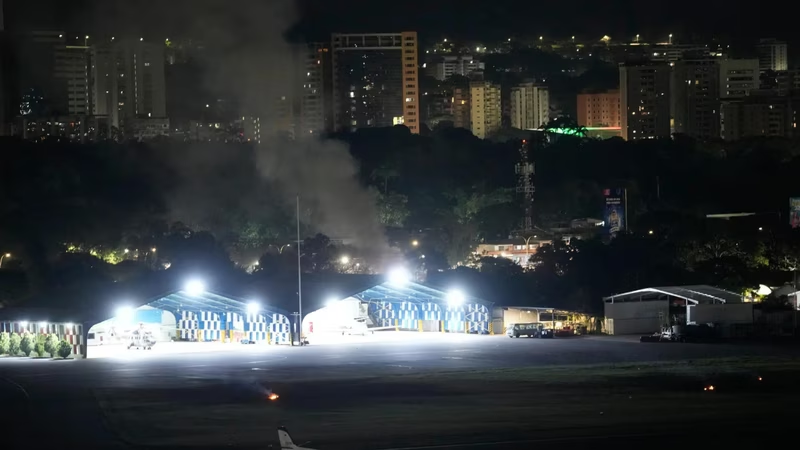
In the early hours of Saturday, January 3, 2026, the calm of the Venezuelan capital was violently ruptured. A series of thunderous Caracas explosions echoed across the city, accompanied by the unmistakable, menacing sound of low-flying aircraft. Panic erupted as residents, shaken from their sleep, captured the terrifying chaos on their phones—videos showing bright flashes in the night sky and streets filled with confusion and fear. This isn’t just a breaking news story; it’s a potential flashpoint for a major international crisis.
Table of Contents
- What Happened in Caracas? The Night of Terror
- The Maduro Government’s Response and Accusations
- Analyzing the Evidence: Videos and Eyewitness Accounts
- The Geopolitical Stakes: Why This Matters
- Summary: A Nation in Crisis
- Sources
What Happened in Caracas? The Night of Terror
At approximately 2:00 a.m. local time, the first of at least seven powerful explosions rocked Caracas . The blasts were not isolated; they were heard in multiple neighborhoods across the capital, with concentrated activity reported near key military installations like Fort Tiuna and the La Carlota air base . The city was plunged into darkness with widespread power outages reported in the vicinity of these strategic sites .
The defining and most chilling feature of the event, however, was the reported presence of low-flying aircraft. Multiple eyewitnesses and media reports confirmed the sound of jets or other military aircraft flying at an unusually low altitude over the city, a detail captured in numerous citizen videos that have since gone viral . One video from La Carlota airport even shows smoke rising in the aftermath . This combination of coordinated explosions and aerial activity points to a deliberate and sophisticated strike, not a random accident.
The Maduro Government’s Emergency Response
The Venezuelan government’s reaction was swift and severe. President Nicolas Maduro wasted no time in assigning blame and mobilizing the state’s full authority. He has publicly accused the United States of orchestrating the attacks . In response to the Caracas explosions, Maduro declared a national emergency and, more significantly, a “state of external disturbance” . This is a critical legal step that grants the president extraordinary powers to manage what he frames as an act of foreign aggression.
Furthermore, Maduro has ordered the implementation of all national defense plans . This move signals a high alert across the country’s military and security apparatus, effectively placing Venezuela on a war footing. The government’s narrative is clear: this was an act of war by a foreign power, and the nation must respond with its full might. This official stance has immediately escalated regional tensions to a boiling point.
What Is a “State of External Disturbance”?
For readers unfamiliar with Venezuelan law, this declaration is a major escalation. It’s a constitutional provision designed for moments of extreme national peril, often involving foreign threats. It can lead to:
- Censorship or strict control of news media and information flow.
- Mobilization and deployment of military forces nationwide.
- Suspension of certain civil liberties and democratic processes.
- Centralization of power in the executive branch (i.e., Maduro himself).
Analyzing the Evidence: Videos and Eyewitness Accounts
While the government’s claims are stark, the initial evidence from the ground paints a picture of a highly coordinated event. The consistency of reports is striking: from different parts of the city, citizens documented the same sequence of events—loud booms followed by the roar of engines overhead .
The videos, many of which show bright flashes illuminating the night sky and panicked residents in their doorways, are a primary source of real-time information in a situation where official communication is heavily politicized . The locations of the blasts near military facilities, as noted in reports of smoke at La Carlota and outages near Fort Tiuna, strongly suggest the targets were strategic, not civilian [[16], [20]]. This precision is a key detail that fuels the government’s assertion of a state-sponsored attack, a claim that is being investigated by international bodies and closely watched by allies and adversaries alike.
The Geopolitical Stakes: Why This Matters
The implications of the Caracas explosions extend far beyond Venezuela’s borders. The country has long been a focal point of geopolitical rivalry, particularly between the United States and its allies, and a bloc of nations opposed to U.S. influence. An unconfirmed but credible attack of this nature, blamed directly on the U.S., has the potential to trigger a cascade of events.
Regional powers will be forced to take sides. Global energy markets, already sensitive to instability, may react to the uncertainty in an oil-rich nation. This event could also be a pivotal moment for the Maduro regime itself. In a country facing severe economic hardship, an external threat can be a powerful tool for rallying domestic support, a strategy often referred to as the “rally ’round the flag” effect. For a deeper understanding of Venezuela’s complex political landscape, see our analysis on [INTERNAL_LINK:venezuela-political-crisis-history].
For more on the historical context of U.S.-Venezuela relations, a high-authority source like the Council on Foreign Relations provides invaluable perspective.
Summary: A Nation in Crisis
The Caracas explosions of January 3, 2026, have thrown Venezuela into its most serious crisis in years. What began as a terrifying series of blasts in the dead of night has rapidly evolved into a full-blown national emergency. With the Maduro government declaring a state of external disturbance and pointing the finger at the United States, the world is now watching to see if this is the spark that ignites a much larger regional or even global conflict. The chaotic videos from its citizens serve as a stark reminder of the human cost of geopolitical brinkmanship.
Sources
- AP News: Explosions ring out in Venezuela as Maduro’s government blames the U.S. [[9], [10], [11]]
- Reuters: Multiple explosions heard in Venezuela’s Capital. Maduro says U.S. behind them [[5], [7], [8]]
- Local Media Reports: Various Venezuelan outlets and social media compilations [[14], [15], [16], [18], [19]]
- Times of India: Blasts rock Venezuela capital: Low-flying airplanes seen in Caracas; videos show panic