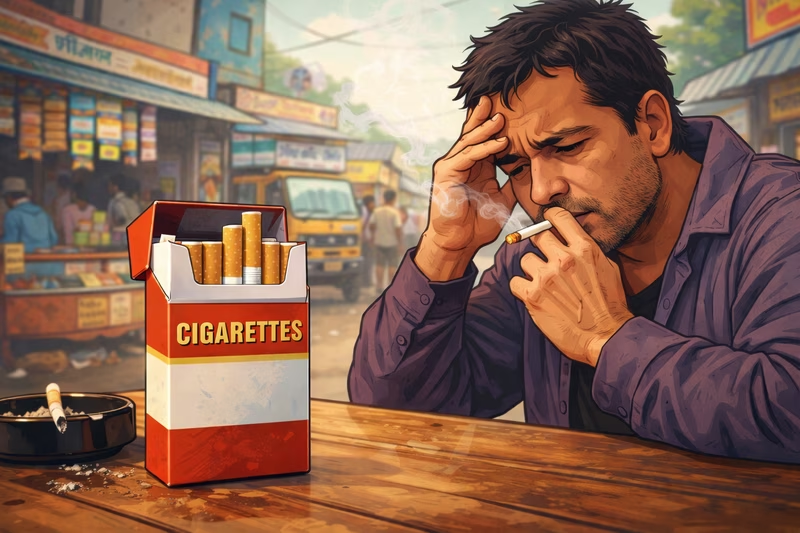
If you’re a smoker in India, get ready to shell out more for your daily pack. Starting February 1, 2026, a sweeping cigarette price hike 2026 will take effect nationwide, making every puff noticeably more expensive. This isn’t just another market fluctuation—it’s a deliberate policy move by the government, combining a steep 40% Goods and Services Tax (GST) with a hike in central excise duties on tobacco products . The goal? To align cigarette pricing with the true public health cost of smoking and nudge consumers toward quitting. For millions of smokers, this means recalibrating their budgets—or reconsidering their habit altogether.
Table of Contents
- Why the Cigarette Price Hike 2026 Is Happening
- The New Tax Structure: Breaking Down GST and Excise Duty
- How Much More Will You Pay? Variety-wise Price List
- Global Context: How India’s Tobacco Taxes Compare
- Public Health Impact: Can Higher Prices Reduce Smoking?
- What Smokers Are Saying—and Possible Backlash
- Conclusion: Is This the End of Affordable Smoking in India?
- Sources
Why the Cigarette Price Hike 2026 Is Happening
The primary driver behind this cigarette price hike 2026 is public health. According to the World Health Organization (WHO), tobacco use kills over 1.3 million people in India every year—a staggering figure that places immense strain on the healthcare system . The government’s logic is simple: if cigarettes become significantly more expensive, consumption will drop, especially among price-sensitive groups like youth and low-income populations. This strategy, known as “sin taxation,” is a proven tool in global tobacco control policy.
Additionally, the move aims to bring India’s tax structure in line with international best practices. For years, public health advocates have criticized India’s tobacco taxation as being too low and fragmented. The new unified 40% GST on all cigarettes, regardless of length, is a step toward correcting that imbalance .
The New Tax Structure: Breaking Down GST and Excise Duty
Previously, cigarette taxation in India was a complex patchwork of state VAT, central excise, and a lower GST slab. The new policy streamlines this by imposing a flat 40% GST on the transaction value of all cigarettes, on top of a revised central excise duty that varies by length .
Here’s how it breaks down:
- Excise Duty: Now higher for all categories—short, regular, and long cigarettes—with the longest sticks bearing the heaviest burden.
- GST: A uniform 40% applied to the retail price after excise, replacing the earlier multi-tier system.
- Compensation Cess: An additional levy remains in place, further inflating the final cost to the consumer.
This layered taxation ensures that the price increase is substantial and unavoidable.
How Much More Will You Pay? Variety-wise Price List
Based on calculations from industry sources and government notifications, here’s an estimated price increase for popular cigarette categories post-February 1 :
| Cigarette Type | Old Approx. Price (₹) | New Approx. Price (₹) | Increase (₹) |
|---|---|---|---|
| Short Length (e.g., Gold Flake Kings) | 25 | 32 | +7 (28%) |
| Regular Length (e.g., Classic Blue) | 30 | 39 | +9 (30%) |
| Long Length (e.g., Marlboro Red) | 35 | 48 | +13 (37%) |
As you can see, the burden is heaviest on premium and long cigarettes, but even budget smokers will feel the pinch. A pack-a-day habit could now cost an extra ₹200–₹400 per month.
Global Context: How India’s Tobacco Taxes Compare
Even after this hike, India’s tobacco taxes remain below the WHO’s recommended benchmark of at least 75% of the retail price. For comparison:
- Australia: Over 70% of cigarette price is tax.
- UK: Around 80% of the price is tax.
- India (Post-Feb 2026): Estimated at 55–60% depending on brand .
This gap suggests that further price increases could be on the horizon as India continues its fight against tobacco use.
Public Health Impact: Can Higher Prices Reduce Smoking?
Research is unequivocal: yes. A WHO fact sheet states that a 10% increase in cigarette prices typically leads to a 4–8% reduction in consumption in high-income countries, and up to 8% in low- and middle-income countries like India . For young people, the effect is even more pronounced.
Beyond reducing consumption, higher taxes also generate significant government revenue—money that can (and should) be reinvested into public health programs like anti-smoking campaigns and cessation support. For more on quitting resources, see our guide on [INTERNAL_LINK:how-to-quit-smoking-in-india].
What Smokers Are Saying—and Possible Backlash
Unsurprisingly, the announcement has sparked frustration among India’s estimated 100+ million smokers. Social media is abuzz with complaints about “government overreach” and “double taxation.” Some fear the hike will fuel a black market for smuggled or illicit cigarettes, which are cheaper and unregulated—a common unintended consequence of steep tax hikes .
While the policy is well-intentioned, its success will depend on enforcement and complementary support systems for those trying to quit.
Conclusion: Is This the End of Affordable Smoking in India?
The cigarette price hike 2026 marks a turning point in India’s tobacco control strategy. It’s no longer just about health warnings on packs; it’s about making smoking financially unsustainable for the average consumer. While the immediate reaction may be grumbling at the counter, the long-term public health benefits could be immense. Whether this policy succeeds in curbing India’s smoking epidemic—or simply pushes it underground—remains to be seen. One thing is certain: your next pack is going to cost you a lot more than it used to.