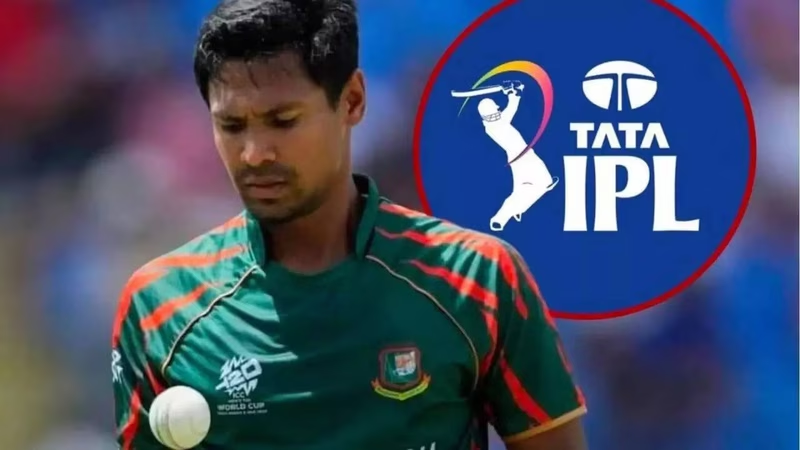
Bangladesh’s premier fast bowler, Mustafizur Rahman, is once again in the spotlight—but this time, the buzz isn’t just about his deadly cutters or match-winning spells. A simmering conflict between his national board, the Bangladesh Cricket Board (BCB), and his desire to play in the Indian Premier League (IPL) has erupted into a full-blown Mustafizur Rahman IPL row. And his recent social media post—simply reading “Always grateful”—has only added fuel to the fire . Coming on the heels of a standout performance in the Bangladesh Premier League (BPL) and amid speculation about his IPL availability, the message feels both humble and defiant. Is this a quiet act of gratitude toward his fans, or a subtle statement against the BCB’s restrictive policies? The cricketing world is watching closely.
Table of Contents
- The Heart of the Mustafizur Rahman IPL Row
- Mustafizur’s Cryptic Post and BPL Success
- BCB Policy vs. Player Aspirations: The Core Conflict
- IPL & Global T20 Leagues: Why They Matter for Careers
- Global Precedents: How Other Boards Handle Franchise Cricket
- Conclusion: What Lies Ahead for Mustafizur and Bangladesh Cricket?
- Sources
The Heart of the Mustafizur Rahman IPL Row
The Mustafizur Rahman IPL row stems from the BCB’s long-standing policy of tightly controlling player releases for overseas T20 leagues, particularly the IPL. While boards like Cricket Australia or England’s ECB have embraced the IPL as a development platform, the BCB has often cited scheduling conflicts, workload management, and national team commitments as reasons to limit participation . Mustafizur, who last played in the IPL in 2022 for Sunrisers Hyderabad, has been a valuable asset in the auction market, but his availability remains at the BCB’s discretion. This has frustrated both the player and IPL franchises that see him as a T20 goldmine.
Recently, reports suggested that the BCB might relax its stance for the 2026 season. But with no official confirmation, and Mustafizur not listed among the expected international signings, uncertainty reigns—creating the perfect storm for the current controversy.
Mustafizur’s Cryptic Post and BPL Success
Amid this tense backdrop, Mustafizur took to social media to celebrate a significant personal milestone: his 100th wicket in the Bangladesh Premier League . His post featured highlights of his BPL performances alongside the caption, “Always grateful.” On the surface, it’s a standard athlete’s acknowledgment. But in context, it reads as layered.
Fans interpreted it as gratitude for continued support despite the IPL limbo. Others saw it as a quiet reaffirmation of his commitment to domestic cricket, possibly to appease the BCB. His performance in the BPL—where he led his team with match-winning figures—proved he’s still at the peak of his powers. The message may have been simple, but its timing turned it into a statement.
BCB Policy vs. Player Aspirations: The Core Conflict
At the core of this issue is a philosophical clash between institutional control and individual agency. The BCB argues that protecting players from burnout and prioritizing national duty is essential for Bangladesh’s long-term cricketing health. They point to past instances where IPL fatigue allegedly impacted national team performance.
However, players like Mustafizur see the IPL as more than just a paycheck. It’s a:
- Global stage to compete against and alongside the world’s best.
- Learning laboratory for mastering high-pressure T20 scenarios.
- Career accelerator that can extend a player’s relevance and financial security.
For a player from a cricketing nation with fewer financial resources, the IPL can be transformative—both professionally and personally.
IPL & Global T20 Leagues: Why They Matter for Careers
The IPL isn’t just a tournament; it’s the epicenter of the modern T20 ecosystem. According to a Cricinfo analysis, players who regularly feature in the IPL see a measurable improvement in their adaptability, tactical awareness, and market value . Mustafizur himself has thrived in the IPL before, taking 45 wickets in 43 matches at an economy of 8.29—a record that speaks to his elite T20 skill.
Missing out on this exposure can isolate a player from evolving trends in the game, putting them at a strategic disadvantage. This is especially critical for fast bowlers from subcontinental nations who must learn to master slower balls, variations, and death-over tactics in the IPL’s high-intensity environment.
Global Precedents: How Other Boards Handle Franchise Cricket
The BCB’s stance is increasingly out of step with global norms. Consider these examples:
- South Africa: Now allows all centrally contracted players to participate in the IPL without restrictions.
- West Indies: Actively encourages its stars to join global leagues, recognizing it as a vital revenue and development stream.
- New Zealand: Has a transparent window system that balances national commitments with IPL participation.
Even the BCCI, which runs the IPL, releases its own players for major overseas leagues like the BBL and SA20. This collaborative approach has helped elevate the global standard of T20 cricket. The BCB’s rigid policy, by contrast, risks leaving its best players behind.
Conclusion: What Lies Ahead for Mustafizur and Bangladesh Cricket?
The Mustafizur Rahman IPL row is more than just a dispute over one player’s calendar. It’s a referendum on how cricket’s emerging nations choose to engage with the sport’s most lucrative and influential private league. Mustafizur’s “Always grateful” post may seem passive, but it underscores a deep longing—to represent his country with pride while also testing himself on the world’s biggest T20 stage. The BCB now faces a choice: double down on control or evolve with the times. For more on the future of franchise cricket, see our feature on [INTERNAL_LINK:global-t20-league-impact-on-international-cricket].