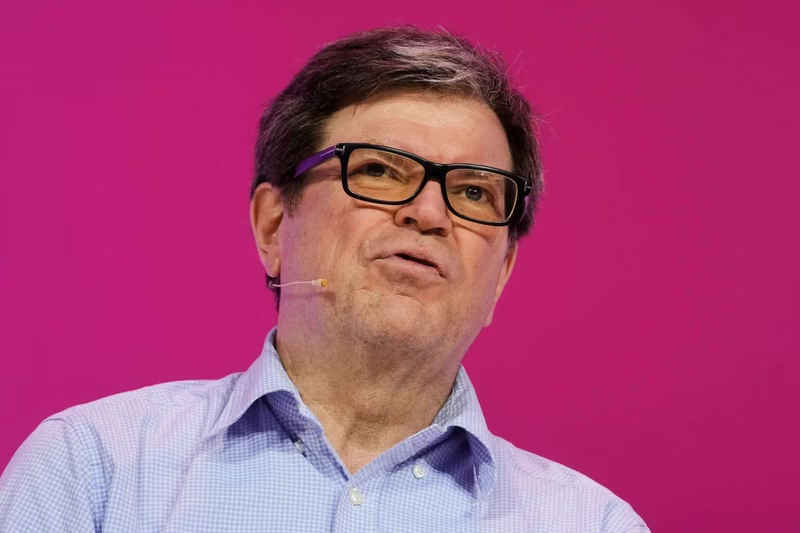
The AI world is reeling from a bombshell announcement: Yann LeCun, Meta’s chief AI scientist and a foundational figure in deep learning, is leaving the company after ten years. This isn’t just a high-profile resignation; it’s a stark declaration of war on the very foundation of today’s AI boom. LeCun, a Turing Award winner who helped build Meta’s esteemed FAIR (Fundamental AI Research) lab, has publicly labeled the company’s massive investment in Large Language Models (LLMs) as a ‘dead end’ on the path to true machine intelligence—a view that directly contradicts CEO Mark Zuckerberg’s multi-billion dollar ‘personal superintelligence’ agenda [[2], [15]].
Table of Contents
- The Parting of Ways: Why Yann LeCun Leaves Meta
- The ‘Dead End’ Debate: LeCun’s Critique of LLMs
- Zuckerberg’s Vision: Meta Bets Big on Superintelligence
- The Future of AI: World Models vs. Word Models
- Conclusion: A Fork in the Road for AI
- Sources
The Parting of Ways: Why Yann LeCun Leaves Meta
The news that Yann LeCun leaves Meta has sent shockwaves through Silicon Valley and the global tech community . For a decade, LeCun was the intellectual bedrock of Meta’s AI ambitions, guiding the FAIR lab to produce groundbreaking research, including the Llama series of open-source LLMs. His departure, however, appears to be the culmination of years of growing tension. Reports suggest that internal reorganizations within Meta’s AI teams have left LeCun and his FAIR group increasingly marginalized, their long-term, fundamental research deprioritized in favor of faster, product-driven LLM initiatives . This strategic shift created an irreconcilable rift between LeCun’s scientific vision and Zuckerberg’s aggressive commercial roadmap, ultimately leading to his decision to walk away .
The ‘Dead End’ Debate: LeCun’s Critique of LLMs
LeCun’s core argument is both simple and damning for the current AI status quo. He contends that while LLMs are impressive ‘word models’ capable of generating fluent text, they lack a crucial element: an understanding of the physical world . They are, in his view, ‘a dead end’ for achieving true artificial general intelligence (AGI) or superintelligence .
His criticism hinges on several key points:
- Lack of Semantic Grounding: LLMs operate on statistical correlations in text data, not on a genuine understanding of concepts, causality, or physics .
- Reasoning Deficiencies: They struggle with tasks requiring complex, multi-step reasoning or common-sense logic that humans find trivial .
- Diminishing Returns: Simply scaling up data, parameters, and compute power yields progressively smaller gains and cannot overcome these fundamental architectural flaws .
In essence, LeCun believes the industry is pouring trillions of dollars into a path that cannot lead to the kind of autonomous, reasoning machines we imagine as true AI.
Zuckerberg’s Vision: Meta Bets Big on Superintelligence
On the other side of this philosophical chasm stands Mark Zuckerberg, who is all-in on the LLM race. His vision for a ‘personal superintelligence’ is the cornerstone of Meta’s future, with the company planning to spend a staggering $65 billion on AI in 2025 alone . The centerpiece of this strategy is ‘Prometheus,’ a massive 1-gigawatt AI supercluster set to come online in 2026, designed to train the next generation of ever-larger LLMs [[17], [18]]. Zuckerberg has repeatedly stated his belief that ‘superintelligence is in sight,’ and his entire corporate strategy—from the future of advertising to the metaverse—is being rebuilt around this premise [[16], [20]]. LeCun’s public dissent and eventual departure represent a major challenge to this narrative, highlighting a deep internal conflict about the company’s technological soul.
The Future of AI: World Models vs. Word Models
So, if not LLMs, then what? LeCun is now championing an alternative path he calls ‘world models’ [[3], [15]]. This approach is inspired by how humans and animals learn: by building internal, predictive models of how the physical and social world works. A machine with a robust world model could understand cause-and-effect, predict the outcomes of its actions, and learn efficiently from far less data than current LLMs require .
The contrast is stark:
| Approach | Foundation | Primary Goal | LeCun’s View |
|---|---|---|---|
| Word Models (LLMs) | Statistical patterns in text | Generate human-like text and code | A technological ‘dead end’ for AGI |
| World Models | Physics, causality, and object permanence | Understand and interact with the real world | The true path to intelligent machines |
LeCun’s post-Meta mission is to prove this theory, likely through a new startup, betting that the future belongs to machines that can reason about the world, not just the words used to describe it .
Conclusion: A Fork in the Road for Artificial Intelligence
Yann LeCun’s exit from Meta is far more than a corporate reshuffle. It marks a critical fork in the road for the entire field of artificial intelligence. On one path is the well-funded, mainstream pursuit of supercharged LLMs, backed by tech giants like Meta, OpenAI, and Google. On the other is LeCun’s heretical but scientifically grounded vision of building machines that learn like humans do. This public schism forces a long-overdue question: are we building truly intelligent systems, or just incredibly sophisticated parrots? The answer will shape the next decade of technological progress. For more on the evolving battle for AI supremacy, see our deep dive on [INTERNAL_LINK:ai-strategy-battle].
Sources
- Times of India: Meta’s most famous employee Yann LeCun breaks silence…
- MIT Technology Review: Meta’s Chief AI Scientist Leaving to Launch Startup
- Wired: Yann LeCun Is Reportedly Leaving Meta to Chase “World Models”
- Forbes: Meta AI Chief Yann LeCun Notes Limits of Large Language Models
- The Verge: Zuckerberg Unveils ‘Personal Superintelligence’ Vision