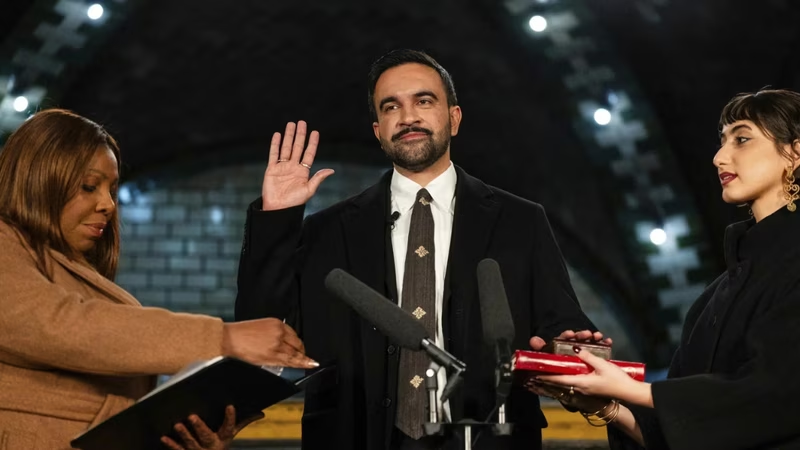
In a diplomatic and political firestorm, India’s ruling Bharatiya Janata Party (BJP) has launched a fierce counter-attack against New York City Mayor Zohran Mamdani. The trigger? A simple, yet politically explosive, note of solidarity from the 34-year-old mayor to jailed Indian activist Umar Khalid. The BJP’s response was swift and unequivocal: “Who is he to question?” they demanded, framing the gesture as a brazen act of foreign interference in India’s internal affairs [[1], [5]].
This controversy has reignited a heated debate about national sovereignty, the role of international opinion in domestic legal matters, and the global attention the Delhi riots conspiracy case continues to attract. At its heart lies the fate of Umar Khalid, a figure who has become a lightning rod for discussions on justice, dissent, and national security in India.
Table of Contents
- Who is Zohran Mamdani, the New York City Mayor?
- Umar Khalid and the Delhi Riots Conspiracy Case: A Brief Overview
- BJP Slams Umar Khalid Support as ‘Anti-India’ Interference
- The Broader US Political Context: More Than Just One Mayor
- Why This Controversy Matters for India’s Global Image
- Conclusion: Sovereignty, Solidarity, and a Deepening Divide
- Sources
Who is Zohran Mamdani, the New York City Mayor?
Before this diplomatic row, Zohran Mamdani was a rising star in American progressive politics. Elected as the 112th mayor of New York City in 2025, he is the city’s first mayor of Ugandan-Indian descent . Born in Kampala, Uganda, and moving to New York at the age of seven, Mamdani’s political career is rooted in democratic socialism, a stance that often puts him at odds with more centrist members of his own Democratic Party [[21], [22]].
His note to Umar Khalid, which reportedly referenced the importance of not letting “bitterness” consume oneself, appears to be an extension of his long-standing advocacy for human rights and social justice, even on a global scale . However, in the Indian political context, this act has been interpreted not as solidarity but as a direct challenge to the nation’s judicial system.
Umar Khalid and the Delhi Riots Conspiracy Case: A Brief Overview
For those unfamiliar, Umar Khalid is a former JNU student leader who has been incarcerated since 2020. He is a prime accused in the investigation led by Delhi Police into the communal violence that erupted in the national capital in February 2020, resulting in over 50 deaths .
He has been charged under the stringent Unlawful Activities (Prevention) Act (UAPA) for his alleged role in a larger conspiracy to orchestrate the riots. His legal team and various human rights organizations have consistently argued that his detention is a case of political persecution and a violation of his right to a fair and speedy trial. As of late 2025, his bail applications have been repeatedly rejected by the courts, though he was recently granted provisional bail to attend his sister’s wedding [[10], [15]].
BJP Slams Umar Khalid Support as ‘Anti-India’ Interference
The BJP’s reaction to Mamdani’s note was one of unbridled fury. Party leaders accused the New York mayor of being part of an “anti-India lobby” that seeks to undermine the nation’s sovereignty . Their core argument is simple and powerful: an outsider, no matter how high their office, has no right to comment on or show support for an individual who stands accused of serious anti-national activities in an active court case.
“India will not tolerate any interference in its internal matters,” a BJP spokesperson stated firmly . The party has framed this as a matter of national pride and judicial independence, arguing that the Indian democracy and its legal system are fully capable of handling its own affairs without external commentary, especially from those who, in their view, may not fully understand the complexities of the case or the gravity of the charges against Khalid .
The Broader US Political Context: More Than Just One Mayor
It’s crucial to note that Mamdani is not acting in a vacuum. His note arrives on the heels of a more formal intervention just days before. On January 1, 2026, a group of eight US lawmakers wrote a letter to the Indian government expressing their “deep concern” over Umar Khalid’s prolonged detention and urging that he be granted bail and a “fair trial” [[12], [13]].
This emerging pattern of US political figures weighing in on the Umar Khalid case has clearly put the Indian government on the defensive. The BJP has begun to link these events to domestic political opponents, suggesting a coordinated international effort to pressure India. They see Mamdani’s personal note as an extension of this broader political pressure campaign .
Why This Controversy Matters for India’s Global Image
This episode is a classic collision between two powerful narratives:
- The Indian Sovereignty Narrative: Championed by the BJP, this view holds that any external comment on an active legal case is a violation of national sovereignty and an insult to the country’s robust democratic institutions.
- The International Human Rights Narrative: This perspective, represented by Mamdani and the US lawmakers, focuses on the length of pre-trial detention under a tough anti-terror law and raises questions about due process, which are of concern to the global human rights community. For a deeper look at international legal perspectives, see the Office of the United Nations High Commissioner for Human Rights.
The controversy forces India to navigate a delicate balance. On one hand, it must defend its judicial autonomy. On the other, it must address genuine international concerns about its human rights record without appearing defensive or authoritarian. It also presents a strategic opportunity for [INTERNAL_LINK:india-foreign-policy-challenges] analysis.
Conclusion: Sovereignty, Solidarity, and a Deepening Divide
The BJP’s sharp rebuke of New York City Mayor Zohran Mamdani over his supportive note to Umar Khalid is far more than a simple diplomatic spat. It is a stark manifestation of the growing tension between India’s assertion of its sovereign judicial rights and the global community’s watchful eye on its democratic and legal processes.
While the BJP sees this as a straightforward case of foreign overreach, the repeated interventions from US political figures suggest that the world is paying close attention to how the Delhi riots conspiracy case unfolds. The core question remains unresolved: where is the line between legitimate international concern for human rights and unacceptable interference in a nation’s internal legal matters? For now, the Indian government’s answer is clear: that line has been crossed.
Sources
- Times of India: Who is he to question? BJP on New York Mayor Zohran Mamdani’s Umar Khalid note
- The Hindu: Umar Khalid’s Bail Application Tracker
- Wikipedia: Zohran Mamdani
- NDTV: Eight US lawmakers urge India to grant bail to Umar Khalid