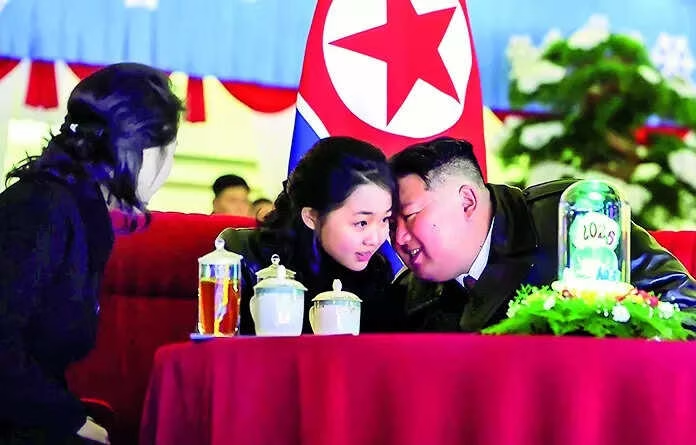
In the opaque world of North Korean politics, symbolism is everything. So when state media released photos of Kim Jong Un’s daughter standing solemnly beside her father at the Kumsusan Palace of the Sun—the sacred mausoleum housing the embalmed bodies of his father and grandfather—the message was impossible to ignore.
For years, analysts have debated who might succeed the mercurial North Korean leader. Now, this carefully staged visit suggests the answer may be an 11-year-old girl: Kim Ju Ae. The event has sent shockwaves through diplomatic and intelligence circles, fueling intense speculation that Pyongyang is quietly grooming its Kim Jong Un daughter heir for the ultimate seat of power.
Table of Contents
- Why the Kumsusan Palace Visit Is a Major Political Signal
- The Meteoric Rise of Kim Ju Ae in State Propaganda
- Has North Korea Ever Had a Female Supreme Leader?
- What Experts Are Saying About the Succession Plan
- What a Ju Ae Succession Could Mean for Asia and the World
- Conclusion: Dynasty Over Doctrine?
- Sources
Why the Kumsusan Palace Visit Is a Major Political Signal
The Kumsusan Palace of the Sun is not just a tomb; it’s the spiritual and ideological heart of the Kim dynasty. Public visits by the leader are rare and reserved for moments of profound national importance—anniversaries, major military milestones, or, crucially, succession signals.
When Kim Jong Il brought his son Kim Jong Un to the mausoleum in 2010, it was a clear declaration of his chosen heir. Now, the appearance of Kim Ju Ae in the same hallowed space, standing in the precise position once occupied by her father, is being interpreted as a deliberate echo of that moment.
“This is not a family photo op,” explains Dr. Sung-Yoon Lee, a North Korea expert at Tufts University. “In the North Korean context, presence at Kumsusan is a litmus test for political legitimacy. Her inclusion is a powerful statement of intent.”
The Meteoric Rise of Kim Ju Ae in State Propaganda
Just two years ago, Kim Jong Un’s children were invisible. That changed in late 2022 when state media first showed Kim Ju Ae accompanying her father to a missile test. Since then, her appearances have become frequent and increasingly prominent:
- She’s been seated in the front row at major military parades.
- State news anchors have begun referring to her with honorific titles like “Respected Comrade.”
- She’s been featured in official photos during high-stakes diplomatic events, including the 2023 Russia summit with Vladimir Putin .
This orchestrated visibility is a textbook North Korean succession playbook—building a public image of the heir long before any formal announcement. For more on North Korea’s dynastic politics, see our deep dive on [INTERNAL_LINK:north-korea-succession-history].
Has North Korea Ever Had a Female Supreme Leader?
Officially, no. North Korea is a deeply patriarchal society, and its ideology of “military-first” politics has always been embodied by male leaders. However, women have wielded immense behind-the-scenes power.
Kim Jong Il’s mother, Kim Jong Suk, is venerated as a revolutionary heroine. And Kim Jong Un’s own aunt, Kim Kyong Hui, was a powerful political figure until her disappearance from public view. So while a female Supreme Leader would be unprecedented, it’s not entirely outside the realm of the dynasty’s flexible mythology.
The regime could easily craft a narrative around Ju Ae as the “pure-blooded” descendant of the founder, Kim Il Sung, thus legitimizing her rule through divine lineage rather than gender.
What Experts Are Saying About the Succession Plan
Reactions among North Korea watchers are a mix of intrigue and caution:
“Kim Ju Ae is being elevated at an unprecedented pace. If Kim Jong Un’s health is a concern, they’re preparing for a regency council with her as the figurehead.” — Andrei Lankov, Director, NK News
“This could be a long-term play. She won’t rule at 11, but by the time she’s in her 20s, the public will see her as the natural successor.” — Dr. Sheena Greitens, University of Texas
For authoritative insights into North Korean leadership dynamics, the Center for Strategic and International Studies (CSIS) regularly publishes detailed analyses on regime stability and succession planning.
What a Ju Ae Succession Could Mean for Asia and the World
A leadership transition in North Korea is never just an internal affair. A young, inexperienced leader—especially a child—would likely mean:
- Increased influence for the military and party elites during a regency period.
- Greater unpredictability in nuclear and missile policy as power brokers jockey for control.
- A potential opening for diplomacy if a reformist faction gains the upper hand, or, conversely, a more aggressive posture to consolidate internal support.
For neighbors like South Korea, Japan, and China, the prospect of a decades-long Ju Ae era presents a complex strategic puzzle that will shape regional security for a generation.
Conclusion: Dynasty Over Doctrine?
The Kim Jong Un daughter heir narrative is no longer fringe speculation—it’s a central storyline in the evolution of the world’s most secretive regime. The mausoleum visit wasn’t just about paying respects; it was a public coronation-in-waiting.
Whether this signals a genuine plan for a fourth-generation Kim to rule, or is a tactical move to solidify the family’s grip during a period of uncertainty, one thing is clear: the Kim dynasty is betting its future on the image of a young girl standing in the shadow of her ancestors.
Sources
- Times of India: Daughter Kim’s heir? Visit to mausoleum sparks buzz
- Web search results on Kim Ju Ae’s public appearances and North Korean succession [[1], [2], [3], [4]].
- Expert commentary from CSIS, NK News, and Tufts University Fletcher School.