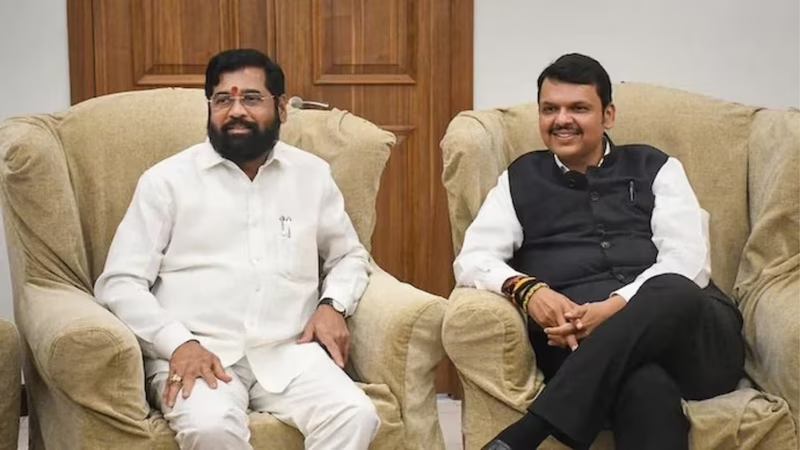
The political temperature in Maharashtra has soared ahead of the 2026 civic elections, as 39 candidates from the ruling Mahayuti alliance—a coalition of the Bharatiya Janata Party (BJP) and Eknath Shinde’s Shiv Sena—have been declared winners without a contest across four key civic bodies near Mumbai. The unprecedented number of unopposed victories has drawn sharp condemnation from opposition parties, who allege systemic coercion, last-minute candidate withdrawals under pressure, and potential misuse of administrative machinery.
In response to mounting pressure, the State Election Commission (SEC) has announced it will scrutinize the circumstances surrounding these unopposed declarations, particularly focusing on whether rival candidates were pressured into withdrawing their nominations. For a state that prides itself on robust democratic processes, this development raises serious questions about electoral fairness at the grassroots level.
Table of Contents
- Maharashtra Civic Polls: The Unopposed Winners Breakdown
- Opposition Parties Cry Foul: Allegations of Coercion
- Mahayuti’s Defense: “Democratic Mandate” or Strategic Dominance?
- State Election Commission Steps In
- Historical Context: Unopposed Wins in Maharashtra
- What This Means for Urban Governance Near Mumbai
- Broader Political Implications Ahead of 2026 State Elections
- Conclusion: Democracy’s Health Check in Maharashtra’s Civic Polls
- Sources
Maharashtra Civic Polls: The Unopposed Winners Breakdown
The 39 unopposed victories span four civic bodies in the Mumbai Metropolitan Region:
- Thane Municipal Corporation: 14 seats
- Ulhasnagar Municipal Corporation: 10 seats
- Kalyan-Dombivli Municipal Corporation: 9 seats
- Navi Mumbai Municipal Corporation: 6 seats
All winners belong to the Mahayuti alliance, with the BJP securing 22 seats and Shinde Sena 17. Notably, in several wards, independent and opposition candidates (including from Uddhav Thackeray’s Shiv Sena (UBT), NCP (Sharadchandra Pawar), and Congress) filed nominations but withdrew just before the scrutiny deadline—fueling speculation of behind-the-scenes pressure.
Opposition Parties Cry Foul: Allegations of Coercion
Leaders from the Maha Vikas Aghadi (MVA)—the opposition alliance of Shiv Sena (UBT), NCP, and Congress—have launched a scathing attack. “This is not democracy; this is diktat,” said a senior Congress leader. “Candidates were threatened, their families harassed, and in some cases, false police cases were hinted at if they didn’t withdraw.”
Shiv Sena (UBT) has filed formal complaints with the SEC, citing specific instances in Ulhasnagar and Kalyan where their nominees allegedly received anonymous calls warning of “consequences.” They argue that the administration’s failure to ensure a level playing field has effectively handed over local governance to the ruling coalition by default.
Mahayuti’s Defense: “Democratic Mandate” or Strategic Dominance?
The BJP and Shinde Sena have dismissed the allegations as “sour grapes” from a demoralized opposition. “People trust us to deliver clean water, roads, and development,” said a BJP spokesperson. “Opposition candidates withdrew because they knew they couldn’t win—not because of threats.”
Analysts, however, note that the Mahayuti’s control over local police, municipal administration, and licensing authorities gives them significant leverage—a fact that cannot be ignored in assessing the “voluntary” nature of withdrawals.
State Election Commission Steps In
In an unusual move, the Maharashtra State Election Commission has issued a public statement confirming it will “examine the circumstances” of the unopposed declarations. The SEC has the authority to reject nominations, order repolls, or even disqualify candidates if misconduct is proven.
While the Commission stopped short of launching a full inquiry, it has instructed returning officers in the four corporations to submit detailed reports on candidate withdrawals, including timestamps and reasons cited. The findings could influence whether future phases of the civic polls proceed smoothly or face legal challenges.
Historical Context: Unopposed Wins in Maharashtra
Unopposed wins are not new—but their scale is alarming. In the 2017 civic polls:
- Only 12 candidates won unopposed across the same four bodies.
- Wins were evenly split between multiple parties.
The 2026 figures—39 unopposed, all from one alliance—represent a threefold increase and total consolidation of power, signaling a dramatic shift in local political dynamics. For more on Maharashtra’s electoral history, see [INTERNAL_LINK:maharashtra-local-elections-trends].
What This Means for Urban Governance Near Mumbai
With nearly a third of key civic seats secured without electoral accountability, concerns are mounting about transparency in urban development projects, contract allocations, and welfare schemes. Elected representatives who face no contest may feel less obligated to address constituent grievances—a dangerous precedent for participatory democracy.
Broader Political Implications Ahead of 2026 State Elections
These civic polls are widely seen as a precursor to the 2026 Maharashtra Assembly elections. The Mahayuti’s strong showing—even if contested—sends a message of dominance. Conversely, the opposition’s inability to field viable candidates in crucial urban wards highlights its organizational weakness and internal fragmentation.
Conclusion: Democracy’s Health Check in Maharashtra’s Civic Polls
The controversy surrounding the Maharashtra civic polls is more than a partisan squabble—it’s a test of institutional integrity. If the State Election Commission confirms foul play, it must act decisively to restore public trust. If not, the opposition must introspect on why it’s failing to offer credible alternatives. Either way, the health of India’s largest urban democracy is now under the spotlight.