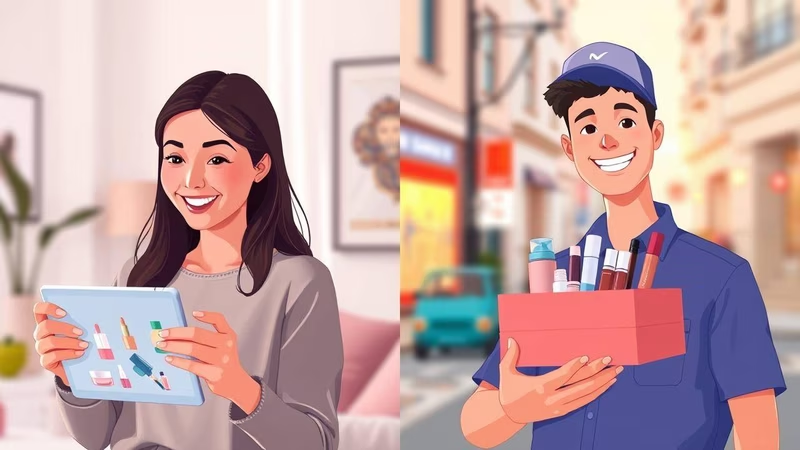
Imagine this: you’re getting ready for a date night, and you realize your favorite serum is empty. Ten minutes later, a delivery executive rings your doorbell—with the exact product in hand. No planning, no waiting, no cart abandonment. This isn’t a scene from a sci-fi movie; it’s the new reality of beauty shopping in urban India, powered by the explosive rise of quick commerce.
According to recent data, beauty and personal care (BPC) products have become one of the fastest-growing categories on quick commerce platforms, with sales soaring by a staggering 160% year-over-year. Once dominated by groceries and snacks, apps like Blinkit, Zepto, and Swiggy Instamart are now transforming into full-fledged beauty marketplaces—ushering in a new era of “glow-on-demand” .
Table of Contents
- The Quick Commerce Beauty Boom: By the Numbers
- Why Beauty Is the Perfect Fit for Quick Commerce
- Global & D2C Brands Race to Secure Shelf Space
- How Consumer Behavior Is Driving This Shift
- Challenges and Opportunities in the Beauty Q-Commerce Space
- The Future of Instant Beauty: What’s Next?
- Conclusion: Beauty Is No Longer a Luxury—It’s a 10-Minute Click Away
- Sources
The Quick Commerce Beauty Boom: By the Numbers
The statistics speak volumes. While quick commerce (q-commerce) initially gained traction with staples like fruits, vegetables, and instant noodles, the BPC category has now emerged as a major revenue driver. A recent industry analysis reveals:
- 160% YoY growth in beauty and personal care sales on quick commerce platforms.
- Skincare products (moisturizers, serums, sunscreens) account for over 60% of BPC sales on these apps.
- Average order value (AOV) for beauty items on q-commerce is 25–30% higher than traditional e-commerce.
- Over 50 global and domestic beauty brands have now partnered with major quick commerce players to ensure real-time inventory in micro-fulfillment centers.
This isn’t just a fad—it’s a structural shift in how Indians discover, trial, and repurchase beauty products.
Why Beauty Is the Perfect Fit for Quick Commerce
At first glance, beauty might seem like an odd fit for a model built on speed. But dig deeper, and it makes perfect sense.
First, beauty products are small, lightweight, and easy to store—ideal for the compact dark stores that power quick commerce logistics. Second, many beauty purchases are **impulse-driven** or **last-minute replenishments** (think: running out of micellar water before a trip). Third, the 10–15 minute delivery window reduces the “decision fatigue” that plagues traditional e-commerce, where shoppers abandon carts after hours of comparison.
As one industry insider put it: “When you can get a sheet mask faster than your pizza, you stop thinking of beauty as a planned purchase—it becomes a spontaneous self-care act.”
Global & D2C Brands Race to Secure Shelf Space
The surge hasn’t gone unnoticed by brands. Legacy players like L’Oréal, Garnier, and Mamaearth are now prioritizing q-commerce as a core sales channel—not just an add-on. Meanwhile, digitally native D2C brands (like Plum, Re’equil, and Minimalist) are leveraging these platforms to drive trial and accelerate customer acquisition.
Unlike traditional e-commerce, where SEO and ads dictate visibility, quick commerce success hinges on **inventory placement** and **category velocity**. Brands that can guarantee fast turnover get prime placement in the app’s beauty section—creating a virtuous cycle of visibility and sales. This is why many are now running **q-commerce-exclusive bundles** or limited-edition minis to encourage first-time buyers.
How Consumer Behavior Is Driving This Shift
The real engine behind this boom? Changing consumer expectations.
Today’s urban Indian shopper—especially Gen Z and millennials—values **convenience over cost** and **speed over selection**. A survey by RedSeer Consulting found that over 68% of q-commerce users would pay a small premium for guaranteed 15-minute delivery of beauty essentials .
Moreover, the ability to **repurchase a trusted product instantly** eliminates the friction of logging into a separate beauty app or waiting 2–3 days for delivery. This “habit loop” is proving sticky: once a customer buys a serum via Blinkit once, they’re 3x more likely to repurchase it the same way.
Challenges and Opportunities in the Beauty Q-Commerce Space
Despite the hype, challenges remain. Counterfeit products, lack of personalized recommendations, and limited product education (no virtual try-ons or reviews) are real concerns. Also, the **unit economics** of delivering a ₹299 face wash in 10 minutes are razor-thin—unless bundled with higher-margin items.
Yet, the opportunities are immense:
- Hyperlocal personalization: Using location data to recommend sunscreens in Mumbai or hydrating creams in Delhi.
- Subscription integration: Auto-replenishment of daily essentials like toner or deodorant.
- Offline-to-online bridge: Beauty counters in malls could offer QR codes for instant home delivery of samples.
For more on the future of retail, see our deep-dive on [INTERNAL_LINK:future-of-retail-india].
The Future of Instant Beauty: What’s Next?
Experts predict that by 2027, quick commerce could account for **up to 25% of all online beauty sales** in India’s top 10 cities. We’ll likely see:
- AI-powered “beauty SOS” features (e.g., “I have a pimple—deliver spot treatment now!”).
- Partnerships with dermatologists for on-demand consultations + instant product delivery.
- Expansion beyond skincare into haircare, makeup, and even premium fragrances.
Conclusion: Beauty Is No Longer a Luxury—It’s a 10-Minute Click Away
The rise of beauty in quick commerce isn’t just about faster delivery—it’s a cultural shift. Self-care is becoming spontaneous, accessible, and seamlessly integrated into daily life. For brands, this is a wake-up call: the future of beauty isn’t in flashy campaigns alone, but in being available the moment a consumer decides they need it. And in urban India, that moment is now.