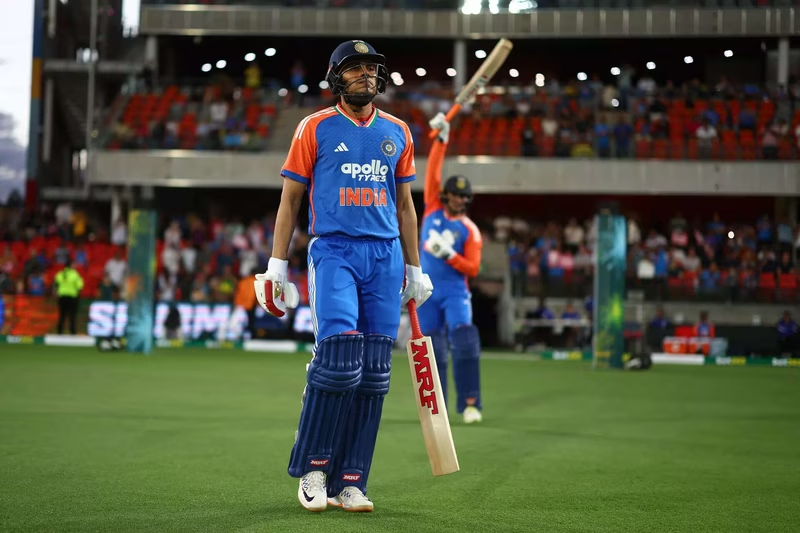
The cricketing community is in an uproar. Just weeks after being named vice-captain, Shubman Gill finds himself on the outside looking in, omitted from India’s T20 World Cup squad. This baffling decision has sparked a fierce debate, with former India cricketer Yograj Singh leading the charge of critics, calling the move a colossal mistake in player management.
Table of Contents
- The Gill Omission: A Shocking Turn of Events
- Yograj Singh’s Scathing Critique
- Shubman Gill Dropped: What Do the Stats Really Say?
- Decoding the Selection Panel’s Strategy
- The Long-Term Vision vs. Short-Term Fix Dilemma
- Conclusion: A Question of Faith in Young Talent
- Sources
The Gill Omission: A Shocking Turn of Events
For a player of Shubman Gill’s caliber, his exclusion from the biggest T20 tournament on the planet was nothing short of a seismic shock. His recent role as vice-captain in the preceding T20I series against South Africa painted a clear picture: the team management saw him as a leader of the future. So, why the sudden U-turn? The official line from the Ajit Agarkar-led selection committee has been one of “team balance” and “current form in the specific format,” but this explanation has left many fans and experts unsatisfied .
Yograj Singh’s Scathing Critique
Yograj Singh, a respected voice in Indian cricket, did not mince his words. He slammed the selectors, calling the decision to drop Shubman Gill “inconsistent” and shortsighted . Drawing a powerful parallel from his own era, Singh invoked the memory of the 1983 World Cup, where legends like Kapil Dev and Bishan Singh Bedi were backed through rough patches, a faith that ultimately led to historic glory .
His core argument is simple yet profound: great players are not built on the foundation of constant selection, but on the faith shown in them during their toughest times. “Just 4–5 failed innings?” Singh questioned, highlighting that Gill’s recent struggles should not overshadow his immense talent and past contributions . This public criticism from a former player adds significant weight to the growing narrative that the selectors may have panicked over a temporary dip in form.
Shubman Gill Dropped: What Do the Stats Really Say?
Let’s cut through the noise and look at the numbers. Gill’s T20I career has been a mixed bag, which is the primary fuel for the selection debate.
In 2024, he played 8 T20Is, scoring 227 runs at an average of around 32, with a high score of 66 . While not spectacular, it wasn’t a complete collapse. However, his overall T20I record prior to the squad announcement stood at 869 runs in 36 matches at an average of 28.03 and a strike rate of just over 126 . For a top-order batter in the modern T20 game, a strike rate in the mid-120s can be seen as a liability by a committee obsessed with explosive starts.
On the flip side, Gill’s ODI and Test records are stellar, proving his class and temperament. The argument from his supporters is that his skill-set is too valuable to discard over a format-specific struggle, especially when he was being groomed for a leadership role.
Decoding the Selection Panel’s Strategy
Chief selector Ajit Agarkar and captain Rohit Sharma have defended their choices, emphasizing the need for a specific balance and players who are in peak form for the T20 format . The squad leans heavily on power-hitters and versatile all-rounders like Hardik Pandya, whose presence, Agarkar claims, is “irreplaceable” for the team’s balance .
The inclusion of players like Rinku Singh, who offers a left-handed power option in the middle order, seems to have come at Gill’s expense. The panel appears to have prioritized immediate, high-impact potential in the death overs over Gill’s more classical, albeit sometimes slower, approach at the top. It’s a high-risk, high-reward strategy that has clearly ruffled feathers.
The Long-Term Vision vs. Short-Term Fix Dilemma
This controversy has reignited a fundamental question in Indian cricket: is the team being built for a decade, or just for the next tournament?
By dropping a young, world-class batter like Gill, the selectors are sending a message that even vice-captaincy is no guarantee of security if form dips in a single format. This could have a chilling effect on other young players, making them risk-averse for fear of a single bad series.
Conversely, the panel’s decision could be seen as a necessary, albeit harsh, message about the ruthless nature of modern T20 cricket, where adaptability is key. The path forward is fraught with tension between these two philosophies. For more on the evolving face of T20 cricket, see our analysis on [INTERNAL_LINK:t20-cricket-evolution].
Conclusion: A Question of Faith in Young Talent
The decision to drop Shubman Gill is far more than just a team selection. It’s a statement about the values and philosophy of the current Indian cricket administration. Yograj Singh’s passionate outburst represents a significant section of the cricketing community that believes in nurturing talent through its valleys, not just its peaks. As the T20 World Cup unfolds, the world will be watching to see if the selectors’ gamble on short-term explosiveness pays off, or if the absence of a proven match-winner like Gill proves to be a costly oversight.