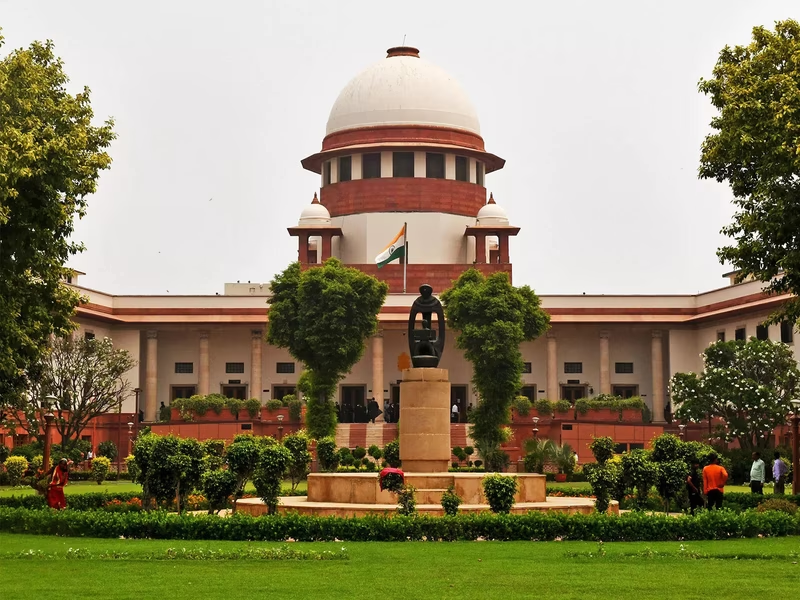
In a decisive judgment that recalibrates the balance of power between the judiciary and investigative agencies, the Supreme Court of India has delivered a clear message: courts should keep their hands off the investigation timeline—unless there’s a serious, unjustifiable delay. This ruling is a direct response to a growing trend where High Courts and lower courts were routinely slapping deadlines on police and central agencies, a practice the apex court now deems as a form of judicial overreach that can cripple a complex probe.
If you’ve ever wondered who’s really in charge of a criminal investigation in India, this ruling provides a definitive answer. It’s a win for police autonomy but also a crucial safeguard for the public’s right to a timely and fair investigation.
Table of Contents
- Why the Supreme Court Intervened
- Key Takeaways from the Judgment
- The Delicate Balance: Judicial Activism vs. Restraint
- What This Means for Investigative Agencies and Citizens
- Conclusion: A Framework for Fair and Effective Justice
- Sources
Why the Supreme Court Intervened
The Supreme Court’s ruling wasn’t born in a vacuum. It came as a corrective measure against a widespread judicial practice that, while well-intentioned, was causing more harm than good. Many courts, in their zeal to ensure prompt justice, were issuing orders to wrap up investigations within arbitrary timeframes—sometimes as short as a few weeks—without fully appreciating the intricate, often global, nature of modern criminal cases.
The Court recognized that an investigation is not a simple, linear task. It involves collecting evidence, tracking down witnesses who may be across the country or even overseas, conducting forensic analyses, and following numerous leads, many of which can be dead ends. To force this complex process into a rigid, court-mandated box is to risk a shoddy, incomplete probe that could let the guilty walk free or, worse, frame the innocent .
Key Takeaways from the Judgment
The apex court’s judgment provides a clear, two-pronged framework for when a court can intervene with a deadline:
- No Prophylactic Timelines: Courts cannot impose investigation deadlines as a standard, preventative measure. It is not their role to manage the day-to-day logistics of an investigation.
- Reactive Intervention Only: A timeline can be imposed only as a last resort, when there is concrete, on-record evidence of an unjustified delay or stagnation in the probe. The burden of proof for this delay lies with the party seeking the deadline.
Essentially, the Court has shifted the paradigm from a proactive to a reactive one. As one legal expert put it, investigation deadlines are now the “exception, not the norm” . This places the autonomy of the investigative process back where it belongs—with the police and agencies like the CBI or NIA, who are trained and equipped for the job.
The Delicate Balance: Judicial Activism vs. Restraint
This judgment is a textbook case of the Indian judiciary reining in its own activist tendencies in favor of judicial restraint. For decades, Indian courts have been lauded for their proactive role in public interest litigation, often stepping in to fill gaps left by the executive. However, this intervention in the operational domain of criminal investigations was seen as a step too far .
True judicial power, the Court implied, lies not in micromanaging other branches of the state but in ensuring they function within the bounds of the law. By asking courts to hold back unless there’s a clear failure, the Supreme Court is reinforcing the principle of separation of powers—a cornerstone of our democracy .
This move strengthens the system by preventing lower courts from becoming a de facto investigation management committee, a role for which they have neither the expertise nor the resources.
What This Means for Investigative Agencies and Citizens
The implications of this ruling are significant for all stakeholders in the criminal justice system.
For Police and Central Agencies
This is a major win for their operational independence. They can now conduct their investigations without the constant, looming pressure of an arbitrary court deadline. This should, in theory, lead to more thorough and professional probes. However, this freedom comes with a heavy responsibility. The judgment is not a blanket license for inaction. Agencies must now be even more diligent in documenting their progress to demonstrate that a probe is active and not stagnant, should their conduct ever be questioned in court.
For Citizens (Accused and Victims)
For the accused, this ruling is a safeguard against a rushed investigation that could lead to a false charge sheet. For victims and their families, it offers a more nuanced protection. While they can no longer demand a blanket deadline, they are now armed with a clearer legal standard. If they can prove that an investigation has genuinely stalled without reason—perhaps through a series of unfulfilled promises or complete inaction from the investigating officer—they have a strong legal footing to ask a court to intervene and set a reasonable timeline .
For those following similar legal battles, our coverage on [INTERNAL_LINK:rights_of_accused_in_india] provides further context on the evolving landscape of criminal justice.
Conclusion: A Framework for Fair and Effective Justice
The Supreme Court’s ruling on investigation deadlines is a masterstroke in legal clarity. It successfully walks the tightrope between two fundamental rights: the citizen’s right to a speedy investigation and the state’s need for a comprehensive, unhurried probe to uncover the truth. By restricting court-imposed timelines to cases of demonstrable delay, the Court has created a framework that respects police autonomy while holding them accountable for genuine inaction. This is not a step backward for justice, but a strategic move forward towards a more robust and reliable criminal justice system.