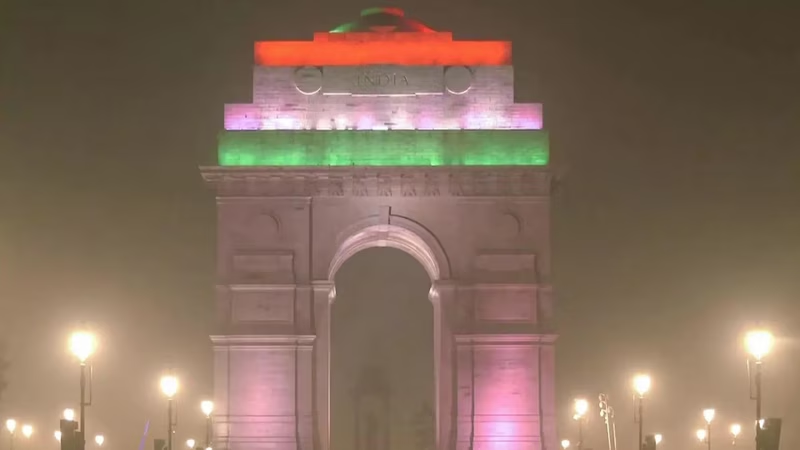
For the first time in over a week, residents of India’s capital woke up to something resembling clean air. Thanks to a timely combination of chilly winds and favorable weather, Delhi pollution levels have finally begun to recede. The city’s Air Quality Index (AQI) dropped to 235 on Saturday, January 3, 2026—officially moving from the “very poor” to the “poor” category and prompting authorities to lift the strictest emergency measures under the Graded Response Action Plan (GRAP). But before you stash your N95 masks, experts urge caution: this improvement is fragile, temporary, and by no means a sign that the smog crisis is over.
In this detailed update, we break down what changed, what restrictions have been rolled back, why the air is still unsafe for vulnerable groups, and what you can do to protect yourself—even as the city takes a cautious step back from emergency mode.
Table of Contents
- Delhi Pollution: What Drove the Improvement?
- GRAP Stage-III Lifted: What Does It Mean?
- Current AQI and Health Implications
- What Measures Remain in Place?
- Why Delhi Still Isn’t Out of the Woods
- How to Stay Safe During Poor Air Quality
- Conclusion: A Temporary Reprieve, Not a Solution
- Sources
Delhi Pollution: What Drove the Improvement?
The primary reason for the drop in pollution isn’t policy—it’s the weather. On Saturday morning, Delhi experienced a welcome shift in meteorological conditions:
- Increased wind speed: Surface winds picked up to 10–15 km/h, helping disperse stagnant pollutants that had accumulated over days.
- Lower humidity: Reduced moisture in the air minimized the formation of secondary particulates like sulfates and nitrates.
- Shallow but effective mixing layer: Even a modest increase in vertical air mixing helped lift pollutants away from ground level .
According to the System of Air Quality and Weather Forecasting and Research (SAFAR), these conditions temporarily overcame the usual winter inversion that traps smog close to the surface—a phenomenon that typically worsens air quality every December and January .
GRAP Stage-III Lifted: What Does It Mean?
The Graded Response Action Plan (GRAP) is a set of emergency protocols activated by the Commission for Air Quality Management (CAQM) based on real-time AQI readings. Stage-III kicks in when AQI remains in the “very poor” range (301–400) for 48 hours or more.
With the AQI now at 235—firmly in the “poor” category (201–300)—authorities have officially revoked Stage-III measures. This means the following restrictions are no longer in force :
- Ban on diesel generator sets (except for emergency services).
- Suspension of brick kilns, hot mix plants, and stone crushers.
- Entry restrictions on trucks carrying non-essential goods.
- Complete stoppage of construction activities larger than 5,000 sq.m.
However, don’t expect a return to business as usual just yet.
Current AQI and Health Implications
An AQI of 235 still falls under the “poor” category, which the Central Pollution Control Board (CPCB) defines as posing health risks—especially for sensitive groups:
- Children and elderly may experience respiratory symptoms like coughing or breathlessness.
- People with asthma, COPD, or heart disease are advised to avoid prolonged outdoor exertion.
- Even healthy adults may feel throat irritation or fatigue with extended exposure .
For context, “good” air quality is below 50. At 235, PM2.5 levels are still more than 9 times the WHO’s recommended 24-hour limit of 15 µg/m³ .
What Measures Remain in Place?
While Stage-III is lifted, GRAP Stages I and II remain active. This means several key restrictions are still enforced:
- Mechanical and anti-smog gun sweeping on major roads.
- Strict action against open waste burning and illegal industrial emissions.
- Enhanced public transport frequency to reduce private vehicle use.
- Continuous monitoring of polluting industries in NCR .
Authorities have also urged citizens to continue avoiding firecrackers, minimize car trips, and report any visible smoke or dust violations.
[INTERNAL_LINK:how-to-check-delhi-aqi-in-real-time] Staying informed through real-time AQI apps like SAMEER or AirVisual can help you plan outdoor activities safely.
Why Delhi Still Isn’t Out of the Woods
Meteorologists warn that this respite could be short-lived. Weather models from the India Meteorological Department (IMD) suggest wind speeds may drop again by mid-week, potentially allowing pollutants to re-accumulate .
Moreover, the root causes of Delhi pollution—vehicle emissions, industrial discharge, power plant coal burning, and seasonal crop stubble burning in Punjab and Haryana—remain largely unaddressed. Without systemic reforms, every winter will bring another smog emergency.
How to Stay Safe During Poor Air Quality
Even with GRAP Stage-III lifted, take these precautions:
- Limit outdoor exercise between 7 AM and 11 AM, when pollution peaks.
- Use an N95 or N99 mask if you must go out for extended periods.
- Keep windows closed during high-pollution hours; use an air purifier indoors.
- Stay hydrated and consume antioxidant-rich foods (like berries, spinach, and nuts) to combat oxidative stress .
Conclusion: A Temporary Reprieve, Not a Solution
The improvement in Delhi pollution is a welcome relief—but it’s a weather-driven pause, not a policy victory. The lifting of GRAP Stage-III should not be mistaken for a return to clean air. With AQI still in the “poor” range, health risks persist, and the underlying structural issues remain untouched. For Delhi’s 20 million residents, vigilance, personal protection, and sustained pressure for long-term environmental reform are more critical than ever.
Sources
- Times of India: “Delhi AQI improves to poor at 235… GRAP Stage-III lifted” (January 3, 2026)
- SAFAR India & India Meteorological Department (IMD) forecasts (January 2026)
- Central Pollution Control Board (CPCB): “AQI Health Advisory Guidelines”
- World Health Organization (WHO): “Global Air Quality Guidelines – 2021 Update”