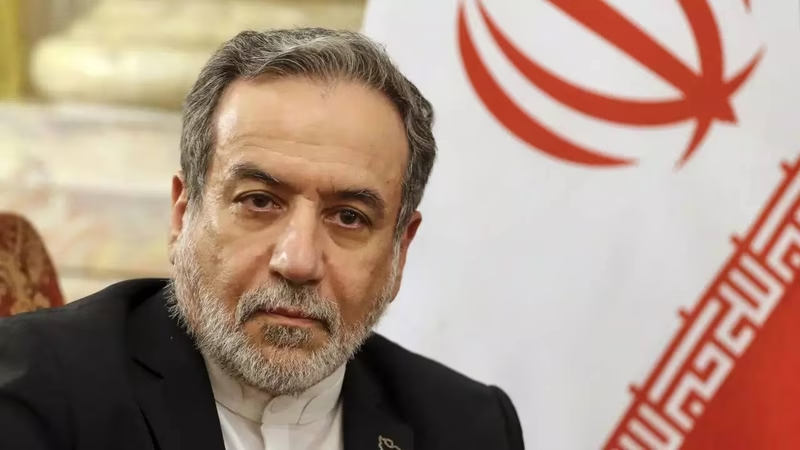
In a high-stakes geopolitical showdown for the new year, the streets of Tehran have become a battleground, and the war of words between Tehran and Washington has reached a fever pitch. The catalyst? A wave of Iran protests fueled by a crippling economic crisis, which has now drawn a stern warning from Iran’s top diplomat to former U.S. President Donald Trump: ‘Know where to aim.’
Table of Contents
- Trump Issues Stark Warning to Iran
- Iran Protests: What Sparked the Unrest?
- Tehran’s Fierce Rejection of US Interference
- The Geopolitical Stakes: What Happens Next?
- Conclusion: A Nation at a Crossroads
- Sources
Trump Issues Stark Warning to Iran
On January 2, 2026, Donald Trump took to his Truth Social platform to issue a direct and unambiguous threat to the Iranian government. He stated that if Iran were to “violently kill peaceful protesters,” the United States would “come to their rescue” . This statement, echoing a familiar interventionist stance, was quickly picked up by global media, with CBS/AFP reporting the same day that Trump was prepared to act if protesters were killed .
This threat from a former U.S. president, made during a period of intense domestic turmoil in Iran, was seen by Tehran not as a gesture of solidarity, but as a dangerous provocation and a textbook case of foreign meddling in its sovereign affairs.
Iran Protests: What Sparked the Unrest?
Contrary to the narrative often pushed from abroad, the current wave of Iran protests is deeply rooted in domestic economic despair. The immediate trigger was not a political manifesto but the harsh reality of daily life for ordinary Iranians.
The protests, which began in late 2025 and intensified into the new year, were sparked by:
- Soaring inflation, reported to be around 40%, which has decimated household budgets .
- Rising food prices and the severe depreciation of the Iranian rial, making basic necessities unaffordable for many .
- Widespread frustration among workers and business owners, with employees from Tehran’s central fruit and vegetable market joining the strikes on January 1st .
While the core of the movement is economic, the situation on the ground has become increasingly complex. Reports from January 2nd describe violent clashes between security forces and protesters in Tehran . Iranian officials have drawn a distinction between peaceful demonstrators voicing economic grievances and individuals they accuse of engaging in “vandalism and destructive acts” .
Tehran’s Fierce Rejection of US Interference
Iran’s response to Trump’s warning was swift and uncompromising. The message from Tehran was unified and clear at every level of government: Iran will not tolerate any external interference in its internal affairs.
Official Condemnation from the Foreign Ministry
Iran’s Foreign Ministry issued a formal statement on January 3rd, 2026, condemning the “interventionist statements of US officials” as a direct affront to its sovereignty . The Ministry’s spokesman, Esmaeil Baghaei, reiterated a core principle of Iran’s political stance: “Iranians, through dialogue and interaction with one another to resolve their problems, will not permit any form of foreign interference” . This sentiment was echoed in a letter of protest sent to the United Nations .
A Stern Warning from the Top
The most direct and memorable rebuke came from Foreign Minister Seyed Abbas Araghchi. In a firm declaration, he vowed that Iran would “forcefully reject” any attempt at foreign meddling . His message was a clear warning to Washington: any military or political action based on Trump’s threat would be met with a resolute and powerful response. This aligns with a warning from Iran’s Supreme National Security Council that US interference would destabilize the entire Middle East .
The Geopolitical Stakes: What Happens Next?
The current crisis sits at a volatile intersection of domestic economic pressure and long-standing international tensions. The Iranian government is navigating a delicate path—attempting to address the legitimate economic concerns of its citizens while simultaneously presenting a united front against what it perceives as a manufactured crisis by its enemies.
Iranian officials have publicly alleged that both the U.S. and Israel are actively stoking the protests to create internal chaos and justify external action . This belief system frames their entire response, turning an internal economic issue into a matter of national defense.
For the United States, the situation is equally precarious. Any overt action based on Trump’s statement would be seen globally as a violation of international law and could trigger a significant regional escalation. It would also risk validating Iran’s narrative of victimhood and external aggression, potentially uniting a fractured populace behind the government—a classic rallying effect.
Conclusion: A Nation at a Crossroads
The Iran protests of early 2026 are a stark reminder of the potent force of economic hardship. While the images of violent clashes in Tehran dominate headlines, the root cause is a population pushed to its limits by inflation and sanctions. Iran’s fiery rejection of Donald Trump’s threat is a defense of its sovereignty, but it also serves a domestic political purpose, shifting the narrative from internal mismanagement to external threat. The world is now watching to see whether this standoff will lead to further escalation or a de-escalation that allows for a focus on the real issue at hand: the economic well-being of the Iranian people.
Sources
- CBS/AFP: “Trump says if Iran ‘kills peaceful protesters,’ the U.S. will ‘come to their rescue'” (Jan 2, 2026)
- Various: “Trump and Iran start 2 026 exchanging new threats”
- Wikipedia: “2025–2026 Iranian protests” (Jan 1, 2026 update)
- News reports: “Security forces violently beat protesters Tehran, Iran” (Jan 2, 2026)
- Iranian state media: “Foreign ministry condemns interventionist statements of US officials” (Jan 3, 2026)
- Iranian state media: “Iran foreign ministry spokesman rejects foreign intervention”
- News reports: “Iranian FM vows to ‘forcefully reject’ interference after Trump’s threat”
- WANA: “Iran’s Letter to the UN Following Trump’s Interference” (Jan 3, 2026)
- Iranian state media: “Iran security chief warns US interference would destabilize region”
- News reports: “Iranian official warns U.S. against interfering in internal affairs”
- Wikipedia: “2025–2026 Iranian protests”
- News reports: “Several killed as Iran protests over rising cost of living spread”