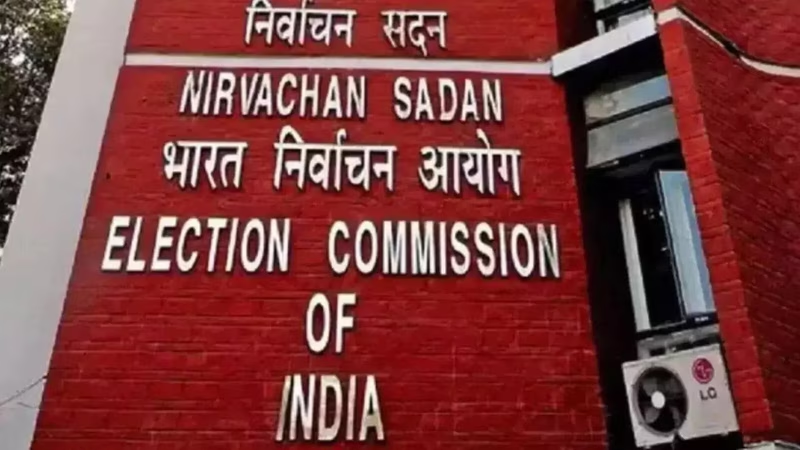
In a development that could reshape voter identity verification in India, West Bengal’s Chief Electoral Officer (CEO) has formally requested the Election Commission (EC) to consider the Madhyamik (Class 10) admit card as an official proof of date of birth. If approved, it would become the 14th document on the EC’s SIR (Special Investigation Report) list—making Bengal the first state to recognize this widely held but unofficial school document as a valid identity marker.
The move comes amid thousands of distress calls from citizens—many of them daily wage earners, women, and elderly residents—who are struggling to produce accepted documents during SIR hearings. While matriculation certificates are already accepted, the admit card—issued months before exams and often the only surviving proof of age for many—remains in limbo. This proposal, if greenlit, could offer a lifeline to countless voters at risk of being removed from electoral rolls. At the heart of this policy push lies the urgent question: can a Madhyamik admit card be used as proof of birth?
Table of Contents
- Why the Madhyamik Admit Card Matters
- What Is a SIR Hearing—and Why Are People Panicking?
- Current List of Accepted Birth Documents by EC
- Bengal’s Proposal: The Case for the Admit Card
- Potential Impact on Voter Enrollment in West Bengal
- Legal and Security Concerns: What Could Go Wrong?
- What Citizens Should Do While Waiting for EC Decision
- Conclusion: A Step Toward Inclusive Democracy?
- Sources
Why the Madhyamik Admit Card Matters
For millions of Bengalis, especially those born before 2000, birth registration was inconsistent. Many families never obtained a birth certificate. Instead, the first official document bearing a verified date of birth is often the Madhyamik admit card—issued by the West Bengal Board of Secondary Education (WBBSE) before the Class 10 board exams.
Unlike the final marksheet or certificate—which can be lost, damaged, or delayed—the admit card is typically issued early and kept safe by students and parents. It contains the candidate’s name, photograph, father’s name, and crucially, date of birth, verified against school records.
“People bring it to SIR hearings all the time,” said a senior electoral official in Kolkata. “But we can’t accept it—yet. That’s why the CEO has escalated this to the EC.”
What Is a SIR Hearing—and Why Are People Panicking?
SIR (Special Investigation Report) hearings are conducted when an individual’s voter registration is flagged for “doubtful” status—often due to mismatched data, lack of documentation, or suspicion of being a “foreigner.” During these hearings, citizens must appear before an officer and present proof of identity and residence.
The approved document list includes passports, PAN cards, matriculation certificates, and birth certificates—but excludes school admit cards. For many poor or rural residents, obtaining these documents is costly, time-consuming, or impossible. Hence, the Madhyamik admit card—already in their possession—has become a symbol of last-resort legitimacy.
Current List of Accepted Birth Documents by EC
The Election Commission currently recognizes 13 documents to prove age/date of birth during SIR or enrollment processes:
- Birth certificate from municipal authority
- Matriculation (Class 10) certificate
- Passport
- PAN card
- Aadhaar card (with DOB)
- Driving license
- Mark sheets from recognized boards (Class 12 and above)
- Service records (for govt. employees)
- Ration card (in select cases)
- Certificate from Gram Panchayat/Pradhan
- Bank passbook with photo & DOB
- Pension documents
- Court orders or affidavits (with corroboration)
The Madhyamik admit card is conspicuously absent—despite its widespread use in Bengal’s education system.
Bengal’s Proposal: The Case for the Admit Card
The West Bengal CEO’s request is grounded in practicality and equity. Key arguments include:
- Verification trail: The admit card is issued only after cross-checking school admission records, which themselves require parental affidavits and prior documentation.
- Standardized format: WBBSE admit cards are centrally printed, tamper-resistant, and include barcodes and photos since 2015.
- Humanitarian need: Over 12,000 SIR cases in Bengal alone involve applicants who only have admit cards as proof of age.
If approved, West Bengal would become the first state to formally include admit cards in voter verification—a precedent other states may follow.
Potential Impact on Voter Enrollment in West Bengal
With assembly elections approaching in 2026, this decision could have significant political and social consequences:
- Increased inclusion: Thousands currently at risk of disenfranchisement could retain voting rights.
- Faster verification: Reduced backlog in SIR hearings, easing pressure on electoral staff.
- Trust in system: Citizens may view the EC as more empathetic to ground realities.
However, critics warn that relaxing standards could open doors to fraudulent claims—though proponents argue that admit cards are harder to forge than affidavits or panchayat certificates.
Legal and Security Concerns: What Could Go Wrong?
The EC will likely scrutinize this proposal carefully. Potential risks include:
- Lack of centralized database: Unlike Aadhaar or PAN, WBBSE records aren’t fully digitized for instant cross-verification.
- Variability across states: Other boards (e.g., CBSE, ICSE) issue admit cards differently—raising questions about national uniformity.
- Forgery risks: Older admit cards (pre-2010) lacked photos or security features.
To mitigate this, the CEO has suggested accepting only WBBSE admit cards with photos and for applicants born before 2005—when birth registration became more robust.
What Citizens Should Do While Waiting for EC Decision
If you’re facing a SIR hearing and only have a Madhyamik admit card:
- Apply for a duplicate matriculation certificate from WBBSE ([INTERNAL_LINK:how-to-get-wbbse-duplicate-certificate]).
- File an affidavit with a notary, supported by two independent witnesses.
- Submit your admit card anyway—some officers may keep it “on file” pending EC guidance.
- Call the National Voter Helpline: 1950 or visit nvsp.in to check your status.
Conclusion: A Step Toward Inclusive Democracy?
The debate over whether a Madhyamik admit card can serve as birth proof is more than bureaucratic—it’s about who gets to participate in democracy. In a country where documentation gaps disproportionately affect the poor, women, and minorities, flexibility isn’t weakness; it’s justice. If the EC says yes, it won’t just validate a piece of paper—it will affirm the dignity of millions who’ve been told, “You don’t exist.”