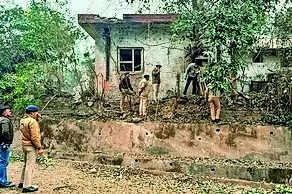
In the quiet industrial town of Nalagarh, Himachal Pradesh, a sudden explosion shattered the peace on Thursday—igniting not just debris, but deep geopolitical anxieties. While the immediate damage was contained, the implications are far-reaching. Punjab Police has now formally stated that the blast likely bears the fingerprints of Pakistan’s Inter-Services Intelligence (ISI), suggesting a coordinated effort to reignite unrest in India’s sensitive northern corridor.
Though two banned outfits—Babbar Khalsa International (BKI) and the Punjab Sovereignty Alliance (PSA)—quickly claimed responsibility through online statements, investigators are dismissing their ideological posturing. According to senior officers, these groups no longer operate independently; they function as tactical proxies for the ISI, carrying out attacks under its direction, funding, and logistical support . This assertion places the Himachal Pradesh blast ISI theory at the center of a high-stakes security debate—one that questions how deeply foreign intelligence agencies are embedded in India’s domestic threat landscape.
Table of Contents
- The Nalagarh Blast: What Happened?
- Why Police Believe ISI Is Behind the Himachal Pradesh Blast
- BKI and PSA: Proxy Players or Independent Actors?
- The Strategic Significance of Nalagarh
- India-Pakistan Tensions and the Resurgence of Cross-Border Terror
- Security Response and Regional Implications
- Conclusion: A Wake-Up Call for Intelligence Coordination
- Sources
The Nalagarh Blast: What Happened?
The explosion occurred in an industrial area of Nalagarh, Solan district, on the morning of January 2, 2026. Initial reports indicated a low-intensity blast, with no casualties but minor structural damage to nearby sheds. Local police treated it as a potential case of industrial sabotage.
However, within 24 hours, online forums and encrypted messaging channels saw statements from BKI and PSA claiming the attack as a “symbolic strike against Indian occupation.” The timing—amid heightened farmer agitation and upcoming state elections—raised red flags for intelligence agencies.
Punjab Police, which has jurisdiction over cross-border terror networks in the region, swiftly took over the forensic and digital investigation. Traces of military-grade explosives and a modus operandi consistent with past ISI-backed operations shifted the narrative from petty vandalism to potential state-sponsored terrorism.
Why Police Believe ISI Is Behind the Himachal Pradesh Blast
Investigators point to three key indicators that point toward ISI involvement:
- Explosive Signature: The chemical composition of the residue matches materials previously used in attacks traced to ISI handlers in Jammu and Kashmir.
- Claim Timing & Coordination: The BKI and PSA statements were nearly identical in wording and released simultaneously—a tactic often used to create the illusion of multiple actors while masking a single command center.
- Strategic Targeting: Nalagarh lies on the critical Delhi-Chandigarh-Shimla corridor. A blast here tests India’s response mechanisms without causing mass casualties—ideal for psychological warfare.
As one senior anti-terror official anonymously told reporters: “These groups haven’t launched a credible attack in over a decade. Their sudden ‘resurgence’ is too convenient—and too precise—to be organic.”
BKI and PSA: Proxy Players or Independent Actors?
Babbar Khalsa International, once a feared militant organization during the 1980s Punjab insurgency, has been designated a terrorist outfit by India, the US, UK, and Canada . The Punjab Sovereignty Alliance is a lesser-known splinter group with minimal operational history.
Security analysts argue that both entities now exist largely as digital shells—brand names rented out or co-opted by the ISI to maintain plausible deniability. “Pakistan can’t afford direct attribution,” explains a South Asia security expert at the Observer Research Foundation. “So they use defunct groups as cover. It’s cheaper, safer, and still effective for spreading fear.”
This strategy aligns with documented ISI tactics in Afghanistan and Kashmir, where shadow militias are activated during periods of diplomatic tension.
The Strategic Significance of Nalagarh
Why target Himachal Pradesh—a state with no history of insurgency?
Nalagarh’s location is key. It sits just 40 km from Chandigarh, the shared capital of Punjab and Haryana, and is a major logistics and manufacturing hub. An attack here sends multiple signals:
- That no part of North India is immune to terror.
- That instability can be manufactured even in peaceful states.
- That India’s internal security is fragile during political transitions.
For the ISI, the goal may not be mass casualties—but to force India into overreacting, thereby straining civil liberties and fueling resentment in border regions.
India-Pakistan Tensions and the Resurgence of Cross-Border Terror
This incident comes amid a prolonged diplomatic freeze between India and Pakistan. With backchannel talks stalled and ceasefire violations on the rise along the Line of Control, intelligence agencies on both sides are on high alert.
The Ministry of Home Affairs has issued an all-India alert, urging state police to monitor suspicious activities near critical infrastructure. Meanwhile, the National Investigation Agency (NIA) has begun coordinating with Himachal and Punjab authorities to trace funding trails and digital footprints linked to the blast.
Historically, such low-intensity attacks spike during periods of political gridlock—serving as pressure valves for Pakistan’s military establishment to assert relevance without triggering full-scale conflict.
Security Response and Regional Implications
In response, Punjab and Himachal Pradesh have jointly launched “Operation Iron Shield,” enhancing surveillance along inter-state highways and industrial zones. Additional checkpoints, drone patrols, and community intelligence networks are being deployed.
For civilians, the message is clear: stay vigilant. Authorities urge reporting of unattended packages or strangers photographing infrastructure. Businesses in sensitive zones are being advised to adopt [INTERNAL_LINK:industrial-security-protocols-north-india].
Conclusion: A Wake-Up Call for Intelligence Coordination
The Himachal Pradesh blast ISI allegations—if confirmed—mark a dangerous evolution in hybrid warfare. It’s no longer just about infiltration or IEDs in conflict zones. The new battlefield is psychological, digital, and spread across peaceful towns far from the border. Countering it demands seamless intelligence sharing between states, robust cyber forensics, and a refusal to let proxy claims distract from the real architects of terror. As India investigates, one truth emerges: in the shadow war between nations, even a single explosion can echo across the entire region.