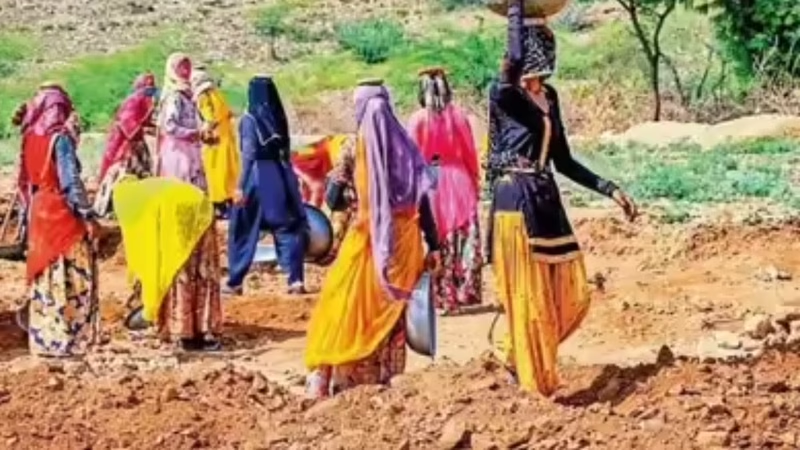
In a striking move that could reshape rural development policy in South India, the Karnataka state government is preparing to walk away from the Centre’s newly launched G-RAM-G scheme. Instead of falling in line, the state is drafting its own Karnataka rural jobs scheme—a bold declaration of autonomy that puts federalism, local control, and the right to work front and center.
This decision isn’t just bureaucratic posturing. It comes in direct response to concerns that G-RAM-G—officially the Garib Kalyan Rojgar Abhiyaan – Rural Asset Mission – Gramin—shifts financial burden onto states while diluting the job security and wage guarantees that millions of rural households depend on. Karnataka’s leadership is now asking a critical question: Is it better to accept compromised central funding, or to build a homegrown safety net that truly serves its people?
Table of Contents
- What Is G-RAM-G and Why Is Karnataka Opposed?
- Karnataka’s Proposed Rural Jobs Scheme: A State-Driven Alternative
- Federalism at Stake: The Political Implications
- How G-RAM-G Differs from NREGA: A Comparative Look
- Economic Impact on Rural Karnataka
- What Happens Next: The Road Ahead
- Conclusion: A Bold Vision for Local Empowerment
- Sources
What Is G-RAM-G and Why Is Karnataka Opposed?
Launched by the Union Government as a successor—or partial replacement—to the long-standing Mahatma Gandhi National Rural Employment Guarantee Act (MGNREGA), G-RAM-G aims to create durable rural assets. However, the scheme introduces a significant shift: it moves from a demand-driven, rights-based model (like NREGA) to a centrally designed, supply-driven framework where states must co-fund projects.
Karnataka’s cabinet has strongly objected to this change. State ministers argue that G-RAM-G undermines federal principles by imposing top-down mandates while reducing the Centre’s financial commitment. “Name change is a small issue. The real problem is the erosion of the right to work and local development control,” a senior minister noted, as reported by the Times of India .
Key objections include:
- Loss of fiscal autonomy: States may have to bear up to 25–50% of implementation costs.
- Weakened worker protections: No guaranteed 100 days of employment or legally enforceable wage payment timelines.
- Reduced Gram Panchayat role: Decision-making shifts from local bodies to central or state-level agencies.
Karnataka’s Proposed Rural Jobs Scheme: A State-Driven Alternative
In response, Karnataka is exploring a homegrown Karnataka rural jobs scheme modeled on the core strengths of MGNREGA—but with greater local flexibility. The proposed program would:
- Guarantee a minimum number of work days (potentially more than 100) for rural households.
- Ensure timely wage disbursement through a state-monitored digital system.
- Empower Gram Panchayats to identify, approve, and manage projects based on local needs—like water conservation, organic farming infrastructure, or rural roads.
- Prioritize women’s participation and socially inclusive labor practices.
While this approach would mean forgoing central funds tied to G-RAM-G, Karnataka believes the long-term benefits of self-reliance and community-driven development outweigh the short-term financial trade-off. The state has already allocated ₹5,000 crore in its budget for rural employment initiatives, signaling serious intent .
Federalism at Stake: The Political Implications
This standoff is more than a policy disagreement—it’s a test of India’s federal structure. Karnataka, ruled by the Congress party, is joining a growing chorus of non-BJP states (including Kerala and Tamil Nadu) that have raised alarms about centralization under new welfare schemes.
By asserting its right to design its own social safety net, Karnataka is making a powerful statement: that states know their people’s needs better than a one-size-fits-all central mandate. Political analysts suggest this could set a precedent for other states to reclaim policy space in areas like health, education, and now, employment .
How G-RAM-G Differs from NREGA: A Comparative Look
| Feature | MGNREGA | G-RAM-G |
|---|---|---|
| Legal Status | Statutory right (Act of Parliament) | Administrative scheme (no legal guarantee) |
| Funding | 90:10 or 100% Centre for wage component | Shared cost with states (up to 50%) |
| Work Guarantee | 100 days/household/year | No fixed entitlement |
| Local Control | Gram Sabhas decide projects | Central/state agencies prioritize assets |
This table underscores why Karnataka sees G-RAM-G as a downgrade from the robust, rights-based NREGA framework that has supported rural resilience for nearly two decades.
Economic Impact on Rural Karnataka
Rural employment isn’t just about wages—it’s a lifeline. In drought-prone regions like Kalaburagi and Koppal, MGNREGA has been a critical buffer against distress migration and agrarian collapse. A weakened or underfunded scheme could push vulnerable households into deeper poverty.
By crafting its own program, Karnataka aims to stabilize rural incomes, boost local demand, and create climate-resilient infrastructure. This aligns with the state’s broader goals under [INTERNAL_LINK:rural-development-karnataka] and its commitment to sustainable livelihoods.
What Happens Next: The Road Ahead
The Karnataka government is expected to present a draft of its new scheme to the cabinet within weeks. If approved, it could be piloted in select districts by mid-2026. The state will also engage with the Ministry of Rural Development to formally opt out of G-RAM-G—a complex legal and fiscal process.
Meanwhile, civil society groups and economists are watching closely. “Karnataka’s experiment could become a blueprint for cooperative federalism in social policy,” notes a researcher from the Centre for Policy Research .
Conclusion: A Bold Vision for Local Empowerment
Karnataka’s potential rejection of G-RAM-G isn’t mere political defiance—it’s a strategic investment in democratic decentralization and economic justice. The proposed Karnataka rural jobs scheme represents a vision where rural citizens aren’t passive recipients of aid, but active architects of their own development. If successful, it could inspire a national conversation about who truly owns the right to work.