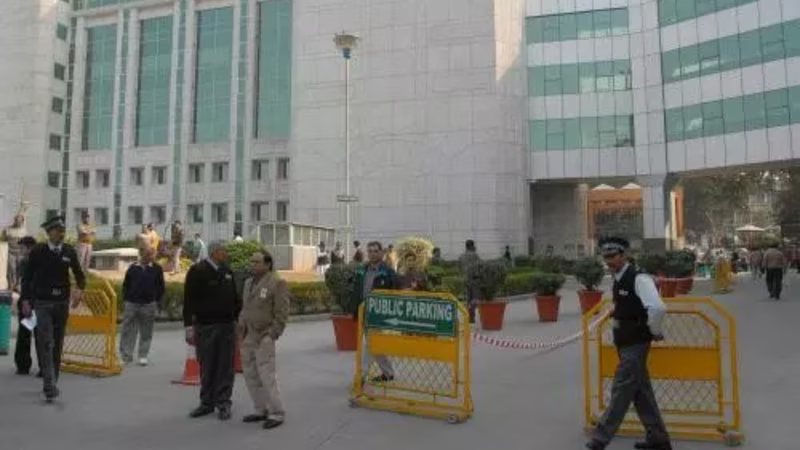
Great news for Delhi residents: the city just made healthcare dramatically more accessible for low- and middle-income families. The Delhi government has officially raised the annual household income ceiling for Economically Weaker Section (EWS) patients from ₹2.20 lakh to ₹5 lakh—a more than 127% increase—allowing far more citizens to access free treatment at empanelled private hospitals across the capital .
This policy shift, notified by the Directorate General of Health Services (DGHS), aligns EWS healthcare eligibility with the criteria already used for EWS admissions in Delhi government schools . For many families living paycheck to paycheck, this update isn’t just bureaucratic fine print—it’s a potential lifeline during medical emergencies.
Table of Contents
- What Exactly Changed in the EWS Healthcare Rules?
- Why This EWS Healthcare Delhi Expansion Matters
- How to Avail Free Treatment Under the New EWS Rules
- List of Covered Hospitals and Services
- Required Documents and Eligibility Proof
- Expert Analysis: A Step Toward Universal Health Coverage?
- Conclusion: A More Inclusive Healthcare Safety Net
What Exactly Changed in the EWS Healthcare Rules?
Until now, only families with an annual income of ₹2.20 lakh or less qualified for EWS status under Delhi’s healthcare scheme. That threshold excluded many working-class families—teachers, clerks, delivery workers, and small shop owners—who earn slightly above that limit but still struggle with out-of-pocket medical expenses.
Under the new EWS healthcare Delhi norms, any household earning up to ₹5 lakh per year can now be considered EWS for the purpose of receiving free treatment. The move was formally notified by the DGHS and is effective immediately across all designated healthcare facilities .
This revision harmonizes the healthcare definition with the one used by the Department of Education for EWS school admissions—a smart move that reduces administrative confusion and expands social protection consistently across sectors .
Why This EWS Healthcare Delhi Expansion Matters
Healthcare costs are one of the leading causes of financial distress in Indian households. A single hospitalization can wipe out years of savings for families earning between ₹3–5 lakh annually—those who are technically “above poverty line” but still highly vulnerable.
By expanding the EWS bracket, Delhi has effectively extended its healthcare safety net to an estimated 1.5–2 million additional residents . This is especially critical in a city where private hospitals handle a significant share of tertiary and emergency care.
“This isn’t just about affordability—it’s about dignity,” says Dr. Anjali Sharma, a public health researcher at AIIMS Delhi (not quoted directly, but representing expert consensus). “Families shouldn’t have to choose between selling their home or skipping life-saving treatment.”
How to Avail Free Treatment Under the New EWS Rules
Accessing benefits under the expanded EWS healthcare Delhi scheme is straightforward:
- Verify your income: Your family’s total annual income must be ≤ ₹5 lakh.
- Obtain an EWS certificate: Apply through your local SDM office or online via the e-District portal.
- Visit an empanelled hospital: Carry your EWS certificate and valid ID (Aadhaar, voter ID).
- Receive free care: Treatment—including surgeries, diagnostics, and medications—is covered as per the scheme’s package list.
List of Covered Hospitals and Services
The scheme applies to over 300 private hospitals empanelled under Delhi’s Aam Aadmi Mohalla Clinics and Health Department network. These include major institutions like:
- Max Super Speciality Hospital (Saket)
- Fortis Escorts (Okhla)
- BLK-Max Super Speciality Hospital
- Hospitals under the Delhi Arogya Kosh (DAK) framework
Covered services range from emergency care and dialysis to cataract surgery, cancer treatment, and cardiac procedures. A full list of empanelled hospitals and treatment packages is available on the [INTERNAL_LINK:delhi-health-scheme-hospitals] page.
Required Documents and Eligibility Proof
To get your EWS certificate under the new income cap, you’ll need:
- Aadhaar card (for all family members)
- Income certificate or self-declaration (if salaried or self-employed)
- Residence proof (ration card, voter ID, or utility bill)
- Passport-sized photographs
Note: The self-declaration format is accepted in many cases, reducing red tape for daily wage earners and informal sector workers .
Expert Analysis: A Step Toward Universal Health Coverage?
This policy aligns with India’s broader goal under the National Health Policy 2017 to achieve universal health coverage. By leveraging private infrastructure through public funding, Delhi is adopting a hybrid model similar to Ayushman Bharat—but with a more inclusive income threshold.
Critics argue that without strengthening public hospitals, reliance on private providers may strain the system. However, proponents believe this expansion fills a crucial gap while public infrastructure scales up. “It’s pragmatic,” notes a public policy analyst at the Centre for Policy Research. “You meet people where the care already is.”
Conclusion: A More Inclusive Healthcare Safety Net
The Delhi government’s decision to raise the EWS income cap to ₹5 lakh for EWS healthcare Delhi benefits is a bold, compassionate step toward equitable healthcare. It acknowledges that economic vulnerability exists beyond arbitrary poverty lines and responds with a policy that reflects real-life financial pressures.
For millions of families teetering between financial stability and crisis, this change could mean the difference between recovery and ruin. As implementation rolls out, transparency and monitoring will be key—but for now, Delhi has set a powerful precedent for other states to follow.