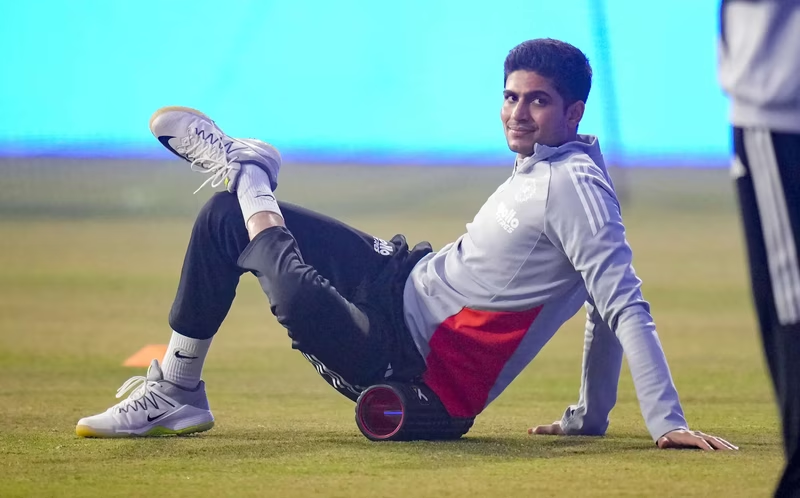
Shubman Gill Domestic Cricket Return Happens in Near Silence
After a quiet and frustrating exit from the T20 World Cup 2024—where he was controversially benched for India’s key matches—Shubman Gill is finally back on the field. Donning the Punjab jersey for the Vijay Hazare Trophy 2026, fans were eager to see how the star opener would bounce back.
But there’s a twist: you can’t watch him play. Not on TV. Not online. Not even in person.
Gill’s match against Sikkim on January 3, 2026, at the Jaipuria College Ground in Ghaziabad is being played behind closed doors—with zero spectators allowed and, critically, **no live broadcast or streaming coverage**. This mirrors recent fixtures involving Virat Kohli, raising urgent questions about transparency and fan access in Indian domestic cricket .
Table of Contents
- Why Fans Can’t Watch Shubman Gill Domestic Cricket
- BCCI Guidelines: Security and Infrastructure Issues
- Gill and Arshdeep Singh’s Punjab Comeback
- The Growing Trend of Unseen Domestic Matches
- Fan Reactions: Social Media Fury
- What to Expect in Punjab’s Next Match Against Goa
- Conclusion: Is Indian Domestic Cricket Invisible by Design?
- Sources
Why Fans Can’t Watch Shubman Gill Domestic Cricket
The answer lies in a combination of venue limitations and BCCI protocols. The Jaipuria College Ground, while functional for local fixtures, lacks the basic infrastructure required for televised cricket:
- No broadcast-quality lighting or camera positions.
- Inadequate spectator stands—official capacity is below BCCI safety thresholds.
- Limited perimeter security to manage crowds during high-profile appearances.
As a result, the BCCI has mandated a “closed-door” policy for this match, citing “security concerns and spectator safety” as key reasons . While understandable from an operational standpoint, it leaves millions of fans disconnected from one of India’s brightest cricketing talents.
BCCI Guidelines: Security and Infrastructure Issues
According to official BCCI directives, any domestic venue hosting matches with international players must meet minimum standards for:
- Media & broadcasting setup – Including fiber connectivity and commentary boxes.
- Crowd control and emergency exits – Certified by local authorities.
- Player security protocols – Especially when high-profile names like Gill or Kohli are involved.
Jaipuria College Ground fails on all three counts. Rather than risk a half-baked broadcast or unsafe crowd situation, the board opted for a private, non-televised fixture—a decision consistent with Virat Kohli’s recent List A matches for Delhi, which also went unseen by the public .
Gill and Arshdeep Singh’s Punjab Comeback
Gill isn’t alone. He’s joined by fellow Indian international Arshdeep Singh, who’s also using the Vijay Hazare Trophy to regain rhythm after the T20 World Cup. Both are expected to play key roles as Punjab aims for a deep run in the tournament.
While their January 3 match against Sikkim is off-limits, their next fixture—against Goa on January 6 at Dr. Sampurnanand Sports Stadium in Varanasi—may see limited broadcast coverage, depending on final venue clearance . Even then, full HD telecast remains unlikely unless local authorities upgrade facilities last-minute.
The Growing Trend of Unseen Domestic Matches
This isn’t an isolated case. Over the past 12 months, at least seven domestic matches featuring current Indian stars have been played without broadcast or public access:
- Virat Kohli’s two Vijay Hazare matches for Delhi (December 2025)
- Ravindra Jadeja’s List A game for Saurashtra (November 2025)
- Shreyas Iyer’s outing for Maharashtra (January 2026)
While the IPL enjoys billion-dollar production values, India’s premier domestic 50-over tournament operates in near obscurity—a stark disconnect that undermines the very pipeline feeding the national team.
Fan Reactions: Social Media Fury
Cricket fans have taken to social media to voice their frustration:
- “So Gill is playing, but we can’t watch? What’s the point of domestic cricket then?” – @CricketFan_India
- “BCCI spends crores on IPL but can’t set up a camera for Gill’s comeback? Priorities are broken.” – @SportsCritic22
- “If Kohli and Gill can’t get a telecast, how will new stars ever get noticed?” – @DomesticCricketBeliever
The sentiment is clear: fans feel alienated from the sport’s grassroots—the very ecosystem that produces future legends.
What to Expect in Punjab’s Next Match Against Goa
Though broadcast remains uncertain, Gill’s performance against Goa could heavily influence his selection for India’s upcoming ODI series. Selectors are known to monitor domestic scores closely, even without visuals.
Fans can follow ball-by-ball updates via the BCCI’s official app and ESPNcricinfo, but the absence of broadcast strips away the emotional connection that live coverage provides—especially for a player rebuilding his confidence after international setbacks.
Conclusion: Is Indian Domestic Cricket Invisible by Design?
The Shubman Gill domestic cricket blackout highlights a systemic flaw: India celebrates its stars on the world stage but ignores them in the tournaments that build their careers. While BCCI guidelines prioritize safety, the lack of investment in broadcast-ready domestic venues sends a troubling message. Until fans can consistently watch future stars—and current icons—play at home, the dream of a robust cricketing ecosystem will remain just that: a dream. For more on how domestic cricket shapes national teams, see our analysis on [INTERNAL_LINK:why-domestic-cricket-matters].