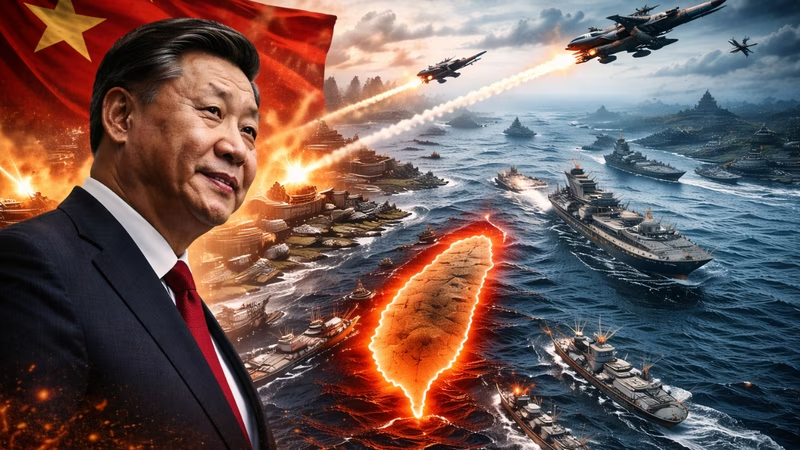
The drumbeat of war in the Taiwan Strait has grown from a distant rumble to a steady, unsettling thud. As we stand in early 2026, the question on every strategist’s mind is simple yet terrifying: Is this the year Xi Jinping makes his move on Taiwan? With a self-imposed 2027 deadline for his military’s modernization, the pressure is mounting in Beijing. But a full-scale invasion might not be the only—or even the most likely—path. Instead, China appears to be methodically tightening its grip through what analysts call the ‘Anaconda strategy,’ a patient, multi-pronged campaign designed to strangle Taiwan’s will and capabilities without ever firing a shot.
Table of Contents
- The 2027 Deadline and the 2026 Inflection Point
- The ‘Anaconda Strategy’: Unpacking China’s Patient Squeeze
- Taiwan 2026: The US Response and its Critical Weaknesses
- Beyond the Headlines: What a Taiwan 2026 Conflict Might Look Like
- Conclusion: Is 2026 the Year of No Return?
- Sources
The 2027 Deadline and the 2026 Inflection Point
President Xi Jinping has set a hard deadline for the People’s Liberation Army (PLA): to be a fully modernized and combat-ready force by its 100th anniversary in April 2027 . This isn’t just a bureaucratic milestone; it’s a political imperative. For Xi, achieving the ‘reunification’ of Taiwan is a core pillar of his ‘Chinese Dream’ and a key to his legacy. This looming deadline has turned 2026 into a critical inflection point. The frequency, scale, and sophistication of China’s military drills encircling Taiwan have escalated dramatically, moving from simple warnings to complex simulations of a full naval and air blockade .
These aren’t random acts of aggression. They are calibrated signals, testing not just Taiwan’s defenses but also the resolve of its primary ally, the United States. The message from Beijing is clear: time is running out, and the window for a peaceful resolution on its terms is closing.
The ‘Anaconda Strategy’: Unpacking China’s Patient Squeeze
Forget Hollywood visions of a sudden, massive amphibious assault. The more likely and terrifying scenario is the one already in motion: China’s ‘Anaconda strategy’ . Like the snake it’s named after, this approach is about patience, constriction, and exhaustion. It’s a holistic campaign that blends military, economic, diplomatic, and psychological warfare to slowly suffocate Taiwan’s autonomy and will to resist.
How the Anaconda Tightens Its Grip
The strategy operates on multiple fronts simultaneously:
- Military Encirclement: Constant sorties by Chinese warplanes into Taiwan’s Air Defense Identification Zone (ADIZ) and large-scale naval drills around the island serve to exhaust Taiwanese pilots and sailors, drain their resources, and normalize a state of constant alert .
- Economic Coercion: Beijing uses its economic leverage to pressure countries to isolate Taiwan diplomatically and to punish Taiwanese businesses that don’t toe the ‘One China’ line.
- Information & Cyber Warfare: A relentless barrage of disinformation and cyberattacks aims to sow discord within Taiwanese society, undermine trust in its democratic institutions, and cripple critical infrastructure .
- Diplomatic Isolation: China systematically poaches Taiwan’s few remaining diplomatic allies and blocks its participation in international organizations, reinforcing the narrative that Taiwan is an inseparable part of China .
The goal is to create a pervasive sense of hopelessness, making the idea of resistance seem futile long before any physical invasion begins .
Taiwan 2026: The US Response and its Critical Weaknesses
The United States remains Taiwan’s most vital security partner, and in a major show of force, it recently approved a massive $11.15 billion arms package in December 2025—the largest in years . This move was a direct response to China’s ‘provocative’ drills and a clear signal of continued support .
However, Washington’s commitment faces a critical, self-inflicted wound: a staggering backlog in arms deliveries. Despite approving these sales, the US defense industry is struggling to fulfill them. The backlog of delayed shipments to Taiwan now exceeds $20 billion, with critical systems like F-16 fighter jets, precision-guided munitions, and advanced torpedoes stuck in the production queue .
This industrial capacity bottleneck is a major strategic vulnerability. It leaves Taiwan dangerously under-equipped at the very moment it needs to be at its strongest. For Beijing, this delay is a glaring opportunity. If the US can’t deliver on its promises, it calls its entire security guarantee into question, a core tenet of the Anaconda strategy to weaken alliance trust .
Beyond the Headlines: What a Taiwan 2026 Conflict Might Look Like
While a full-scale invasion remains a high-risk, high-cost option for China, a limited conflict in 2026 is far from out of the question. The PLA is far more likely to initiate a blockade or a campaign of ‘grey-zone’ warfare—using coast guard cutters, fishing fleets, and cyber-attacks to create a crisis that falls short of formal war but achieves its strategic objectives.
The danger in this scenario is miscalculation. The constant military posturing creates countless flashpoints. A single accident between fighter jets or naval vessels could spiral out of control, dragging the US and its allies into a conflict nobody truly wants. The US has already urged China to ‘cease military pressure on Taiwan’ as tensions rise . The risk is that in 2026, with the 2027 deadline casting a long shadow, Xi Jinping might be willing to take that risk to secure his legacy.
Conclusion: Is 2026 the Year of No Return?
A full-blown invasion of Taiwan in 2026 remains a significant gamble for China. The logistical, military, and economic costs are immense, and the global backlash would be severe. However, the ‘Anaconda strategy’ is already in its final, most constricting phase. The combination of the 2027 deadline, a US hamstrung by its own industrial shortcomings, and a steadily escalating campaign of pressure makes 2026 the most dangerous year yet for the Taiwan Strait. The path to war may not be a sudden charge, but a slow, patient squeeze that leaves the world—and Taiwan—gasping for air. The decisions made in the coming months will determine whether this anaconda strikes or simply continues to tighten its grip.
Sources
[INTERNAL_LINK:taiwan-strait-geopolitics]
[INTERNAL_LINK:us-defense-industrial-base]
CSIS: Taiwan Crisis Scenarios
- What China’s Latest Military Drills Around Taiwan Signal
- Mapped: China’s Military Drills Around Taiwan (2022-2025)
- Slow arms deliveries to Taiwan blamed on US production
- Backlog of US Arms Shipments to Taiwan Exceeds $20 Billion
- U.S. approves over $11 billion arms sale to Taiwan
- China’s ‘Anaconda Strategy’
- China’s “Anaconda Strategy” Is Slowly Choking Taiwan
- China’s ‘Anaconda Strategy’ Aims To Squeeze Taiwan
- US says Chinese military drills around Taiwan cause
- U.S. urges China to halt military pressure on Taiwan, days