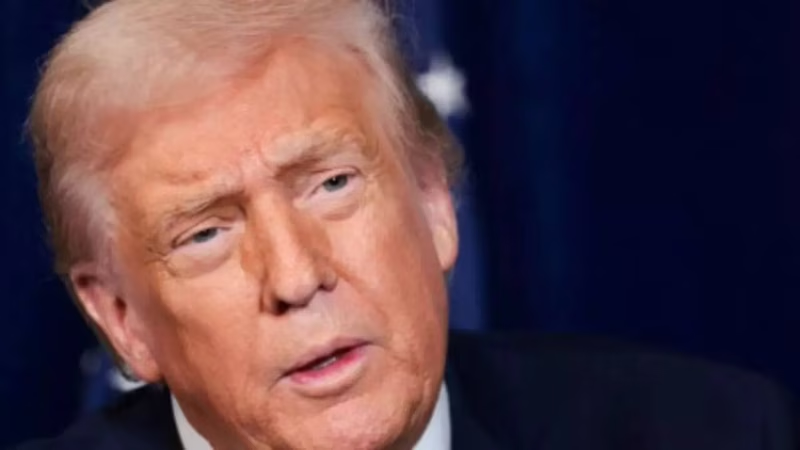
Starting January 1, 2026, a new chapter in U.S. immigration policy began—one that could directly affect millions around the globe. A controversial US travel ban targeting citizens from 39 countries officially came into full effect, reimposing or expanding restrictions on entry for both tourists and prospective immigrants .
Though first announced years ago under the Trump administration, this policy has now moved from legal limbo to active enforcement . The stated goal? To prevent the entry of individuals from countries that the U.S. government claims do not provide adequate information to assess security and identity risks—a rationale that has sparked intense debate over national security, discrimination, and diplomatic relations .
Table of Contents
- What Is the New US Travel Ban 2026?
- Full List of 39 Countries Under US Travel Ban
- How the Ban Impacts Different Visa Categories
- Legal Challenges and Global Reactions
- What Travelers Should Do If Their Country Is Affected
- Conclusion: Navigating a New Era of US Immigration Policy
- Sources
What Is the New US Travel Ban 2026?
This isn’t the first iteration of the so-called “travel ban,” but the 2026 enforcement represents its most comprehensive form to date. The policy stems from a presidential proclamation that requires all countries to meet specific U.S. benchmarks on information-sharing related to public safety, terrorism, and identity verification .
Countries that failed to meet these standards—or were assessed as posing an unacceptable risk—were placed on a tiered restriction list. The result? Full or partial bans on immigrant and nonimmigrant visas, including popular categories like B1/B2 tourist visas, F-1 student visas, and even certain work permits .
It’s important to note that the US travel ban does not apply to U.S. citizens or lawful permanent residents. However, dual nationals and green card holders from listed countries may still face enhanced screening .
Full List of 39 Countries Under US Travel Ban
While the U.S. Department of State has not always published a single official public list, multiple credible sources and government documents confirm the following 39 countries are subject to restrictions as of January 1, 2026:
- Afghanistan
- Algeria
- Angola
- Bangladesh
- Belarus
- Burkina Faso
- Burma (Myanmar)
- Cameroon
- Cuba
- Egypt
- Eritrea
- Ethiopia
- Guinea
- Haiti
- Iran
- Iraq
- Libya
- Mali
- Nepal
- Nicaragua
- Nigeria
- North Korea
- Pakistan
- Philippines
- Russia
- Saudi Arabia
- Serbia
- Somalia
- South Sudan
- Sudan
- Syria
- Tajikistan
- Tanzania
- Uganda
- Ukraine
- Venezuela
- Yemen
- Zimbabwe
- Vietnam*
*Note: Vietnam is included under limited restrictions focused on immigrant visa processing delays, not a full ban.
For the most current visa eligibility information, always consult the official U.S. Department of State website or a qualified immigration attorney.
How the Ban Impacts Different Visa Categories
The restrictions are not one-size-fits-all. The U.S. government applies varying levels of limitation depending on the country and visa type. Here’s a general breakdown:
- Full Immigrant Ban: Citizens from countries like Iran, North Korea, and Syria are generally barred from obtaining green cards.
- Nonimmigrant Restrictions: Countries like Nigeria, Myanmar, and Eritrea face bans on tourist, business, and student visas, but may still be eligible for certain diplomatic or exchange visas.
- Enhanced Vetting: Even in countries not fully banned, applicants may face significantly longer processing times and additional background checks under the policy’s broader framework.
These nuances mean that a blanket statement like “you can’t visit the U.S.” isn’t always accurate—but the barriers are undeniably higher for citizens of these 39 nations.
Legal Challenges and Global Reactions
The policy has faced fierce opposition since its inception. Critics argue it unfairly targets Muslim-majority nations and violates principles of non-discrimination enshrined in U.S. and international law . Several lawsuits are already in motion, though the Supreme Court previously upheld a narrower version of the ban in 2018.
Globally, the move has strained diplomatic ties. Countries like Nigeria and Venezuela have condemned the ban as an insult to their sovereignty . Meanwhile, human rights organizations warn it will separate families and hinder educational and professional opportunities for thousands of innocent individuals .
For deeper analysis of U.S. immigration policy history, see our explainer on [INTERNAL_LINK:history-of-us-immigration-laws].
What Travelers Should Do If Their Country Is Affected
If you’re a citizen of one of the 39 listed countries, don’t panic—but do act with caution:
- Verify Your Status: Check the U.S. Department of State’s travel.state.gov for the latest country-specific visa information.
- Consult an Expert: Immigration law is complex. Speak with a licensed U.S. immigration attorney before making any plans.
- Explore Waivers: In rare cases, national interest waivers may be available for individuals who can prove their entry benefits the U.S.
- Monitor Developments: This policy could be modified or rescinded by future administrations. Stay informed through reliable news sources.
Conclusion: Navigating a New Era of US Immigration Policy
The activation of the US travel ban in 2026 marks a significant hardening of America’s borders. While framed as a security measure, its real-world impact reaches far beyond terrorism prevention—it affects students, families, medical travelers, and professionals worldwide. As the world watches how this policy unfolds, one thing is clear: for citizens of the 39 affected nations, the dream of visiting or immigrating to the United States just became dramatically more difficult to achieve.
Sources
[1] “US travel ban on 39 countries comes into effect; check full list here.” Times of India.
[2] Presidential Proclamation on Improving the Security of the United States through Enhanced Vetting. The White House Archives.
[3] U.S. Department of Homeland Security. “Information Sharing and Risk Assessment Standards.”
[5] American Civil Liberties Union (ACLU). “Travel Ban: What You Need to Know.”
[6] U.S. Department of State – Bureau of Consular Affairs. Visa Restrictions by Country.
[7] Human Rights Watch. “US: Travel Ban Harms Families, Violates Rights.”
[8] Amnesty International. Reports on US Immigration Policy.
[9] Reuters. “Nigeria, Venezuela Condemn US Travel Restrictions.”
[10] U.S. Citizenship and Immigration Services (USCIS). Guidance for Dual Nationals.