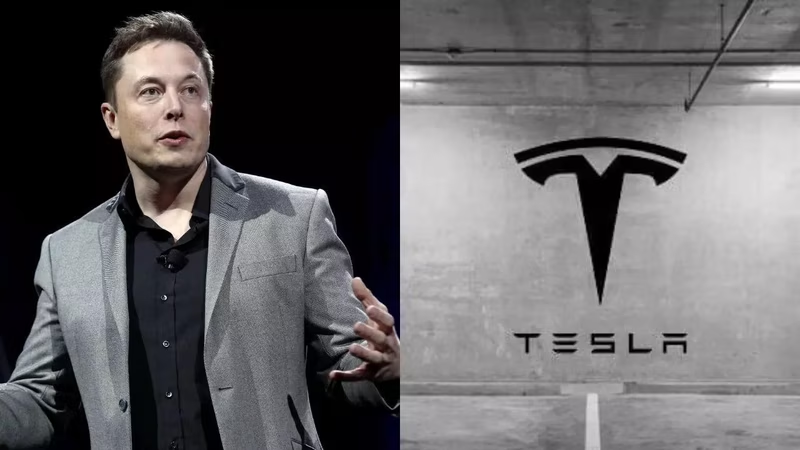
The electric vehicle (EV) landscape just experienced its most significant earthquake in a decade. For years, Tesla stood unchallenged at the summit, a symbol of innovation and a market leader by a wide margin. But the times, they are a-changin’. In a historic turn of events for 2025, Chinese automotive powerhouse BYD has officially overtaken Tesla to become the world’s largest seller of electric vehicles. This isn’t just a blip on the radar; it’s the culmination of a second consecutive year of declining deliveries for Tesla, while BYD roared ahead with a record-breaking performance .
Table of Contents
- The Facts Behind the Fall: Tesla’s 2025 Delivery Decline
- BYD’s Blueprint for Global Dominance
- Beyond the Numbers: What This Shift Really Means
- What’s Next for Tesla and BYD?
- Conclusion
The Facts Behind the Fall: Tesla’s 2025 Delivery Decline
The data is stark. After a record-breaking 2023, Tesla has now seen its global vehicle deliveries shrink for two years running. In 2025, the company delivered approximately 1.64 million vehicles, marking a significant 9% decline
Several key factors contributed to this slump:
- Market Saturation in Key Regions: The initial wave of early adopters in the US and Europe has largely been captured, and mainstream consumers are now more price-sensitive and cautious.
- Loss of Government Incentives: The expiration of the full US federal EV tax credit for Tesla models in late 2024 made its vehicles significantly more expensive for many buyers overnight .
- Intensifying Competition: The market is no longer a one-horse race. Legacy automakers and a new wave of Chinese competitors have flooded the market with compelling, often more affordable, alternatives.
- Product Cycle Fatigue: Tesla’s core lineup—Model 3 and Model Y—has remained largely unchanged for several years, making them feel dated against newer rivals.
BYD’s Blueprint for Global Dominance
While Tesla stumbled, BYD executed a near-perfect strategy. The company didn’t just sell more EVs; it sold a staggering 4.6 million new energy vehicles (NEVs) globally in 2025 . This figure includes both battery electric vehicles (BEVs) and its highly popular plug-in hybrids (PHEVs). Its pure BEV sales alone reached an estimated 2.26 million, decisively surpassing Tesla’s 1.64 million .
How did BYD pull off this monumental feat? Its secret sauce lies in a multi-pronged approach:
A Master of Vertical Integration
Unlike most automakers, BYD controls its entire supply chain, from mining raw materials to manufacturing its own batteries (Blade Battery), semiconductors, and electric motors. This vertical integration grants it incredible cost control, allowing it to offer high-quality vehicles at highly competitive prices—a powerful advantage in an increasingly price-conscious market.
A Diverse and Agile Product Portfolio
BYD doesn’t just have a few hero models; it has an entire army of them. From affordable sedans like the Qin Plus to popular SUVs like the Song and the luxury-oriented Denza brand, BYD caters to every segment of the market. Its strong PHEV lineup has also been a major driver, offering a compelling transition option for consumers still wary of pure electric range anxiety—a strategy that proved particularly effective in 2025 .
Global Expansion on Steroids
While its home market in China remains its fortress, BYD has been aggressively expanding abroad. In 2025, it sold a record 1 million vehicles outside of China, a massive 150% increase from 2024 . The company has been building factories in Europe, Southeast Asia, and is eyeing a major move into the US market, solidifying its position as a truly global player.
Beyond the Numbers: What This Shift Really Means
The headline “BYD overtakes Tesla” is more than just a change in ranking; it’s a symbol of a much larger transformation in the global automotive industry. It signifies:
- The Rise of China’s EV Ecosystem: This victory isn’t just BYD’s; it’s a triumph for the entire Chinese EV and battery supply chain, which has become the most advanced and cost-efficient in the world. The global EV market is now being shaped from the East.
- From Tech Hype to Industrial Scale: The EV race is evolving. The initial phase was dominated by tech-forward companies like Tesla. The current phase is being won by industrial giants with superior manufacturing, supply chain, and cost management capabilities—the domain where BYD excels.
- A More Competitive and Dynamic Market: For consumers, this is fantastic news. The intense competition between BYD, Tesla, and other global players is driving down prices and accelerating innovation in batteries, software, and vehicle design at an unprecedented pace .
What’s Next for Tesla and BYD?
Does this mean Tesla’s story is over? Not by a long shot. The company and its investors remain remarkably optimistic, and there’s a clear reason why.
Tesla is increasingly positioning itself not just as a car company, but as an AI and robotics firm. Elon Musk has been vocal about his belief that the future lies in autonomous mobility and humanoid robots like Optimus, suggesting that these ventures could eventually dwarf its automotive business in value . The idea is that while its car sales might face headwinds, its long-term bet on AI-powered autonomy will pay off massively down the line .
Meanwhile, BYD shows no signs of slowing down. Its focus remains on scaling its manufacturing might, refining its technology, and expanding its global footprint. The competition between these two giants will now play out on multiple fronts: affordability vs. perceived technological leadership, and automotive scale vs. a future AI-driven ecosystem.
Conclusion
2025 marks a definitive end to Tesla’s undisputed reign over the EV market. The crown has now passed to BYD, a company that has masterfully leveraged its industrial prowess, strategic product planning, and relentless global ambition. This isn’t merely a shift in sales figures; it’s a fundamental realignment of the industry’s power structure, signalling that the future of electric mobility will be shaped by a complex interplay of manufacturing scale, cost efficiency, and technological innovation from a new set of global players. The race has just gotten a lot more interesting.
Sources
Tesla annual sales decline 9% as it’s overtaken by BYD (Reuters)
Tesla Q4 Deliveries Miss Big on 418K Deliveries (CNBC)
Tesla Q4 Deliveries May Disappoint (Forbes)
BYD Sells 4.6 Million EVs in 2025, Overtakes Tesla Globally (Bloomberg)
BYD says sales outside of China climbed to a record 1 million vehicles (Financial Times)
China’s BYD logs record EV sales in 2025 (Bloomberg)
Elon Musk Warns He Wants to ‘Slow Down AI and Robotics’ (Time)
Tesla AI & Robotics
Top five hot trends in China’s EV market in 2025 (SCMP)