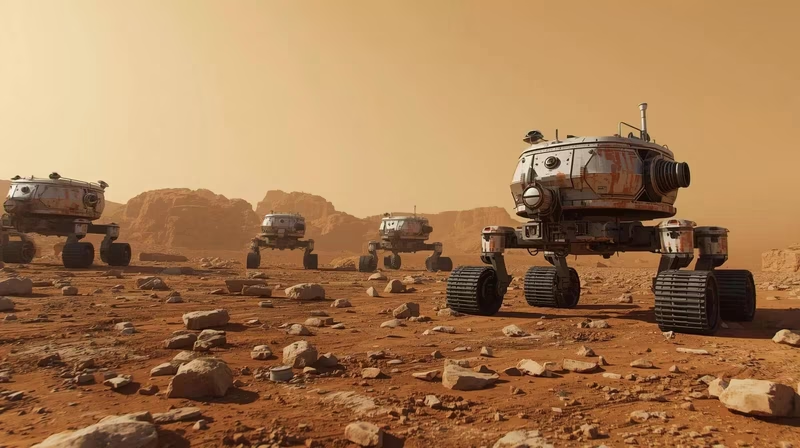
Forget science fiction. The future of human spaceflight isn’t being written by astronauts in gleaming suits—it’s being quietly coded, mapped, and built by a silent legion of robots. While we scroll through our feeds, NASA’s robotic vanguard is hard at work on the Moon and Mars, laying the literal and figurative road to Mars one critical data point at a time .
These aren’t just machines; they are pathfinders, geologists, meteorologists, and survival scouts rolled into one. Their mission? To ensure that when the first human crew finally embarks on the multi-month journey to the Red Planet, they won’t be walking into the unknown blindfolded.
Table of Contents
- The Unsung Heroes Paving the Road to Mars
- Mission Critical #1: Tracking the Invisible Killer—Radiation
- Mission Critical #2: Hunting for the Stuff of Life—Water
- Mission Critical #3: Conquering the Martian Dust Devil
- The Future of Scouting: Ingenuity’s Legacy and Beyond
- Why the Road to Mars Starts on Earth
- Conclusion: The Silent Army Shaping Our Cosmic Future
- Sources
The Unsung Heroes Paving the Road to Mars
The dream of a human mission to Mars is old, but the practical steps to achieve it are being taken right now. NASA’s strategy hinges on a simple, powerful idea: send the robots first. These machines are tasked with gathering the foundational intelligence needed to keep astronauts alive in an environment that is, frankly, trying to kill them .
From the Perseverance rover’s tireless geological surveys to orbiters scanning for subsurface ice, a vast network of robotic assets is creating the most detailed atlas of Mars ever conceived. This isn’t just exploration for its own sake. Every byte of data is a brick in the road to Mars, informing everything from where to land to where to build the first habitat.
Mission Critical #1: Tracking the Invisible Killer—Radiation
Space is a deadly place. Beyond Earth’s protective magnetic field, astronauts are bombarded by galactic cosmic rays and solar particle events. For a long-duration mission to Mars, radiation exposure is arguably the single greatest health risk, with potential missions exceeding NASA’s safety standard of 600 mSv .
Robots like the Mars Science Laboratory’s Curiosity rover carry instruments such as the Radiation Assessment Detector (RAD), which has been continuously measuring the surface radiation environment since 2012. This data is invaluable. It doesn’t just tell us how much radiation is present; it helps scientists model how future habitats can be shielded—either with regolith (Martian soil), water, or by finding natural shelters.
Mission Critical #2: Hunting for the Stuff of Life—Water
You can’t build a sustainable colony without water. It’s needed for drinking, for growing food, and even for producing rocket fuel. Thankfully, Mars isn’t a completely dry desert. NASA’s robotic scouts have already confirmed the presence of vast amounts of water ice, particularly at the poles and in the mid-latitudes .
The upcoming missions, like the planned Mars Sample Return, will provide even more granular data. Knowing exactly where and how deep this ice is located is critical for mission planners to select a landing site that is both scientifically interesting and logistically viable for a human outpost.
Mission Critical #3: Conquering the Martian Dust Devil
Martian dust is more than just a nuisance; it’s a serious engineering challenge. The fine, electrostatically charged particles can cling to everything—from spacesuits to solar panels—reducing power output and potentially damaging sensitive equipment .
Robots are our frontline defense in understanding this threat. The Perseverance rover is equipped with a suite of environmental sensors that monitor dust levels, wind speed, and weather patterns. This data is being used to design future hardware that can withstand the harsh, dusty environment, ensuring our life-support systems won’t be choked by the Red Planet’s most pervasive element.
The Future of Scouting: Ingenuity’s Legacy and Beyond
Perhaps the most revolutionary robotic scout was NASA’s Ingenuity helicopter. Nicknamed “Ginny,” this tiny, 4-pound drone made history as the first aircraft to achieve powered, controlled flight on another planet . Over its incredible 72-flight mission from 2021 to 2024, it proved that aerial scouting is not only possible but essential .
Ingenuity’s legacy is its vision. Future Mars drones, inspired by its success, could fly ahead of rovers or astronauts, scouting out terrain that’s too dangerous or distant for ground-based vehicles. They could even search for cave entrances or lava tubes—natural formations that could serve as ready-made, radiation-shielded habitats for future human colonists .
Why the Road to Mars Starts on Earth
It’s not all happening on the Red Planet. NASA is also rigorously testing its next generation of robotic explorers right here on Earth. In the harsh, Mars-like deserts of the American Southwest, teams are putting robotic “dog” platforms and prototype drones through their paces, simulating the tasks they will perform on the Moon and Mars .
These terrestrial tests are crucial for developing the autonomy and resilience these robots will need. On Mars, with its 20-minute communication delay, a robot can’t wait for a human to tell it what to do next. It must be able to think and act for itself—a capability that is being honed in Earth’s most extreme environments.
For more on the future of autonomous space tech, see our deep dive on [INTERNAL_LINK:future-of-space-robotics].
Conclusion: The Silent Army Shaping Our Cosmic Future
The road to Mars is not a physical highway of steel and concrete, but a complex, data-driven path forged by an army of robotic pioneers. From tracking lethal radiation to mapping hidden water and conquering pervasive dust, these machines are doing the dangerous, dirty, and essential work that will one day allow humans to follow. Their quiet, relentless efforts are not just shaping a mission; they are shaping the future of humanity among the stars.
Sources
- Times of India: “Nasa is using robots to quietly shape the road to Mars”
- NASA Mars Exploration Program: https://mars.nasa.gov/
- NASA JPL: “Ingenuity Mars Helicopter”
- Space.com: “Ingenuity, NASA’s Mars Helicopter, Ends Mission After Historic 72 Flights”
- NASA: “Buying Down the Risk of Space Radiation for Moon to Mars”
- IEEE Spectrum: “NASA Tests Drones and Robot Dogs in U.S. Deserts to Prep for Moon and Mars”