Table of Contents
- A Nation in Uprising
- The Iran Protests: Roots of the Revolt
- From Mahsa to Mass Movement
- The Regime’s Response—and Its Cost
- Is This the End for Khamenei?
- Conclusion
- Sources
A Nation in Uprising
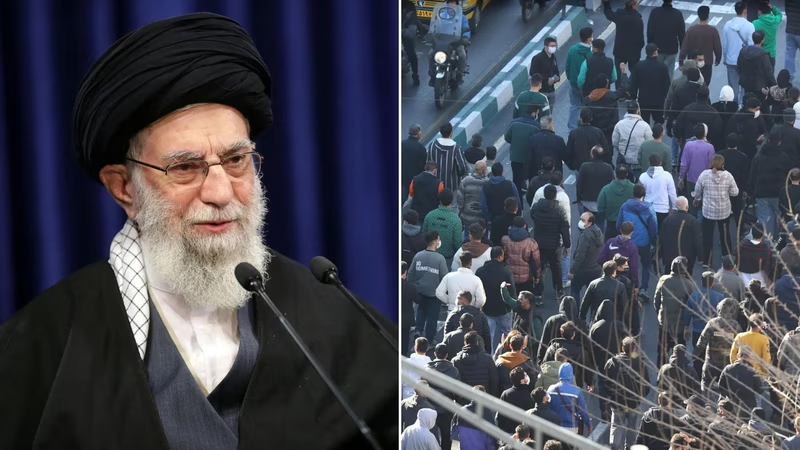
Across Iran, a single, defiant slogan echoes through the streets: “Mullahs must leave!” This isn’t the isolated cry of a fringe group—it’s the unified voice of a population pushed to its absolute limit. In early January 2026, a wave of Iran protests has surged with a scale and ferocity not seen since the 2022 uprising following Mahsa Amini’s death .
What makes this moment different is the breadth of participation. Students, shopkeepers, factory workers, and even segments of the middle class long co-opted by the system are now openly questioning the very foundation of the Islamic Republic. The target is no longer just a single policy or official; it’s the entire theocratic structure, with Supreme Leader Ayatollah Ali Khamenei at its helm. The central question on everyone’s mind: is this the beginning of the end for the Khamenei regime?
The Iran Protests: Roots of the Revolt
The current Iran protests are not a sudden spark but the inevitable explosion of decades of pent-up frustration. Three critical factors have created a perfect storm for revolt.
From Mahsa to Mass Movement
The 2022 “Woman, Life, Freedom” movement ignited a fire that never truly went out. The brutal murder of Mahsa Amini for allegedly not wearing her hijab “properly” became a symbol of the regime’s oppressive control over every aspect of life. While the regime temporarily suppressed the visible protests, the anger went underground, only to resurface stronger than ever . Today’s protests carry that same feminist and anti-authoritarian spirit, but with a more explicit political goal: regime change .
The Regime’s Response—and Its Cost
The Islamic Republic’s typical playbook has been a mix of brutal repression and limited concessions. Security forces have once again filled the streets, making mass arrests and using live ammunition against demonstrators . But this time, the tactic is backfiring spectacularly.
The public has seen this script before. They know that any minor concession, like a temporary relaxation of the hijab law, is a tactical retreat, not a change of heart. The regime’s credibility is at an all-time low, and its violent response is only fueling more anger. Social media, despite heavy censorship, continues to leak videos of the crackdowns, turning local incidents into national moments of outrage [INTERNAL_LINK:iran-censorship-and-digital-resistance].
Is This the End for Khamenei?
This is the critical question. While the chants are clear, predicting the fall of a regime as entrenched as Iran’s is a fool’s game. However, several alarming signs suggest the Khamenei regime is facing its most serious internal threat in decades.
- Economic Collapse: Hyperinflation has eroded savings, and unemployment, especially among the youth, is rampant. The average Iranian is poorer now than they were a decade ago . An economy in freefall is the fertile ground on which revolutions grow.
- Loss of Ideological Legitimacy: The regime can no longer sell its “resistance” narrative to a population that sees its wealth being squandered on foreign militias while they struggle to afford bread. The social contract has been irrevocably broken .
- Fragmentation Within the Elite: There are growing whispers of dissent even within the ranks of the Revolutionary Guards and the clerical establishment. While public, these factions fear a post-Khamenei power vacuum more than they love the current system .
Yet, the regime’s survival instinct is formidable. It has a vast security apparatus, deep pockets from its shadow economy, and a well-practiced strategy of playing its regional enemies (like the US and Israel) as a unifying threat to rally its base . The coming weeks will be decisive. If the protests can maintain their momentum, broaden their geographic reach beyond major cities, and crucially, trigger a significant crack in the security forces’ loyalty, then the unthinkable could become possible.
Conclusion
The Iran protests of January 2026 are more than just another wave of dissent; they represent a profound crisis of legitimacy for the Islamic Republic. The slogan “Mullahs must leave” is a direct challenge to the very core of the regime’s power. While the path from protest to revolution is long and fraught with danger, the sheer scale of public anger and the regime’s inability to offer any credible solution suggest that Iran’s political landscape is entering a period of extreme volatility. Whether this is the beginning of the end for Khamenei or merely another brutal chapter in a long struggle remains to be seen, but one thing is certain: Iran will not return to the uneasy status quo that preceded this uprising.
Sources
- Times of India: ‘Mullahs must leave’: Why Iran is protesting — Is it the end for Khamenei regime?
- Human Rights Watch: Iran
- BBC News: Iran protests: What’s driving the latest unrest?
- Al-Monitor: Iran’s economic crisis fuels new wave of protests
- Council on Foreign Relations: What Explains the Rise of Iran’s ‘Woman, Life, Freedom’ Movement?