Table of Contents
- A Deadly Escalation in Yemen
- The Saudi-UAE Alliance Cracks
- Who Are the Southern Transitional Council (STC)?
- Why the Rift? Toward Yemen’s Future
- What Comes Next?
- Conclusion
- Sources
A Deadly Escalation in Yemen
The fragile landscape of the Yemeni conflict has just been jolted by a shocking new development. On Friday, January 2nd, 2026, a series of Saudi airstrikes pounded camps belonging to UAE-backed southern separatists in eastern Yemen, specifically in the strategic port city of Mukalla [[1], [3]].
The human cost is already grim: at least seven people have been killed, and over twenty others lie wounded [[4], [18]]. This isn’t just another skirmish in a long-running war; it’s a direct military strike by one Gulf power against the proxies of another, its former wartime ally. The Saudi-led coalition, once a unified front against the Houthi rebels, now appears to be fracturing from within, with Yemen as the tragic battleground.
The Saudi-UAE Alliance Cracks
For years, Saudi Arabia and the United Arab Emirates (UAE) presented a united front in Yemen, leading a coalition to restore the internationally recognized government and counter Iranian influence via the Houthis. However, their strategic goals have quietly diverged. While Saudi Arabia seeks a unified Yemen as a buffer, the UAE has increasingly backed the Southern Transitional Council (STC), which demands full independence for South Yemen .
Recent weeks have seen this simmering tension boil over. The Saudi airstrikes are the most violent manifestation yet of this rift. Riyadh has publicly accused Abu Dhabi of secretly arming the separatists, a charge that has strained their partnership to its limits . This conflict of interests has already led to tangible consequences, like the suspension of flights at Aden International Airport, a stark symbol of the deepening crisis .
Who Are the Southern Transitional Council (STC)?
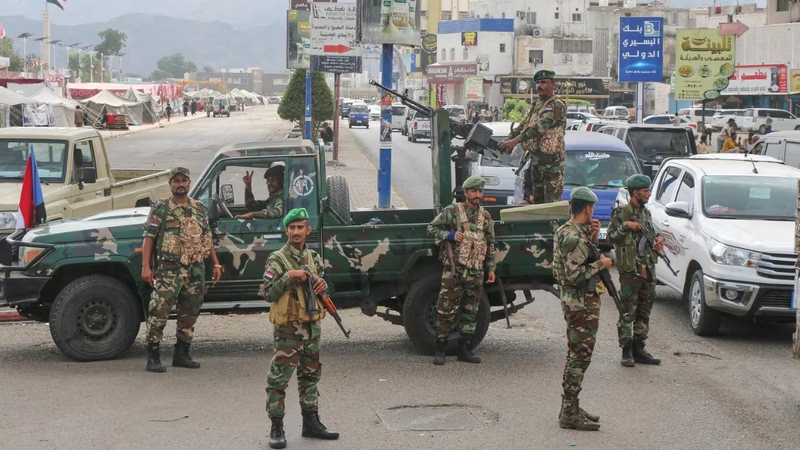
To understand the current crisis, you must understand the STC. Formed in 2017, the Southern Transitional Council is a political and military organization that is the primary voice for the Southern Movement, a long-standing campaign for the secession of South Yemen .
Crucially, the STC is not just a local Yemeni faction. It is heavily funded, trained, and equipped by the UAE, making it a key proxy for Emirati influence in the region . The STC controls significant territory in southern Yemen, including the strategic port of Aden. Their refusal to fully withdraw from their positions in the face of Saudi demands has been a major flashpoint leading up to the recent airstrikes .
Why the Rift? Toward Yemen’s Future
The core of the conflict between Riyadh and Abu Dhabi lies in their competing visions for Yemen’s post-war future.
- Saudi Arabia’s Goal: A stable, unified Yemen that acts as a friendly neighbor and a security buffer on its southern border. A divided Yemen could create a power vacuum and invite more chaos.
- UAE’s Goal: A weakened or even partitioned Yemen, where an independent south would be a loyal Emirati client state, granting the UAE significant military and economic influence over a critical maritime corridor.
This fundamental disagreement has turned former partners into rivals on the ground in Yemen. The Saudi airstrikes on UAE-backed separatists are a clear signal from Riyadh that it will not tolerate Emirati ambitions that undermine its own strategic objectives . The situation is exacerbated by the fact that these strikes targeted not just land camps but also reportedly two ships linked to the UAE in Mukalla’s port, a highly provocative act .
What Comes Next?
The immediate future for Yemen looks perilously unstable. The STC has announced a redeployment of its forces in the eastern provinces, but this appears to be a tactical move rather than a strategic retreat . The underlying tensions remain unresolved.
Analysts fear this new front in the conflict could lead to a wider proxy war between Saudi Arabia and the UAE, further fracturing the country and making a comprehensive peace deal even more elusive. The internationally recognized government in Yemen is now caught in the crossfire of its two most powerful patrons, leaving it with diminished authority and leverage.
For the wider region, this crisis is a stark reminder that the Gulf’s internal dynamics are as volatile as its external ones. A prolonged Saudi-UAE feud over Yemen could have ripple effects on global energy markets and regional security architecture.
Conclusion
The deadly Saudi airstrikes on UAE-backed camps in Mukalla mark a dangerous new chapter in the Yemen conflict. What was once a war defined by its north-south, Houthi vs. coalition dynamic has now become a complex, multi-layered struggle where former allies are now competing for influence. This fracture between Riyadh and Abu Dhabi doesn’t just risk prolonging Yemen’s suffering; it threatens to redraw the map of the country and destabilize the entire southern Arabian Peninsula. The world must now watch closely to see if this rift can be mended before it consumes what’s left of Yemen.
Sources
- Times of India: Yemen conflict: Saudi-led airstrikes hit UAE-backed separatist camps; at least seven killed
- Al Jazeera: Saudi airstrikes hit UAE-backed separatists in southern Yemen
- Reuters: Saudi-led airstrikes hit UAE-backed separatist camps in Yemen, killing seven
- BBC News: Seven killed in Saudi-led strikes on UAE-backed Yemeni separatists
- International Crisis Group: Saudi-UAE fallout and its impact on Yemen’s recognised government