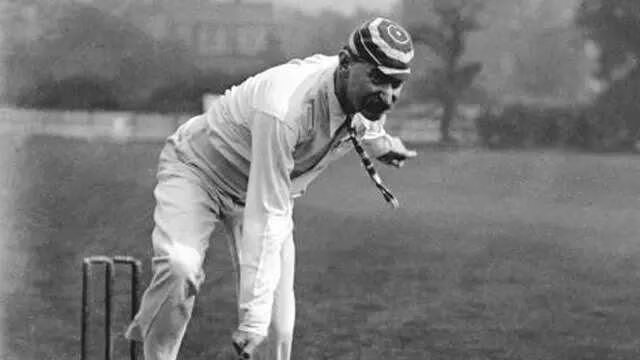
Imagine a world where the word ‘hat-trick’ didn’t exist in cricket. No roars from the crowd, no hats flying onto the field, no legendary status instantly bestowed upon a bowler. That was the reality—until January 2, 1879. On that crisp summer day at the Melbourne Cricket Ground (MCG), a fiery Australian fast bowler named **Fred Spofforth** didn’t just take three wickets in three balls—he invented a moment that would echo through cricketing eternity: the **first Test hat-trick**.
Exactly 147 years later, on January 2, 2026, we look back at this watershed moment that wasn’t just a statistical oddity—it was a declaration of Australia’s arrival as a cricketing force and a masterclass in psychological warfare disguised as bowling. Spofforth, playing only his second Test match, didn’t merely win the game; he terrified England into submission and carved his name into the sport’s bedrock.
Table of Contents
- The Historic Match Context
- The Moment: The First Test Hat-Trick
- Who Was Fred Spofforth? The Original ‘Terror’
- Impact on the Game and Legacy
- How Hat-Tricks Evolved in Test Cricket
- Conclusion: More Than Just Three Wickets
- Sources
The Historic Match Context
The second Test between Australia and England—the very first ever played on Australian soil—was already tense. Australia had lost the inaugural Test in Melbourne in 1877, and national pride was on the line. England, confident and dismissive of their colonial opponents, batted first and were bowled out for a modest 113. Australia responded with 122, taking a slim lead.
But it was England’s second innings that became the stage for Spofforth’s immortality. Chasing just 122 to win, England slumped to 77/5. The pressure mounted. And then, in the 28th over of the innings, history unfolded.
The Moment: The First Test Hat-Trick
With the score at 92/7, Fred Spofforth—nicknamed “The Demon Bowler” for his ferocious pace and bounce—stepped up to bowl to England’s tailenders. What followed was pure theatre:
- Ball 1: He clean-bowled **Vernon Royle** with a searing yorker.
- Ball 2: Next man in, **Francis MacKinnon**, was caught behind by wicketkeeper Jack Blackham.
- Ball 3: The final victim, **Tom Emmett**, was trapped lbw as he shouldered arms to a ball that kept devastatingly low.
Three balls. Three wickets. Game over. England were all out for 101. Australia raced to their target for a **10-wicket victory**—their first-ever Test win on home soil . The crowd, estimated at 10,000, erupted. Newspapers the next day hailed it as “a feat never before witnessed in the Colonies.”
Who Was Fred Spofforth? The Original ‘Terror’
Frederick Spofforth wasn’t just a bowler; he was a pioneer. Standing 6’0” with a whippy, side-on action, he generated pace and steep bounce on pitches that offered little assistance—decades before covered pitches or modern fitness regimes. He was the first bowler to truly understand the psychological dimension of fast bowling, using glare, aggression, and sheer unpredictability to unsettle batsmen .
Over his 18-Test career (1877–1887), he took 94 wickets at an astonishing average of 18.41—a record that stood for years. But beyond stats, Spofforth embodied the Australian fighting spirit that would define their cricketing identity for generations. He famously declared before the 1882 Test at The Oval: “This thing can be done!”—a vow that led to Australia’s win and the birth of The Ashes.
Impact on the Game and Legacy
Spofforth’s **first Test hat-trick** did more than win a match—it changed how cricket was played and perceived:
- Elevated Fast Bowling: Proved pace could be a match-winning weapon, not just support for spinners.
- Created a New Legend: The term “hat-trick” (borrowed from hockey) entered cricketing lexicon permanently.
- Boosted Australian Cricket: Gave the young nation a sporting hero and global credibility.
The MCG pitch where it happened is now part of cricket’s sacred geography. A plaque commemorates the moment, and Spofforth was among the inaugural inductees into the ICC Hall of Fame in 2009 .
How Hat-Tricks Evolved in Test Cricket
Since Spofforth’s breakthrough, only **44 hat-tricks** have been recorded in over 2,500 Test matches—a testament to their rarity . Some notable successors include:
- Hugh Trumble (1902): The only bowler with two Test hat-tricks.
- Harbhajan Singh (2001): First Indian to achieve the feat, against Australia in Kolkata.
- Stuart Broad (2023): His hat-trick against Pakistan at the MCG echoed Spofforth’s 144 years later on the same ground.
Each of these moments owes a debt to the Demon Bowler who dared to do the impossible on a January afternoon in 1879.
Conclusion: More Than Just Three Wickets
Fred Spofforth’s **first Test hat-trick** wasn’t just a cricketing milestone—it was a cultural earthquake. It announced that cricket was no longer the exclusive domain of English gentlemen; it was a global, competitive, and dramatic sport where heroes could emerge from anywhere. Today, as fans marvel at the speed of Bumrah or the swing of Anderson, they stand on the shoulders of the man who first made fast bowling terrifying—and triumphant. To explore more cricketing firsts, dive into our feature on [INTERNAL_LINK:landmark-moments-in-test-cricket-history].